. 1999 Jan 4;189(1):123-9.
doi: 10.1084/jem.189.1.123.

Activated Ras signals developmental progression of recombinase-activating gene (RAG)-deficient pro-B lymphocytes

Affiliations

Activated Ras signals developmental progression of recombinase-activating gene (RAG)-deficient pro-B lymphocytes

A C Shaw et al. J Exp Med. .

Abstract

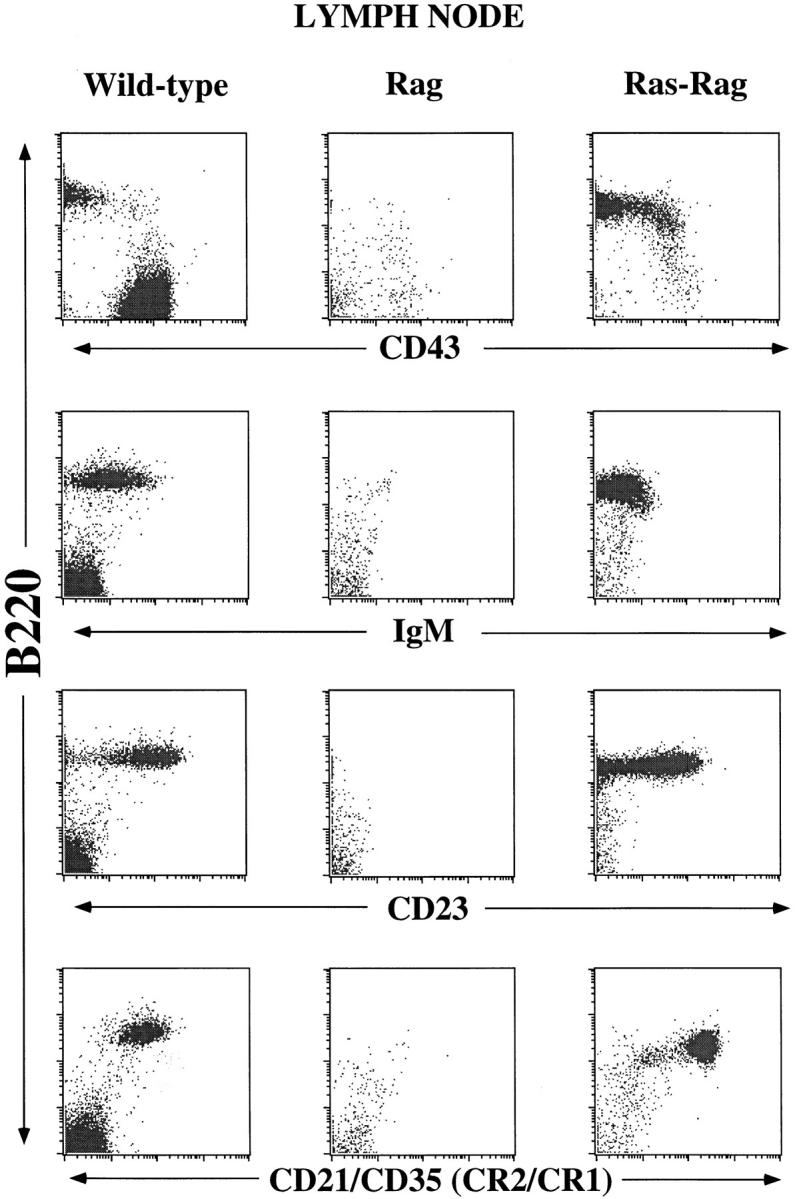
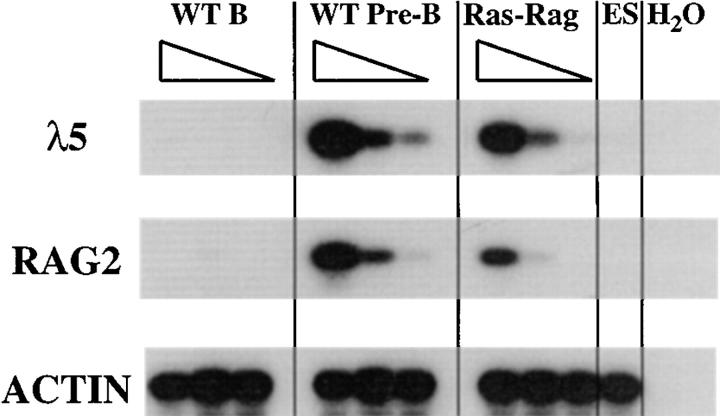
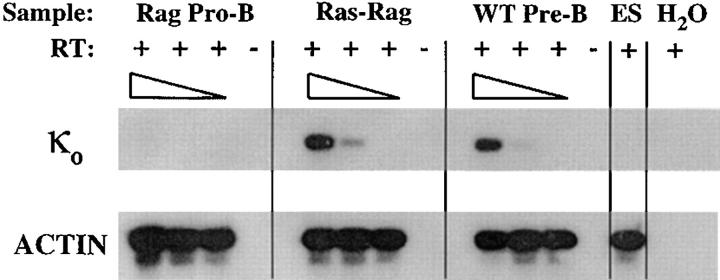
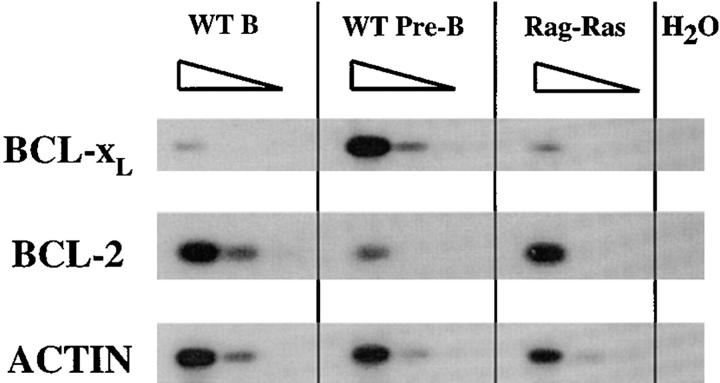
To elucidate the intracellular pathways that mediate early B cell development, we directed expression of activated Ras to the B cell lineage in the context of the recombination-activating gene 1 (RAG1)-deficient background (referred to as Ras-RAG). Similar to the effects of an immunoglobulin (Ig) mu heavy chain (HC) transgene, activated Ras caused progression of RAG1-deficient progenitor (pro)-B cells to cells that shared many characteristics with precursor (pre)-B cells, including downregulation of surface CD43 expression plus expression of lambda5, RAG2, and germline kappa locus transcripts. However, these Ras-RAG pre-B cells also upregulated surface markers characteristic of more mature B cell stages and populated peripheral lymphoid tissues, with an overall phenotype reminiscent of B lineage cells generated in a RAG- deficient background as a result of expression of an Ig mu HC together with a Bcl-2 transgene. Taken together, these findings suggest that activated Ras signaling in pro-B cells induces developmental progression by activating both differentiation and survival signals.


Figures
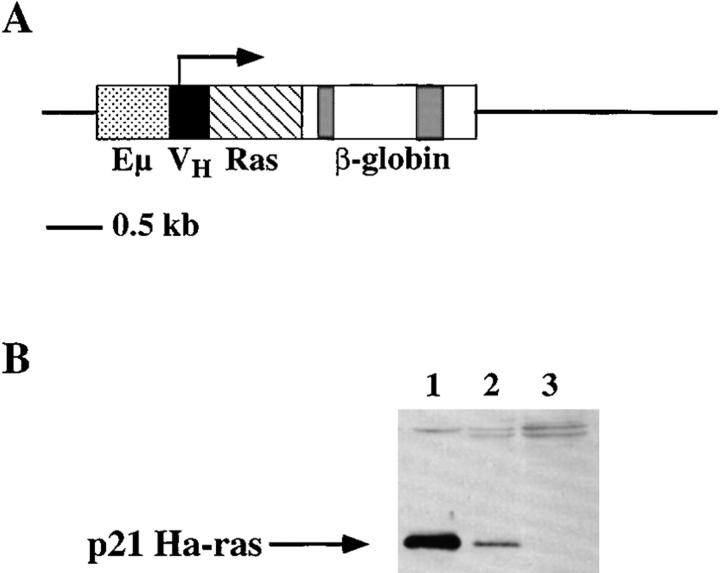
Figure 1
Figure 1
Activated c-Ha-Ras expression vector and Western blot analysis of c-Ha-Ras expression. (A) Diagram of the pEμRasV12 expression vector. Eμ, Ig HC enhancer; VH, HC variable region promoter; Ras, c-Ha-ras V12 cDNA; β-globin, β-globin exons 2 and 3 with polyadenylation signal. (B) Western blot analysis of total spleen or lymph node lysates from a Ras–RAG1−/−, RAG2-deficient chimera and RAG2-deficient mouse, probed with a monoclonal antibody against Ha-ras. The position of p21 Ha-ras is indicated by the arrow. Ponceau-S staining was employed to verify equivalent loading of protein. Lane 1, Ras–RAG1−/− total lymph node; lane 2, Ras–RAG1−/− total spleen; lane 3, RAG2−/− total spleen.
Figure 2
Figure 2
Surface phenotype of Ras–RAG B lineage cells. Lymphocytes isolated from lymph node of Ras–RAG1−/−, RAG2-deficient chimera, RAG2−/−, and wild-type (129 Sv/Ev) mice were subjected to FACS® analyses. Depicted are log-scale dot plots of B220 versus CD43, IgM, CD23, and CD21/CD35. The plots reflect 20,000 collected events, with dead cells excluded by forward and side scatter. Similar results were found in the spleen. Results shown are representative of those obtained in the analysis of six chimeric mice derived from two independent transfected ES clones. The number of B220+Ly9.1+ cells in these RAG2-deficient chimeras ranged from 5 × 10⁵ to 1.6 × 10⁷ in lymph node and 2 × 10⁶ to 7 × 10⁶ in spleen. Chimeric animals analyzed for evidence of B cell developmental progression showed no gross evidence of malignancy. Older chimeric mice do tend to develop B lineage lymphomas, but such transformed cells are significantly larger in cell size and have markedly altered surface antigen staining characteristics (data not shown). Ras-Rag, activated Ras-complemented-RAG1–/–, RAG2-deficient chimera; Rag, RAG2−/− mouse.
Figure 3
Figure 3
Analysis of λ5 and RAG expression. RNA isolated from Ras–RAG1−/− (Ras-Rag), wild-type mature B (WT B), and wild-type pre-B (WT Pre-B) lymphocytes purified from lymph node and spleen was reverse transcribed, and first-strand cDNA was subjected to PCR analysis using λ5, RAG2, and β-actin primer pairs (see Materials and Methods). For each B lineage cell type, serial fivefold dilutions are shown. ES cell cDNA was added to the 5- and 25-fold dilutions of each B lineage cDNA sample to equalize template quantity. Single lanes containing no cDNA (H2O) or ES cDNA alone are shown for each primer pair.
Figure 4
Figure 4
κ light chain locus germline transcripts are upregulated in Ras–RAG B lineage cells. RNAs from sorted B220+ Ly 9.1+Ras– RAG1−/− (Ras-Rag) B lineage cells, from B220+ CD43IgM wild-type pre-B cells (WT Pre-B), and from B220+CD43+ RAG2-deficient pro-B cells (Rag Pro-B) were subjected to RT-PCR analysis for detection of germline κ transcripts. Serial fivefold dilutions are shown, and ES cell cDNA was diluted into 5- and 25-fold dilutions. Samples with (+) and without (–) reverse transcriptase are indicated.
Figure 5
Figure 5
Analysis of Bcl-2 and Bcl-xL expression. RNAs from sorted Ras–RAG1−/− (Ras-Rag), mature wild-type B (WT B), and wild-type pre-B (WT Pre-B) lymphocytes were subjected to RT-PCR analysis, using β-actin expression as a standard. Serial fivefold dilutions are shown for each B lineage cell type.

References

    1. Willerford DM, Swat W, Alt FW. Developmental regulation of V(D)J recombination and lymphocyte differentiation. Curr Opin Genet Dev. 1996;6:603–609. - PubMed
    1. Karasuyama H, Rolink A, Melchers F. Surrogate light chain in B cell development. Adv Immunol. 1996;63:1–41. - PubMed
    1. Kitamura D, Roes J, Kuhn R, Rajewsky K. A B cell-deficient mouse by targeted disruption of the membrane exon of the immunoglobulin μ gene. Nature. 1991;350:423–426. - PubMed
    1. Shinkai Y, Rathbun G, Lam KP, Oltz EM, Stewart V, Mendelsohn M, Charron J, Datta M, Young F, Stall A, Alt FW. RAG-2-deficient mice lack mature lymphocytes owing to inability to initiate V(D)J rearrangement. Cell. 1992;68:855–867. - PubMed
    1. Mombaerts P, Iacomini J, Johnson RS, Herrup K, Tonegawa S. RAG-1-deficient mice have no mature B and T lymphocytes. Cell. 1992;68:869–877. - PubMed

Publication types