. 1999 Jan;119(1):143-52.
doi: 10.1104/pp.119.1.143.

Feedback inhibition of chlorophyll synthesis in the phytochrome chromophore-deficient aurea and yellow-green-2 mutants of tomato

Affiliations

Feedback inhibition of chlorophyll synthesis in the phytochrome chromophore-deficient aurea and yellow-green-2 mutants of tomato

MJ Terry et al. Plant Physiol. 1999 Jan.

Abstract

The aurea (au) and yellow-green-2 (yg-2) mutants of tomato (Solanum lycopersicum L.) are unable to synthesize the linear tetrapyrrole chromophore of phytochrome, resulting in plants with a yellow-green phenotype. To understand the basis of this phenotype, we investigated the consequences of the au and yg-2 mutations on tetrapyrrole metabolism. Dark-grown seedlings of both mutants have reduced levels of protochlorophyllide (Pchlide) due to an inhibition of Pchlide synthesis. Feeding experiments with the tetrapyrrole precursor 5-aminolevulinic acid (ALA) demonstrate that the pathway between ALA and Pchlide is intact in au and yg-2 and suggest that the reduction in Pchlide is a result of the inhibition of ALA synthesis. This inhibition was independent of any deficiency in seed phytochrome, and experiments using an iron chelator to block heme synthesis demonstrated that both mutations inhibited the degradation of the physiologically active heme pool, suggesting that the reduction in Pchlide synthesis is a consequence of feedback inhibition by heme. We discuss the significance of these results in understanding the chlorophyll-deficient phenotype of the au and yg-2 mutants.


Figures
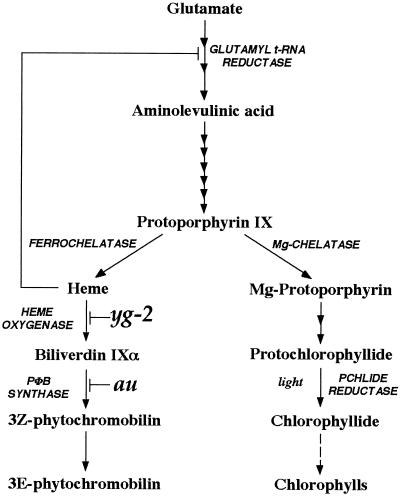
Figure 1
Figure 1
The tetrapyrrole-biosynthesis pathway.
Figure 2
Figure 2
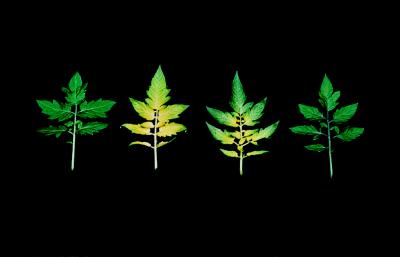
Leaf phenotype of au and hp-1 mutants. Leaves are from 6-week-old wild-type (left), au (second from left), au,hp-1 (second from right), and hp-1 (right) plants grown in the greenhouse.
Figure 3
Figure 3
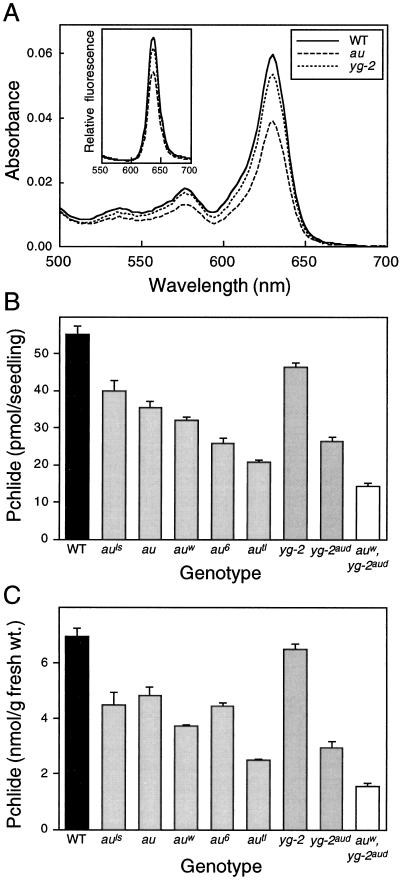
Analysis of Pchlide levels in au and yg-2. A, Room-temperature absorption and fluorescence (inset, excitation at 440 nm) spectra of hexane-washed acetone extracts from 5-d-old, dark-grown wild-type, au, and yg-2 seedlings. B and C, Quantitation of Pchlide from multiple absorption spectra in different alleles of au and yg-2 expressed per seedling (B) or on a fresh weight basis (C). The wild-type (WT) value represents the mean ± se of four different backgrounds (Ailsa Craig, Moneymaker, breeding line GT, and VF145 [Table I]; n ≥ 3 for each). All other values are means ± se (n ≥ 3).
Figure 4
Figure 4
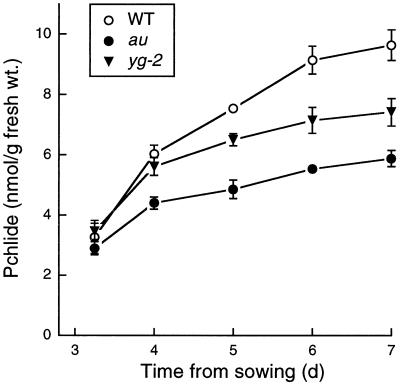
Time course of Pchlide accumulation in au and yg-2 mutants. Pchlide was measured at various times in dark-grown wild-type (WT), au, and yg-2 seedlings. Values are means ± se (n ≥ 3).
Figure 5
Figure 5
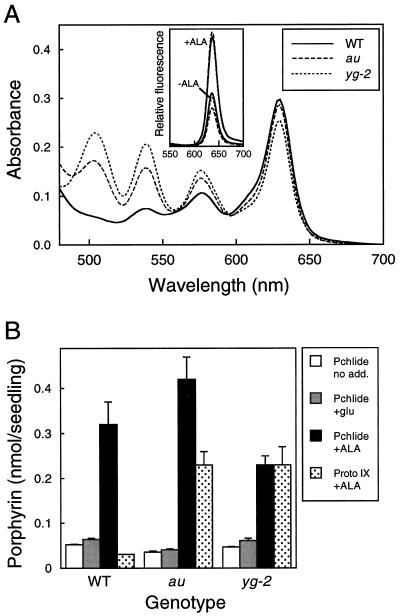
Analysis of porphyrin synthesis in au and yg-2 mutants following incubation in porphyrin precursors. A, Room-temperature absorption and fluorescence (inset, excitation at 440 nm) spectra of hexane-washed acetone extracts from dark-grown wild-type (WT), au, and yg-2 seedlings incubated in the dark for 20 h in 10 mm ALA. B, Quantitation of Pchlide and Proto IX following incubation in 10 mm ALA or 10 mm glutamate (glu). Values are means ± se (n ≥ 3). The data for no addition (no add.) are from intact seedlings and are the same as those shown in Figure 3 (au and yg-2 only).
Figure 6
Figure 6
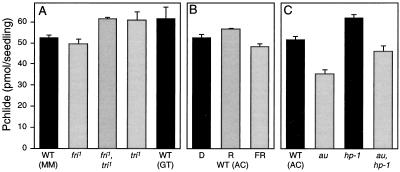
Analysis of Pchlide levels in a range of photomorphogenic mutants following brief light treatments. A and C, Pchlide was measured in 5-d-old, dark-grown wild-type (WT) and phyA (fri), phyB1 (tri), au, hp-1, and double-mutant seedlings. MM, GT, and AC represent different genetic backgrounds (Table I). B, Pchlide was measure in 5-d-old wild-type (WT) seedlings treated with 5 min of red (R; 17 μmol m−2 s−1) or 15 min of far red (FR; 12 μmol m−2 s−1) light 24 h after imbibition. Values are means ± se (n ≥ 3).
Figure 7
Figure 7
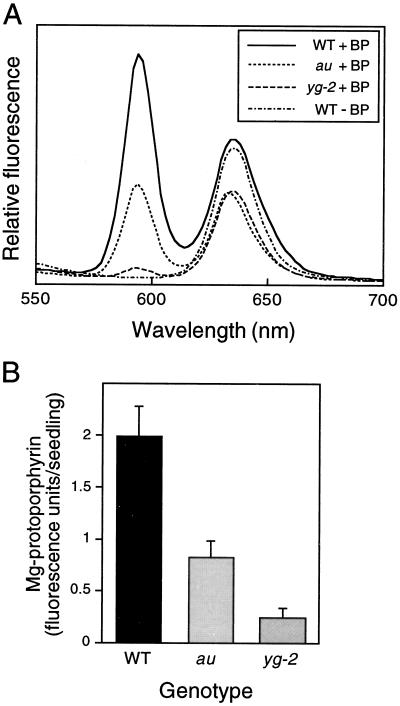
Analysis of Mg-protoporphyrin synthesis in au and yg-2 mutants following incubation in the iron chelator 2′2′-bipyridyl (BP). A, Room-temperature fluorescence spectra (excitation at 410 nm) of hexane-washed acetone extracts from dark-grown wild-type (WT), au, and yg-2 seedlings incubated in the dark for 20 h in 10 mm 2′2′-bipyridyl. B, Quantitation of Mg-protoporphyrin from multiple fluorescence spectra. Values are means ± se (n = 3).

References

    1. Adamse P, Peters JL, Jaspers PAPM, van Tuinen A, Koornneef M, Kendrick RE. Photocontrol of anthocyanin synthesis in tomato seedlings: a genetic approach. Photochem Photobiol. 1989;50:107–111.
    1. Batschauer A, Gilmartin PM, Nagy F, Schäfer E. The molecular biology of photoregulated genes. In: Kendrick RE, Kronenberg GHM, editors. Photomorphogenesis in Plants, Ed 2. Dordrecht, The Netherlands: Kluwer Academic Publishers; 1994. pp. 559–600.
    1. Beale SI, Weinstein JD. Biochemistry and regulation of photosynthetic pigment formation in plants and algae. In: Jordan PM, editor. Biosynthesis of Tetrapyrroles. Amsterdam, The Netherlands: Elsevier; 1991. pp. 155–235.
    1. Becker TW, Foyer C, Caboche M. Light-regulated expression of the nitrate-reductase and nitrite-reductase genes in tomato and in the phytochrome-deficient aurea mutant of tomato. Planta. 1992;188:39–47. - PubMed
    1. Castelfranco PA, Jones OTG. Protoheme turnover and chlorophyll synthesis in greening barley tissue. Plant Physiol. 1975;55:485–490. - PMC - PubMed

LinkOut - more resources