. 1999 Jan;119(1):173-8.
doi: 10.1104/pp.119.1.173.

An in vitro system from maize seedlings for tryptophan-independent indole-3-acetic acid biosynthesis

Affiliations

An in vitro system from maize seedlings for tryptophan-independent indole-3-acetic acid biosynthesis

A Ostin et al. Plant Physiol. 1999 Jan.

Abstract

The enzymatic synthesis of indole-3-acetic acid (IAA) from indole by an in vitro preparation from maize (Zea mays L.) that does not use tryptophan (Trp) as an intermediate is described. Light-grown seedlings of normal maize and the maize mutant orange pericarp were shown to contain the necessary enzymes to convert [14C]indole to IAA. The reaction was not inhibited by unlabeled Trp and neither [14C]Trp nor [14C]serine substituted for [14C]indole in this in vitro system. The reaction had a pH optimum greater than 8.0, required a reducing environment, and had an oxidation potential near that of ascorbate. The results obtained with this in vitro enzyme preparation provide strong, additional evidence for the presence of a Trp-independent IAA biosynthesis pathway in plants.


Figures
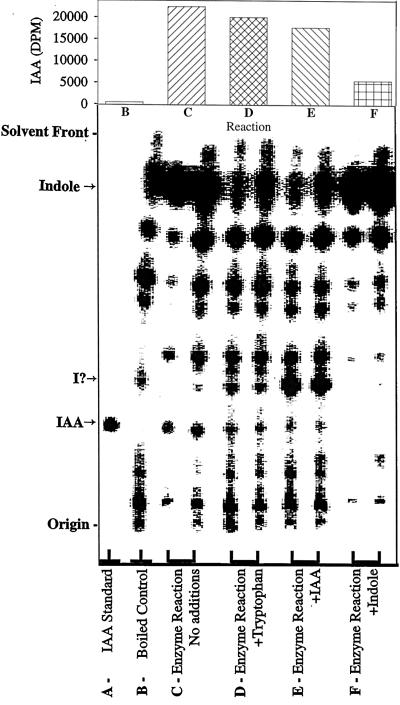
Figure 1
Figure 1
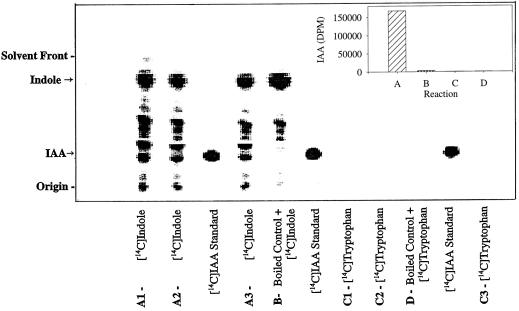
Silica-gel TLC analysis of the radiolabeled reaction products obtained from [14C]indole. The reaction products were partitioned at acidic pH into ethyl acetate and 50 ng of unlabeled IAA was added before concentration and application to the TLC plate. Except for the IAA standard and the boiled control, duplicate reactions were spotted in adjacent lanes, as shown. After development in solvent S1tlc, radiolabeled products were visualized using an AMBIS 4000 radioimaging system. The RF values of IAA and indole (as indicated on the abscissa) were confirmed by visualization of the indole and the added unlabeled IAA using the reagent of Ehmann (1977) and superimposing the two images. A potential intermediate that accumulated with the addition of unlabeled IAA (lanes D) and was not detected in the reactions with added unlabeled indole (lanes F) is indicated on the abscissa (I?). Quantification of radioactivity at the RF of IAA (obtained by software analysis of the scanned image and correction for counting efficiency) is shown in the bar graph at the top of the figure. The data on the graph for C, D, E, and F are the averages of the values from each pair of lanes shown.
Figure 2
Figure 2
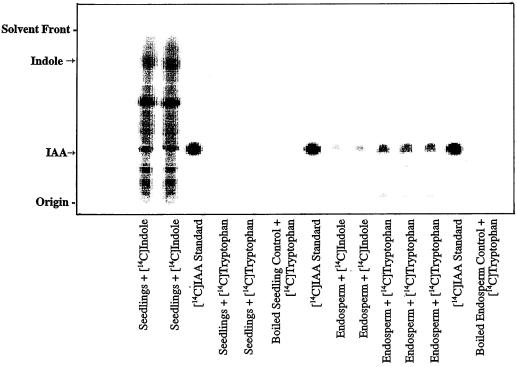
Results were obtained with the in vitro assay as described for Figure 1, and compared with results obtained from maize endosperm. Note that the endosperm preparations were able to convert [14C]Trp as well as [14C]indole to IAA, whereas only [14C]indole was an effective substrate with the seedling preparations.
Figure 3
Figure 3
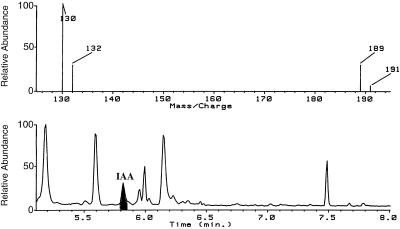
Selected ion chromatogram (bottom) and selected ion spectrum (top) for IAA formed in the enzyme reaction. The sample was purified by C18 HPLC, methylated, and analyzed by GC-MS. Ions at m/z 130 and 189 are characteristic of unlabeled methyl-IAA resulting from unlabeled IAA or indole in the reaction mixture from the plant enzyme preparation. Ions at m/z 132 and 191 are the corresponding ions for the methyl ester from the 14C-labeled IAA formed from the radioactive indole supplied to the reaction.
Figure 4
Figure 4
Results were obtained from in vitro preparations of orange pericarp seedlings of maize. Conditions are as described for Figure 1. A1 to A3 are three replicated reactions using [14C]indole in the reaction mixture, and for replicates C1 to C3 the radiolabeled substrate was [14C]Trp. Trp does not partition into ethyl acetate from the aqueous phase, so it is not shown on these chromatograms. Quantification of radioactivity at the RF of IAA (obtained by software analysis of the scanned image and correction for counting efficiency) is shown in the bar-graph inset (data from A1–A3 and C1–C3 were averaged).
Figure 5
Figure 5
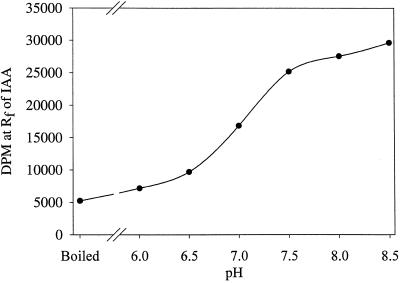
The effect of pH on the formation of IAA from [14C]indole by in vitro preparations from maize seedlings. For this experiment, the standard reaction was changed to a mixed buffer system composed of 40 mm POPSO plus 40 mm Mes. This mixed buffer allowed a pH range of 6.0 to 8.5 to be analyzed without changing the organic buffers present in the reaction.
Figure 6
Figure 6
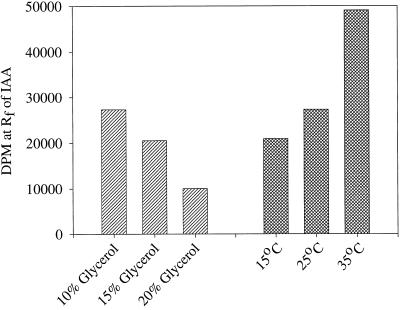
The effect of changes in the glycerol concentration and incubation temperature on the amount of [14C]IAA formed from [14C]indole by in vitro preparations from maize seedlings during a 5-h incubation.

References

    1. Baldi BG, Maher BR, Slovin JP, Cohen JD. Stable isotope labeling in vivo of d- and l-tryptophan pools in Lemna gibba and the low incorporation of label into indole-3-acetic acid. Plant Physiol. 1991;95:1203–1208. - PMC - PubMed
    1. Bandurski RS, Cohen JD, Slovin JP, Reinecke DM. Auxin biosynthesis and metabolism. In: Davies PJ, editor. Plant Hormones: Physiology, Biochemistry and Molecular Biology. Dordrecht, The Netherlands: Kluwer Academic Publishers; 1995. pp. 35–57.
    1. Bartel B. Auxin biosynthesis. Annu Rev Plant Physiol Plant Mol Biol. 1997;48:51–66. - PubMed
    1. Chauhan YS, Rathore VS, Garg GK, Bhargava A. Detection of an indole oxidizing system in maize leaves. Biochem Biophys Res Commun. 1978;83:1237–1245. - PubMed
    1. Cohen JD, Bialek K. The biosynthesis of indole-3-acetic acid in higher plants. In: Crozier A, Hillman JR, editors. The Biosynthesis and Metabolism of Plant Hormones. Society for Experimental Biology Seminar 23. Cambridge, UK: Cambridge University Press; 1984. pp. 165–181.

LinkOut - more resources