. 1999 Feb;73(2):939-47.
doi: 10.1128/JVI.73.2.939-947.1999.

Human adeno-associated virus type 5 is only distantly related to other known primate helper-dependent parvoviruses

Affiliations

Human adeno-associated virus type 5 is only distantly related to other known primate helper-dependent parvoviruses

U Bantel-Schaal et al. J Virol. 1999 Feb.

Abstract

We have characterized 95% (4,404 nucleotides) of the genome of adeno-associated virus type 5 (AAV5), including part of the terminal repeats and the terminal resolution site. Our results show that AAV5 is different from all other described AAV serotypes at the nucleotide level and at the amino acid level. The sequence homology to AAV2, AAV3B, AAV4, and AAV6 at the nucleotide level is only between 54 and 56%. The positive strand contains two large open reading frames (ORFs). The left ORF encodes the nonstructural (Rep) proteins, and the right ORF encodes the structural (Cap) proteins. At the amino acid level the identities with the capsid proteins of other AAVs range between 51 and 59%, with a high degree of heterogeneity in regions which are considered to be on the exterior surface of the viral capsid. The overall identity for the nonstructural Rep proteins at the amino acid level is 54.4%. It is lowest at the C-terminal 128 amino acids (10%). There are only two instead of the common three putative Zn fingers in the Rep proteins. The Cap protein data suggest differences in capsid surfaces and raise the possibility of a host range distinct from those of other parvoviruses. This may have important implications for AAV vectors used in gene therapy.


Figures
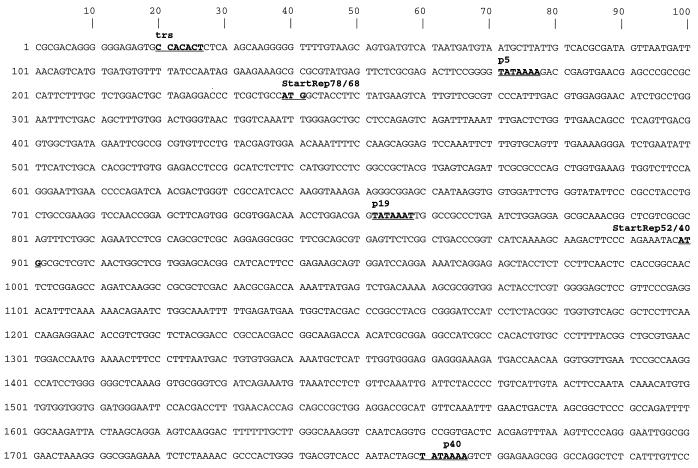
FIG. 1
FIG. 1
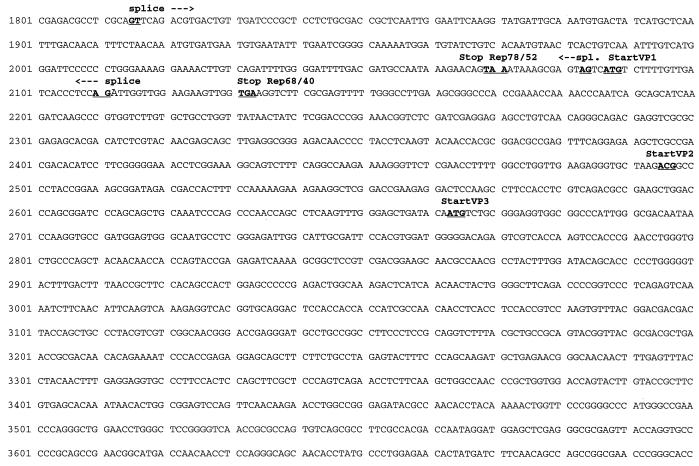
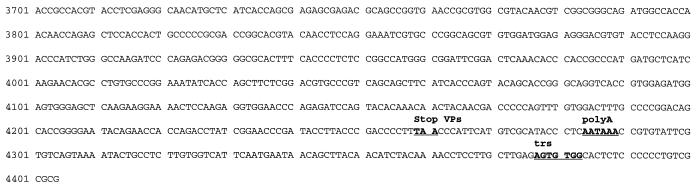
Partial sequence of AAV5. The 4,404 bases obtained by sequencing of AAV5 are shown. The putative promoters (p5, p19, and p40), polyadenylation signal (polyA), start and stop codons for nonstructural (Rep) and capsid (VP) proteins, splice sites (arrows), and the trs are underlined and marked by boldface letters. The position of the inverted terminal sequence counterpart of the terminal resolution site is also indicated by “trs.”
FIG. 1
FIG. 1
Partial sequence of AAV5. The 4,404 bases obtained by sequencing of AAV5 are shown. The putative promoters (p5, p19, and p40), polyadenylation signal (polyA), start and stop codons for nonstructural (Rep) and capsid (VP) proteins, splice sites (arrows), and the trs are underlined and marked by boldface letters. The position of the inverted terminal sequence counterpart of the terminal resolution site is also indicated by “trs.”
FIG. 1
FIG. 1
Partial sequence of AAV5. The 4,404 bases obtained by sequencing of AAV5 are shown. The putative promoters (p5, p19, and p40), polyadenylation signal (polyA), start and stop codons for nonstructural (Rep) and capsid (VP) proteins, splice sites (arrows), and the trs are underlined and marked by boldface letters. The position of the inverted terminal sequence counterpart of the terminal resolution site is also indicated by “trs.”
FIG. 2
FIG. 2
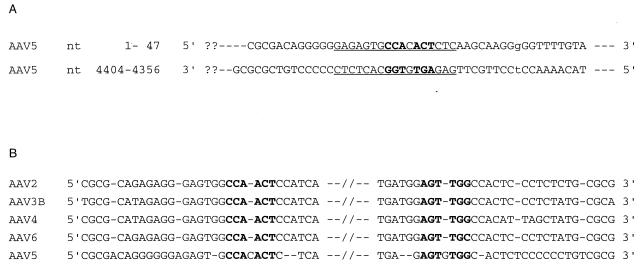
Partial sequence of inverted terminal repeats of AAV5. (A) Part of the inverted terminal repeats comprising the first 47 nt that could be deduced at the 5′ end (nt 1 to 47) and the last 49 nt of the 3′ end (nt 4356 to 4404). The lowercase letters “g” and “t” mark the nucleotide pair at positions 38 and 4365 that does not match the repeat. The putative trs (50) and the respective inverted sequence are shown in boldface letters. Note that the underlined sequences may fold back in AAV5 DNA and form a 7-bp double-stranded loop. (B) Alignment of AAV sequences surrounding the trs and the respective inverted positions in the 5′ and 3′ ends of the DNA molecules. The trs consensus sequence and the respective inverted sequences are shown in boldface letters. Dashes indicate gaps introduced in the alignment. Nucleotides included in the alignment were as follows: AAV2, 104 to 133 and 4547 to 4576; AAV3B, 103 to 132 and 4590 to 4619; AAV4, 104 to 133 and 4635 to 4664; AAV6, 104 to 133 and 4551 to 4580; AAV5 partial sequence, 1 to 30 and 4373 to 4402.
FIG. 3
FIG. 3
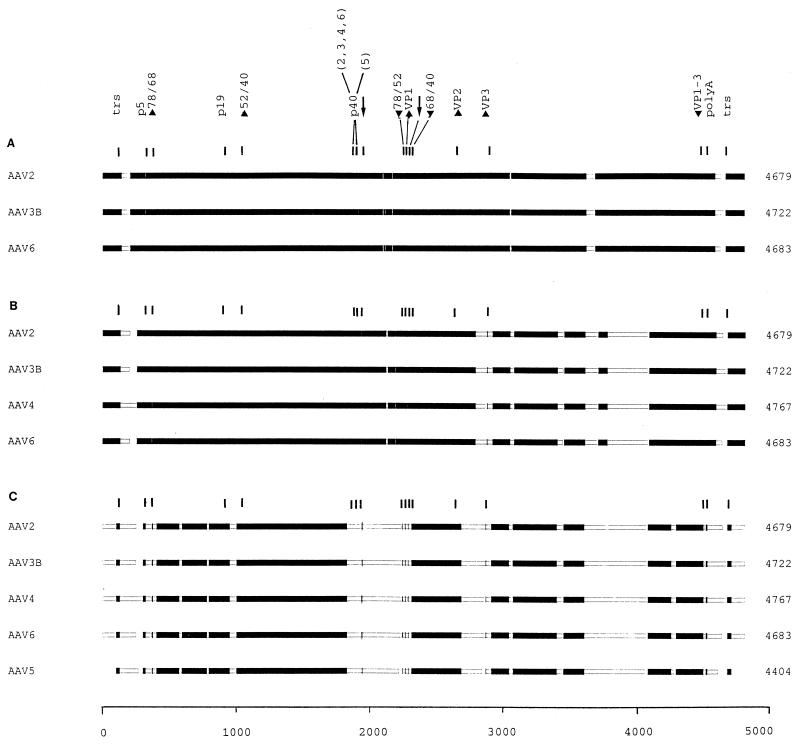
Block alignment of AAV genomic sequences. The complete sequences of AAV2, AAV3B, AAV4, and AAV6 and the partial sequence of AAV5 were aligned with the MACAW program. Segment pair overlap with a minimum segment pair score of 60 was used as a search method to define nucleotide blocks of local similarity. The aligned blocks were linked into the alignment (solid bars). To determine the start and end positions for the alignment of AAV5, the trs (50) were selected by sequence analogy. The scale of alignment is 5,000 nt. Nucleotide positions on the individual genomes are in relation to this scale. The panels show the alignment of AAV2, AAV3B, and AAV6 (A); the alignment of AAV2, AAV3B, AAV4, and AAV6 (B); and the alignment of AAV2, AAV3B, AAV4, AAV6, and AAV5 (C). The positions of the conserved genetic elements are marked, including the p5, p19, and p40 promoters (position of TATA boxes); the intron splice sites (GT/AG [arrows]); the polyadenylation signal (polyA); the translation start (up arrowheads) and stop (down arrowheads) sites for the Rep (Rep 78, 68, 52, and 40) and capsid (VP1 to VP3) proteins; and the terminal resolution site and its inverted counterpart (both marked trs). Note that all of the elements in panel A were within blocks defined by the program and that in panel B only the start of VP3 was excluded, while in panel C several were no longer in regions that met the criteria required for block selection [p5, p40, start Rep 78 and 68, stop Rep 78 and 52, start VP1 and VP3, the splice signals, and the poly(A) site]. Such positions were marked manually. Note that the p40 sites in panel C are located in stretches of high dissimilarity and were not aligned.
FIG. 4
FIG. 4
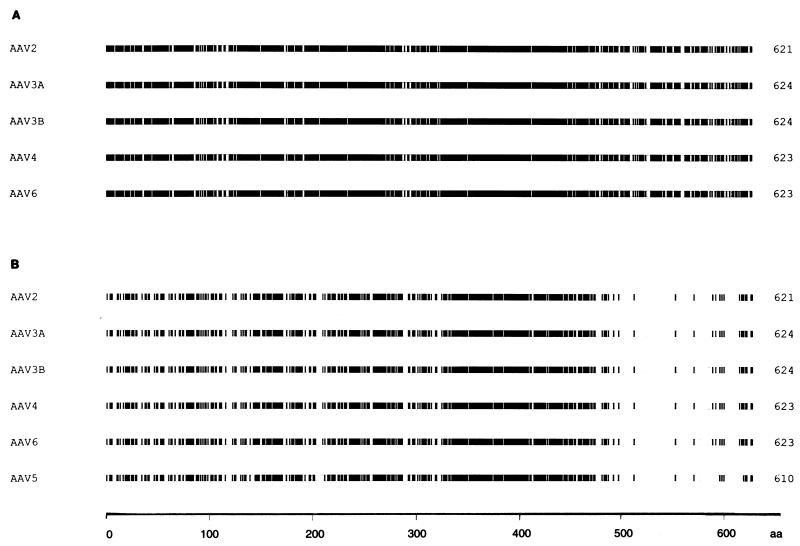
Comparison of the left-sided ORFs of AAV. The left-sided ORFs of AAV were aligned with the MACAW program. Segment pair overlap with a minimum segment pair score of 60 was used as a search method to define amino acid (aa) blocks of local similarity. The aligned blocks were linked and identical amino acid residues were shaded. Shown are alignments of AAV2, AAV3A, AAV3B, AAV4, and AAV6 (A) and AAV2, AAV3A, AAV3B, AAV4, AAV6, and AAV5 (B).
FIG. 5
FIG. 5
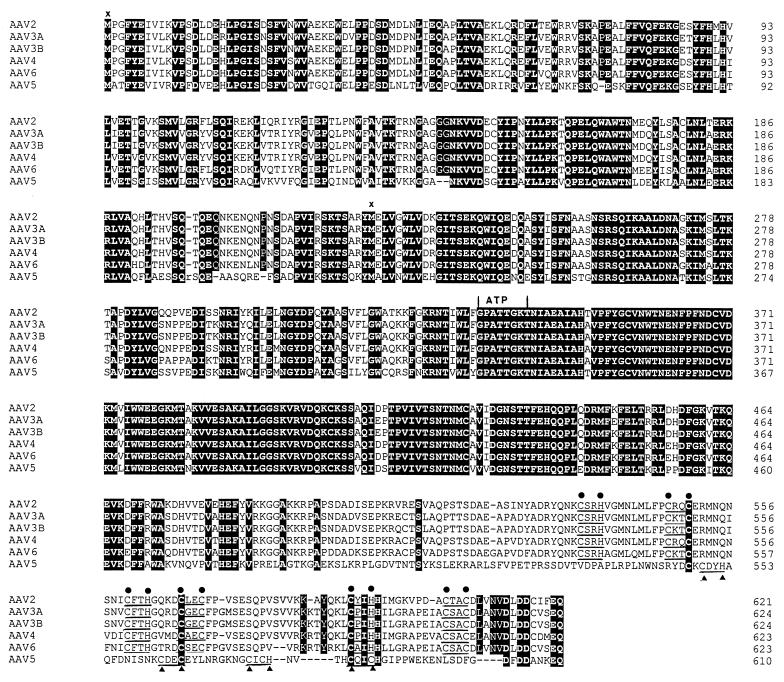
Putative amino acid sequences of the Rep ORFs. The Rep ORFs of AAV2, AAV3A, AAV3B, AAV4, AAV6, and AAV5 were compared by using the MACAW alignment program. Identical amino acids are shown with white letters on a black background. Dashes indicate gaps in the sequence added by the alignment program. The putative ATP-binding site (ATP) and Zn fingers (three pairs of black dots above the sequences for all AAVs except AAV5, and two pairs of black triangles below the sequences for AAV5) are marked. ×, start of the two unspliced Rep proteins.
FIG. 6
FIG. 6
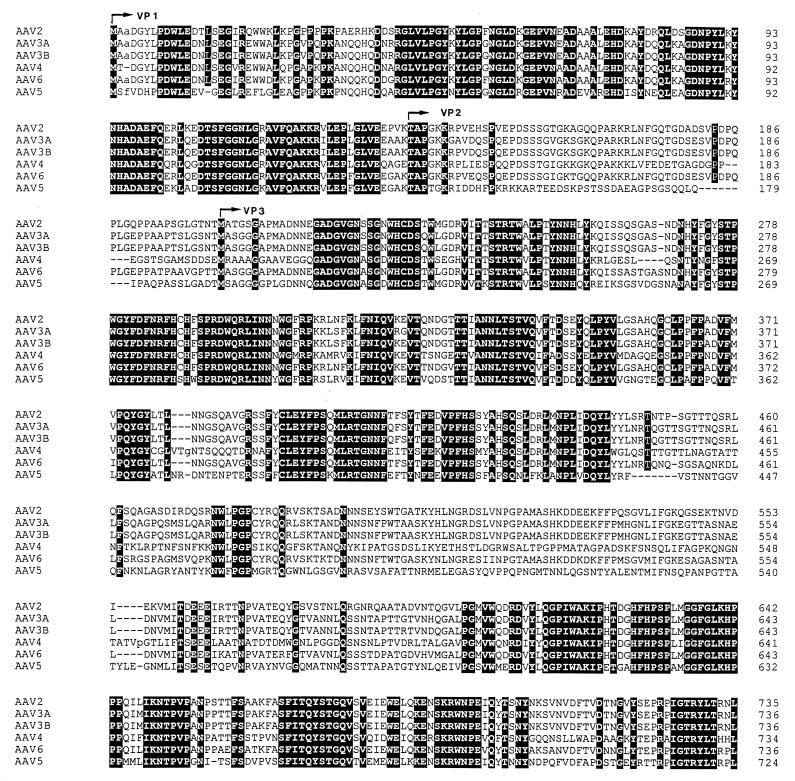
Alignment of the right-sided cap ORFs of AAV. The right-sided ORFs of AAV were aligned with the MACAW program. Segment pair overlap with a minimum segment pair score of 60 was used as the search method to define amino acid blocks of local similarity. Identical amino acid residues are shown with white letters on a black background. VP1, VP2, and VP3 indicate the beginnings of the respective capsid proteins.

References

    1. Atchison R W, Casto B C, Hammon W M. Adenovirus-associated defective virus particles. Science. 1965;194:754–756. - PubMed
    1. Bachmann P A, Hoggan M D, Melnick J L, Pereira H G, Vago C. Parvoviridae. Intervirology. 1975;5:83–92. - PubMed
    1. Bantel-Schaal U. Growth properties of a human melanoma cell line are altered by adeno-associated parvovirus type 2. Int J Cancer. 1995;60:269–274. - PubMed
    1. Bantel-Schaal, U., and H. Delius. 1998. Unpublished results.
    1. Bantel-Schaal U, zur Hausen H. Characterization of the DNA of a defective human parvovirus isolated from a genital site. Virology. 1984;134:52–63. - PubMed

Associated data

LinkOut - more resources