


doi: 10.1128/JB.181.2.666-669.1999.
Targeted mutagenesis by duplication insertion in the radioresistant bacterium Deinococcus radiodurans: radiation sensitivities of catalase (katA) and superoxide dismutase (sodA) mutants
Affiliations
- PMID: 9882685
- PMCID: PMC93425
- DOI: 10.1128/JB.181.2.666-669.1999
Item in Clipboard
Targeted mutagenesis by duplication insertion in the radioresistant bacterium Deinococcus radiodurans: radiation sensitivities of catalase (katA) and superoxide dismutase (sodA) mutants
J Bacteriol.
1999 Jan.
Abstract
Deinococcus radiodurans R1 is extremely resistant to both oxidative stress and ionizing radiation. A simple and general targeted mutagenesis method was developed to generate catalase (katA) and superoxide dismutase (sodA) mutants. Both mutants were shown to be more sensitive to ionizing radiation than the wild type.
Figures
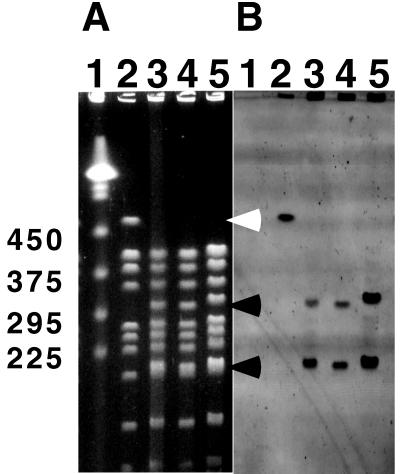
(A) PFGE analysis of wild type and transformants. DNA agarose plugs were digested with NotI restriction enzyme, and digested fragments were resolved with a contour-clamped homogeneous electric field mapper. The gel was stained with ethidium bromide. Lane 1, yeast markers; lane 2, R1 (wild type); lane 3, KKW7001 (complete katA); lane 4, KKW7002 (katA with its promoter region deleted); lane 5, KKW7003 (partial internal coding region of katA). The 485-kb NotI fragment (which disappears) is indicated by the white arrowhead. The two new NotI fragments are indicated by black arrowheads. The molecular sizes in kilobases are shown on the left. (B) Southern blot from gel shown in panel A and hybridized with fluorecein-labelled probe generated from pKKW1 plasmid DNA. The hybridization signal was detected with a FluorImager SI as described previously (24).
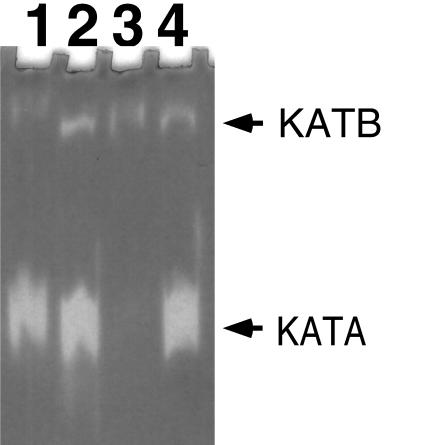
Analysis of catalase activity. Lane 1, R1 (wild type); lane 2, KKW7001 (complete katA); lane 3, KKW7003 (internal coding region of katA); lane 4, KKW7002 (katA with promoter region deleted). The two catalase bands shown are labelled KATA (catalase A) and KATB (catalase B).
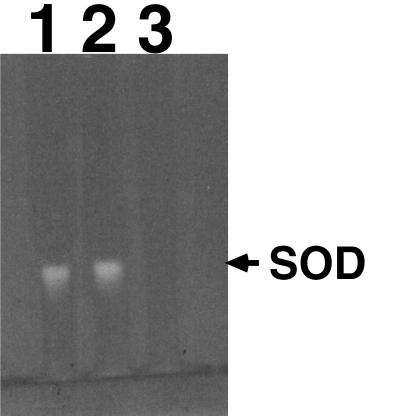
Analysis of superoxide dismutase activity. Lane 1, R1 (wild type); lane 2, KKW7003 (katA mutant); lane 3, KKW7004 (sodA mutant). SOD, superoxide dismutase.
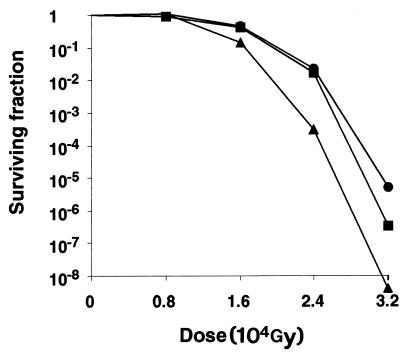
Cell survival after gamma ray exposure. Gamma radiation was from a 60Co source (GammaBeam 650). Circles, strain R1 (wild type); squares, strain KKW7003 (katA mutant); triangles, strain KKW7004 (sodA mutant). The exposure rate was 368 Gy per min.
References
-
- Bauer A W, Kirby W M, Sherris J C, Turck M. Antibiotic susceptibility testing by a standardized single disk method. Am J Clin Patrol. 1966;45:493–496. - PubMed
-
- Beauchamp C, Fridovich I. Superoxide dismutase: improved assays and an assay applicable to acrylamide gels. Anal Biochem. 1971;44:276–287. - PubMed
-
- Bradford M M. A rapid and sensitive method for the quantification of microgram quantities of protein utilizing the principle of protein-dye binding. Anal Biochem. 1976;72:248–254. - PubMed
-
- Carbonneau M A, Melin A M, Perromat A, Clerc M. The action of free radicals on Deinococcus radiodurans carotenoids. Arch Biochem Biophys. 1989;275:244–251. - PubMed
Publication types
MeSH terms
Substances
LinkOut - more resources
Full Text Sources
Other Literature Sources
Molecular Biology Databases
