Randomised controlled trial of efficacy of teaching patients with bipolar disorder to identify early symptoms of relapse and obtain treatment
- PMID: 9888904
- PMCID: PMC27688
- DOI: 10.1136/bmj.318.7177.149
Randomised controlled trial of efficacy of teaching patients with bipolar disorder to identify early symptoms of relapse and obtain treatment
Abstract
Objective: To determine the efficacy of teaching patients with bipolar disorder (manic-depressive psychosis) to identify early symptoms of relapse and seek prompt treatment from health services.
Design: Single blind randomised controlled trial with matching on four baseline variables using a minimisation algorithm.
Setting: Mental health services in four NHS trusts (one teaching, three non-teaching).
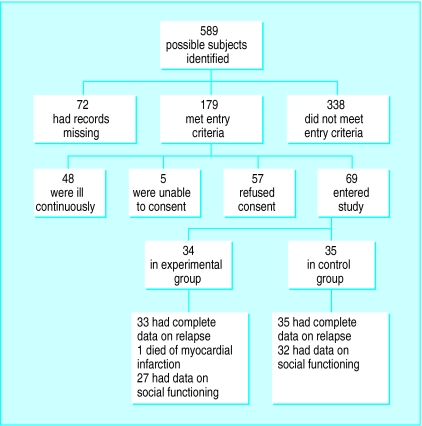
Subjects: 69 patients with bipolar disorder who had had a relapse in the previous 12 months.
Interventions: Seven to 12 individual treatment sessions from a research psychologist plus routine care or routine care alone.
Main outcome measures: Time to first manic or depressive relapse, number of manic or depressive relapses, and social functioning examined by standardised interviews every six months for 18 months.
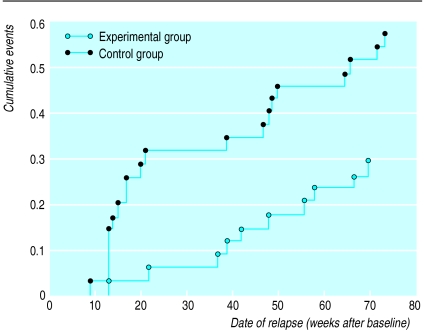
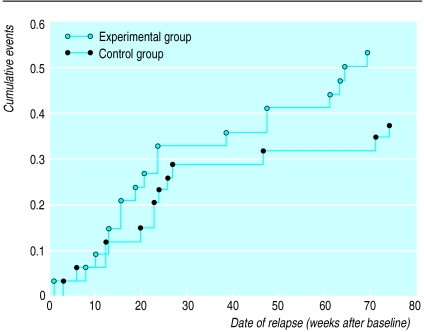
Results: 25th centile time to first manic relapse in experimental group was 65 weeks compared with 17 weeks in the control group. Event curves of time to first manic relapse significantly differed between experimental and control groups (log rank 7.04, df=1, P=0.008), with significant reductions in the number of manic relapses over 18 months (median difference 30% (95% confidence interval 8% to 52%), P=0.013). The experimental treatment had no effect on time to first relapse or number of relapses with depression, but it significantly improved overall social functioning (mean difference 2.0 (0.7 to 3.2), P=0.003) and employment (mean difference 0.7 (0.1 to 1.3), P=0.030) by 18 months.
Conclusion: Teaching patients to recognise early symptoms of manic relapse and seek early treatment is associated with important clinical improvements in time to first manic relapse, social functioning, and employment.
Figures
Comment in
-
Teaching patients with bipolar disorder to identify early symptoms of relapse. When were outcomes separated?BMJ. 1999 Jun 5;318(7197):1557-8. doi: 10.1136/bmj.318.7197.1557b. BMJ. 1999. PMID: 10356031 Free PMC article. No abstract available.
References
-
- American Psychiatric Association. Diagnostic and statistical manual of mental disorders, third edition revised. Washington, DC: APA; 1987.
-
- Coryell W, Keller M, Endicott J, Andreasen N, Clayton P, Hirschfeld R. Bipolar II illness: course and outcome over a five year period. Psychol Med. 1989;19:129–141. - PubMed
-
- Harrow M, Goldberg JF, Grossman LS, Meltzer HY. Outcome in manic disorders. A naturalistic follow-up study. Arch Gen Psychiatry. 1990;47:665–671. - PubMed
-
- Tohen M, Waternaux GM, Tsuang MT. Outcome in mania: a 4 year prospective follow-up of 75 patients utilising survival analysis. Arch Gen Psychiatry. 1990;47:1106–1111. - PubMed
-
- Keller MB, Lavori PW, Coryell W, Endicott J, Mueller TI. Bipolar I: a five year prospective follow up. J Nerv Ment Dis. 1993;181:238–245. - PubMed
Publication types
MeSH terms
LinkOut - more resources
Full Text Sources
Medical
Miscellaneous