Medical students' risk of infection with bloodborne viruses at home and abroad: questionnaire survey
- PMID: 9888908
- PMCID: PMC27693
- DOI: 10.1136/bmj.318.7177.158
Medical students' risk of infection with bloodborne viruses at home and abroad: questionnaire survey
Abstract
Objective: To determine risks of exposure to and prevention of bloodborne virus infections among medical students during their elective period.
Design: Questionnaire study of students returning from their electives in 1997-8.
Setting: Urban teaching hospital.
Subjects: 220 final year medical students.
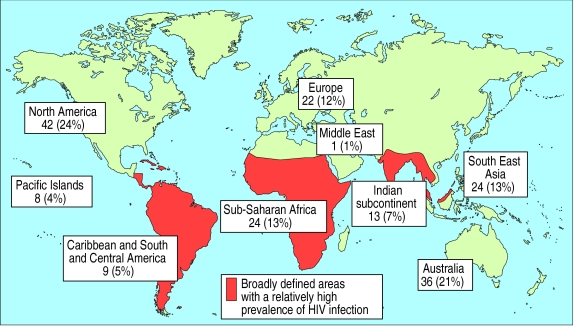
Results: 148 students (67%) returned questionnaires; all had been vaccinated against hepatitis B. 65 respondents (44%) had visited areas of relatively high endemicity for HIV, although 27 (42%) of these, all of whom had visited areas other than sub-Saharan Africa, were unaware of this. All but one had discussed their elective with advisers. Four students experienced percutaneous or mucosal exposure to potentially infectious body fluids, three in areas with a high prevalence of HIV infection. 44 respondents (30%) had experienced at least one such exposure during their clinical training; 75% of these exposures were unreported. 34% (13/38) students who visited areas known to have a high prevalence of HIV infection took with them a starter pack of zidovudine for post-exposure prophylaxis; 53% (20) took latex gloves and 63% (24) a medi-kit. None of the 27 students who were unaware that the areas they visited had a relatively high prevalence of HIV infection took zidovudine; only 15% (4) took gloves and 30% (8) a medi-kit.
Conclusions: Medical schools should produce, regularly update, and implement guidelines regarding protection from bloodborne viruses during clinical studies, including electives. Education and training in infection control should start at the earliest opportunity.
Figures
Comment in
-
Medical students, their electives, and HIV.BMJ. 1999 Jan 16;318(7177):139-40. doi: 10.1136/bmj.318.7177.139. BMJ. 1999. PMID: 9888884 Free PMC article. No abstract available.
-
Medical student electives and infectious diseases. Zidovudine alone is not recommended prophylaxis.BMJ. 1999 Apr 24;318(7191):1145-6. doi: 10.1136/bmj.318.7191.1145b. BMJ. 1999. PMID: 10213754 Free PMC article. No abstract available.
-
Medical student electives and infectious diseases. Risk of hepatitis C is greater than HIV.BMJ. 1999 Apr 24;318(7191):1146. BMJ. 1999. PMID: 10366272 No abstract available.
References
-
- UK Health Departments. AIDS/HIV-infected health care workers: guidance on the management of infected health care workers. Recommendations of the Expert Advisory Group on AIDS. London: Department of Health; 1994.
-
- Banatvala JE, Chrystie IL, Palmer SJ, Sumner D, Kennedy J, Kenney A. HIV screening in pregnancy. Lancet. 1991;337:1218.
-
- UK Health Departments. Guidelines on Post-exposure prophylaxis for Health Care Workers Occupationally Exposed to HIV. London: Department of Health; 1997.
-
- Public Health Laboratory Service. AIDS and HIV infection worldwide. CDR. 1997;7:461–462. - PubMed
MeSH terms
LinkOut - more resources
Full Text Sources
Medical