


Quantitative analysis of mRNA as a marker for viability of Mycobacterium tuberculosis
- PMID: 9889206
- PMCID: PMC84288
- DOI: 10.1128/JCM.37.2.290-295.1999
Quantitative analysis of mRNA as a marker for viability of Mycobacterium tuberculosis
Abstract
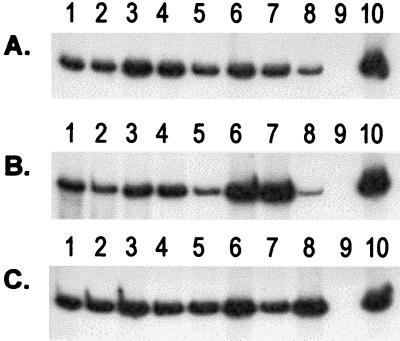
Numerous assays which use conserved DNA or rRNA sequences as targets for amplification have been described for the diagnosis of tuberculosis. However, these techniques have not been applied successfully to the monitoring of therapeutic efficacy owing to the persistence of amplifiable nucleic acid beyond the point at which smears and cultures become negative. Semiquantitative analysis of rRNA has been used to reduce the time required for antimicrobial susceptibility testing of Mycobacterium tuberculosis, although growth for up to 5 days in the presence of some drugs is still required to discriminate resistant strains. The purpose of the present study was to determine whether quantitative analysis of M. tuberculosis mRNA could be used to assess bacterial viability and to illustrate the application of this technique to rapid determination of drug susceptibility. Levels of mRNA encoding the 85B protein (alpha-antigen), IS6110 DNA, and 16S rRNA were compared in parallel cultures of M. tuberculosis that were treated with either no drug, 0. 2 microg of isoniazid per ml, or 1 microg of rifampin per ml. Exposure of sensitive strains to isoniazid or rifampin for 24 h reduced the levels of 85B mRNA to <4 and <0.01%, respectively, of those present in control cultures without drug. In contrast, the levels of IS6110 DNA and 16S rRNA did not diminish over the same period. Strains which were resistant to either isoniazid or rifampin demonstrated no reduction in 85B mRNA in the presence of the drug to which they were nonresponsive. Quantitative analysis of 85B mRNA offers a potentially useful tool for the rapid determination of M. tuberculosis drug susceptibility and for the monitoring of therapeutic efficacy.
Figures
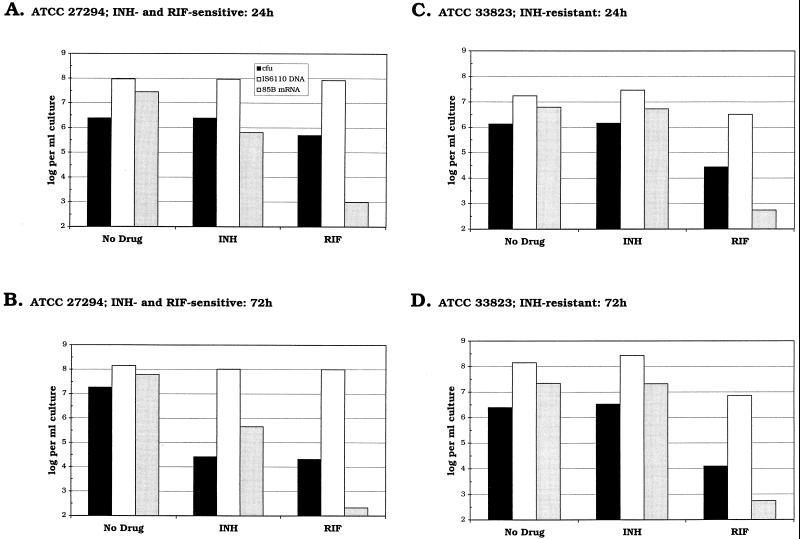
 ) per milliliter of culture for each of the three strains of M. tuberculosis after 24 h (A, C, and E) or 72 h (B, D, and F) of exposure to either no drug, 0.2 μg of INH per ml, or 1 μg of RIF per ml. The nucleic acid levels presented here are the mean values obtained from extraction of duplicate samples.
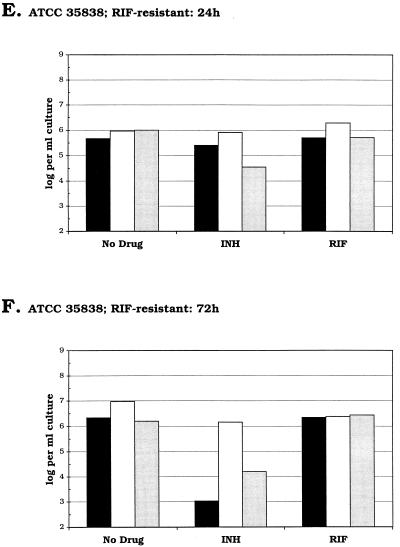 ) per milliliter of culture for each of the three strains of M. tuberculosis after 24 h (A, C, and E) or 72 h (B, D, and F) of exposure to either no drug, 0.2 μg of INH per ml, or 1 μg of RIF per ml. The nucleic acid levels presented here are the mean values obtained from extraction of duplicate samples.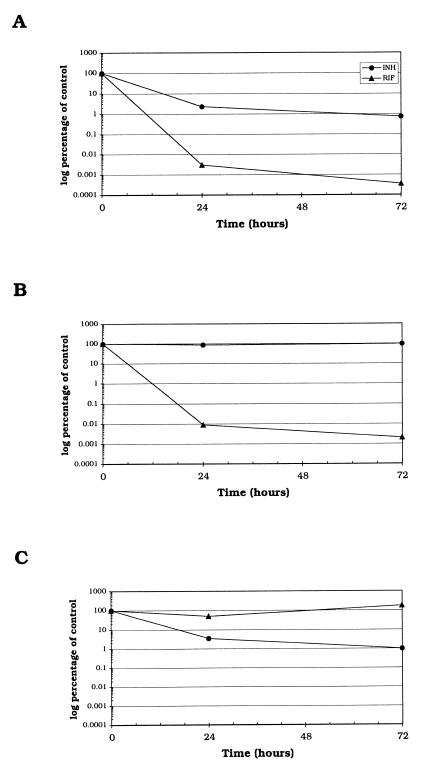
References
-
- Belasco J G, Nilsson G, von Gabain A, Cohen S N. The stability of E. coli gene transcripts is dependent on determinants localized to specific mRNA segments. Cell. 1986;46:245–251. - PubMed
-
- Ben-Hamida F, Schlessinger D. Synthesis and breakdown of ribonucleic acid in Escherichia coli starving for nitrogen. Biochim Biophys Acta. 1966;119:183–191. - PubMed
-
- Blanchard J S. Molecular mechanisms of drug resistance in Mycobacterium tuberculosis. Annu Rev Biochem. 1996;65:215–239. - PubMed
Publication types
MeSH terms
Substances
Grants and funding
LinkOut - more resources
Full Text Sources
Other Literature Sources
Molecular Biology Databases
