. 1999 Feb;19(2):1056-67.
doi: 10.1128/MCB.19.2.1056.

A complex containing RNA polymerase II, Paf1p, Cdc73p, Hpr1p, and Ccr4p plays a role in protein kinase C signaling

Affiliations

A complex containing RNA polymerase II, Paf1p, Cdc73p, Hpr1p, and Ccr4p plays a role in protein kinase C signaling

M Chang et al. Mol Cell Biol. 1999 Feb.

Abstract

Yeast contains at least two complex forms of RNA polymerase II (Pol II), one including the Srbps and a second biochemically distinct form defined by the presence of Paf1p and Cdc73p (X. Shi et al., Mol. Cell. Biol. 17:1160-1169, 1997). In this work we demonstrate that Ccr4p and Hpr1p are components of the Paf1p-Cdc73p-Pol II complex. We have found many synthetic genetic interactions between factors within the Paf1p-Cdc73p complex, including the lethality of paf1Delta ccr4Delta, paf1Delta hpr1Delta, ccr4Delta hpr1Delta, and ccr4Delta gal11Delta double mutants. In addition, paf1Delta and ccr4Delta are lethal in combination with srb5Delta, indicating that the factors within and between the two RNA polymerase II complexes have overlapping essential functions. We have used differential display to identify several genes whose expression is affected by mutations in components of the Paf1p-Cdc73p-Pol II complex. Additionally, as previously observed for hpr1Delta, deleting PAF1 or CDC73 leads to elevated recombination between direct repeats. The paf1Delta and ccr4Delta mutations, as well as gal11Delta, demonstrate sensitivity to cell wall-damaging agents, rescue of the temperature-sensitive phenotype by sorbitol, and reduced expression of genes involved in cell wall biosynthesis. This unusual combination of effects on recombination and cell wall integrity has also been observed for mutations in genes in the Pkc1p-Mpk1p kinase cascade. Consistent with a role for this novel form of RNA polymerase II in the Pkc1p-Mpk1p signaling pathway, we find that paf1Delta mpk1Delta and paf1Delta pkc1Delta double mutants do not demonstrate an enhanced phenotype relative to the single mutants. Our observation that the Mpk1p kinase is fully active in a paf1Delta strain indicates that the Paf1p-Cdc73p complex may function downstream of the Pkc1p-Mpk1p cascade to regulate the expression of a subset of yeast genes.


Figures

FIG. 1
FIG. 1
Hpr1p and Ccr4p are present in the Paf1p-Cdc73p-Pol II complex. Proteins separated on SDS polyacrylamide gels were transferred and probed with antibodies directed against Hpr1p and Ccr4p as indicated. ECL was used for antibody detection. (A) Transcription-competent whole-cell extracts (WCE) were isolated and used as a source to purify GST-tagged Tfg2p, Cdc73p, and associated proteins by glutathione agarose chromatography as described in Materials and Methods. Lanes 1, 3, 5, and 7 (labeled IP) contain the input WCE from the indicated strains; lanes 2, 4, 6, and 8 (labeled B) contain the proteins bound to the glutathione agarose beads. Lanes 1 and 2 (labeled WT-GST) are from wild-type (YJJ662) cells transformed with the GST vector alone; lanes 3 and 4 (labeled GST-TFG2) are from the tfg2Δ mutant complemented with GST-Tfg2p (YJJ854); lanes 5 and 6 (labeled cdc73Δ-GST) are from cdc73Δ (YJJ665) mutant cells transformed with the GST vector; and lanes 7 and 8 (labeled GST-CDC73) are from the cdc73Δ mutant complemented by GST-Cdc73p (YJJ691). (B) Transcription-competent WCE were isolated and used as a source to purify GST-tagged Hpr1p and associated proteins by glutathione agarose chromatography as described in Materials and Methods. Lanes labeled IP and B are as described in panel A. Lanes 1 and 2 (labeled hpr1Δ-GST) are from an hpr1Δ strain transformed with the GST vector alone (YJJ954); lanes 3 and 4 (labeled GST-HPR1) are from an hpr1Δ strain transformed with GST-Hpr1p (YJJ952). (C) Fractions from antibody affinity chromatography performed as described in Wade et al. (58). Lanes: WCE, 40 μg of protein from a transcription competent WCE; α-ς70, 10 μl of the salt-eluted fraction from a control column containing antibody directed against the ς70 subunit of E. coli RNA polymerase; α-CTD, 10 μl of the salt-eluted fraction from a column containing antibody directed against the C-terminal domain of the largest subunit of RNA Pol II.
FIG. 2
FIG. 2
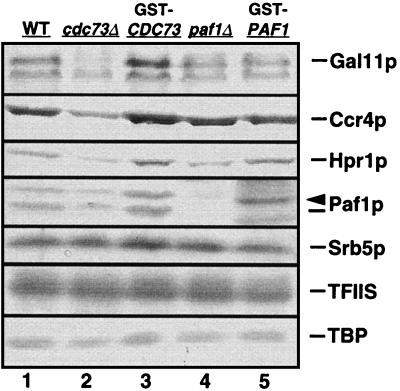
A mutation in the CDC73 gene affects the abundance of Ccr4p, Hpr1p, Gal11p, and Paf1p. The abundance of the indicated proteins was analyzed as described in Materials and Methods in different transcription-competent WCEs. Antibodies were detected with alkaline phosphatase. Lanes 1, 2, and 4 show WCEs from wild-type (WT; YJJ662), cdc73Δ (YJJ665), and paf1Δ (YJJ664) cells, respectively, transformed with the GST vector alone. Lanes 3 and 5 show cdc73Δ and paf1Δ mutant strains complemented by GST-Cdc73p (YJJ691) and GST-Paf1p (YJJ676), respectively. The arrowhead above Paf1p points to the position of the GST-Paf1p protein seen in lane 5. Proteins absent from the Paf1p-Cdc73p-Pol II complex, including Srb5p, TFIIS, and TBP, are used as loading controls.
FIG. 3
FIG. 3
Transcripts identified by differential display are differentially expressed in isogenic paf1Δ, cdc73Δ, gal11Δ, srb5Δ, ccr4Δ, and hpr1Δ mutant strains. Differential display was performed as described in Materials and Methods. DNA encoding the differentially expressed transcripts was cloned and sequenced to identify the yeast gene. RNA was isolated from the indicated isogenic strains and probed for transcripts from each gene as described in Materials and Methods. Abundance was determined with a PhosphorImager and was normalized to the signal for 18S rRNA. The data is presented relative to a transcript abundance in wild type set as 1, which is shown as a dashed line in each panel. The results shown represent the averages and standard deviations from six to nine separate RNA isolations. The yeast strains used for RNA isolation were paf1Δ-YJJ664, cdc73Δ-YJJ665, gal11Δ-YJJ564, srb5Δ-YJJ875, ccr4Δ-YJJ879, and hpr1Δ-YJJ898.
FIG. 4
FIG. 4
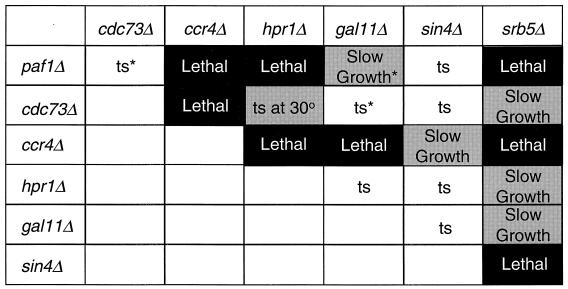
Synthetic genetic interactions between pairwise combinations of factors in RNA Pol II complexes. Tetrad analysis of heterozygous diploids obtained by sporulating crosses between isogenic single deletion mutants and tetrad dissection. At least 30 tetrads were dissected for each diploid analyzed. All of the single deletion mutants are ts at 38°C. The growth phenotypes of the double-deletion mutants are shown in the figure, with shaded areas highlighting significant synthetic interactions (solid box, synthetic lethality; gray box, synthetic enhancement). The genotypes of inviable spores were deduced by the markers used to delete the genes. “Slow growth” means that the double mutants grew significantly more slowly than either of the parents. The “ts at 30°” means that the permissive temperature for the double mutant is reduced to 22°C. The “ts” in an unshaded box indicates that the phenotype of the double mutant was not significantly worse than either of the parent strains. The asterisks refer to previously published results (51, 52) included for completeness. The strains used in the crosses were paf1Δ-YJJ664 or -YJJ577; cdc73Δ-YJJ665 or YJJ681; gal11Δ-YJJ564; sin4Δ-YJJ832 srb5Δ-YJJ956, -YJJ935, or -YJJ875; ccr4Δ-YJJ932 or -YJJ879 and hpr1Δ-YJJ898 or -YJJ899.
FIG. 5
FIG. 5
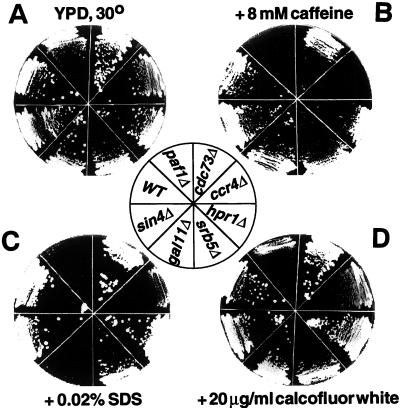
Mutations in PAF1, CCR4, and GAL11 lead to increased sensitivity to cell wall-damaging agents. Isogenic wild type (WT; YJJ662) and paf1Δ (YJJ664), cdc73Δ (YJJ665), gal11Δ (YJJ564), srb5Δ (YJJ875), ccr4Δ (YJJ879), sin4Δ (YJJ832), and hpr1Δ (YJJ898) were grown on YPD or YPD plus the indicated additions. The cells were allowed to grow at 30°C for 3 to 4 days.
FIG. 6
FIG. 6
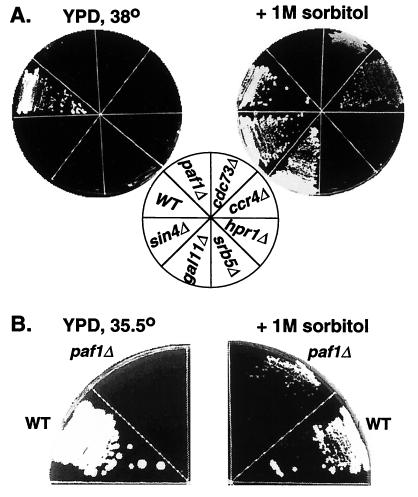
The ts phenotype of paf1Δ, cdc73Δ, ccr4Δ, and gal11Δ can be corrected by the cell wall-stabilizing agent sorbitol. (A) Isogenic wild type (WT; YJJ662), paf1Δ (YJJ664), cdc73Δ (YJJ665), gal11Δ (YJJ564), srb5Δ (YJJ875), ccr4Δ (YJJ879), sin4Δ (YJJ832), and hpr1Δ (YJJ898) strains were grown on YPD or YPD plus 1 M sorbitol at 38°C for 4 days. (B) Isogenic wild-type (WT; YJJ662) and paf1Δ (YJJ664) strains were grown on YPD or YPD plus 1 M sorbitol at 35.5°C for 2.5 days.
FIG. 7
FIG. 7
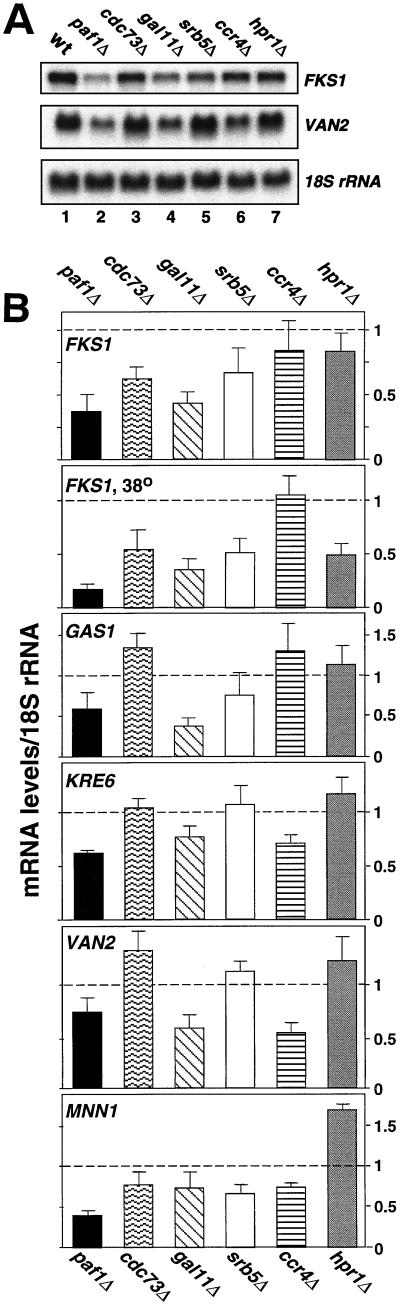
Expression of genes involved in cell wall biosynthesis is reduced in paf1Δ ccr4Δ and gal11Δ mutants. (A) Total yeast RNA was prepared from isogenic mutant strains and probed for the indicated genes as described in Materials and Methods. (B) The results shown are based on three or more independently isolated sets of RNA. The RNA abundance was normalized to 18S rRNA, and the wild-type value is set as 1, which is shown as a dashed line in each panel. The RNA in the panel labeled FKS1 at 38°C was isolated from cells shifted from 30 to 38°C and incubated for 5 h. The yeast strains used for RNA isolation were wild type-YJJ662, paf1Δ-YJJ664, cdc73Δ-YJJ665, gal11Δ-YJJ564, srb5Δ-YJJ875, ccr4Δ-YJJ879, and hpr1Δ-YJJ898.
FIG. 8
FIG. 8
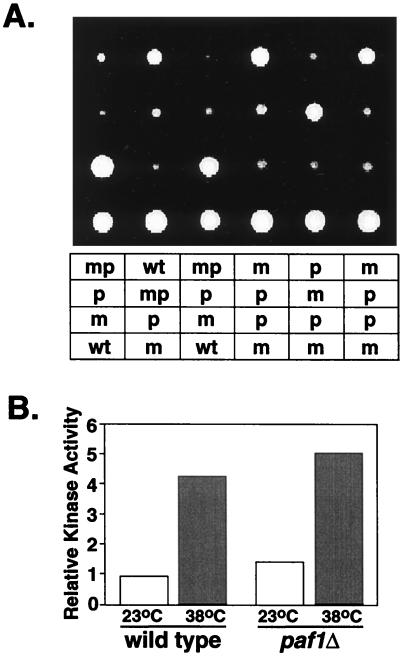
Interactions between PAF1 and MPK1. (A) A strain heterozygous for paf1Δ and mpk1Δ (YJJ998) was sporulated, and tetrads were dissected. The figure shows 6 of 30 tetrads, all of which showed similar results. The genotype of the spores was determined from the markers associated with the deletions. wt, Wild type; m, mpk1Δ::URA3; p, paf1Δ::HIS3; mp, mpk1Δpaf1Δ. (B) Cell extracts were prepared from wild type (WT; YJJ755) and paf1Δ (YJJ756) strains containing a 3HA-tagged form of Mpk1p and grown at the indicated temperatures. The tagged Mpk1p was isolated and used to phosphorylate the MAP kinase substrate MBP as described by Zarzov et al. (62). The data represent the phosphorylation of MBP normalized to the amount of HA-tagged Mpk1p in each extract.
FIG. 9
FIG. 9
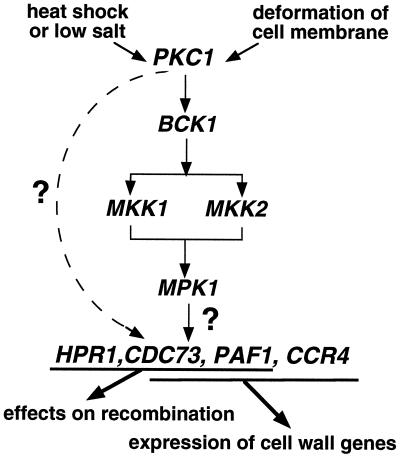
A model for the interactions between the Paf1p-Cdc73p-Pol II transcription complex and the Pkc1p-Mpk1p protein kinase cascade. An explanation of the model is provided in the text.

References

    1. Aguilera A, Klein H L. Genetic control of intrachromosomal recombination in Saccharomyces cerevisiae. I. Isolation and genetic characterization of hyper-recombination mutations. Genetics. 1988;119:779–790. - PMC - PubMed
    1. Aguilera A, Klein H L. HPR1, a novel yeast gene that prevents intrachromosomal excision recombination shows carboxy-terminal homology to the Saccharomyces cerevisiae TOP1 gene. Mol Cell Biol. 1990;10:1439–1451. - PMC - PubMed
    1. Archambault J, Lacroute F, Ruet A, Friesen J D. Genetic interaction between transcription elongation factor TFIIS and RNA polymerase II. Mol Cell Biol. 1992;12:4142–4152. - PMC - PubMed
    1. Botstein D, Falco S C, Stewart S E, Brennan M, Scherer S, Stinchcomb D T, Struhl K, Davis R W. Sterile host yeasts (SHY): a eukaryotic system of biological containment for recombinant DNA experiments. Gene. 1979;8:17–24. - PubMed
    1. Buehrer B M, Errede B. Coordination of the mating and cell integrity mitogen-activated protein kinase pathways in Saccharomyces cerevisiae. Mol Cell Biol. 1997;17:6517–6525. - PMC - PubMed

Publication types

MeSH terms