


Quadriceps weakness in knee osteoarthritis: the effect on pain and disability
- PMID: 9893569
- PMCID: PMC1752483
- DOI: 10.1136/ard.57.10.588
Quadriceps weakness in knee osteoarthritis: the effect on pain and disability
Abstract
Objectives: (1) To determine the importance of quadriceps strength, structural change, and psychological status in terms of knee pain in the community. (2) To determine the relative importance of quadriceps function, structural change, and psychological status with respect to disability in subjects with knee pain.
Methods: 300 men and women with pain and 300 controls without pain (aged 40-79) were seen. Isometric quadriceps strength (MVC) was measured and muscle activation was assessed by twitch superimposition. Disability (Western Ontario McMaster Osteoarthritis Index (WOMAC)) and anxiety and depression were assessed (Hospital Anxiety and Depression Index (HAD)). Radiographs were obtained of the tibiofemoral and patellofemoral joints and total score for osteophyte, narrowing, and sclerosis calculated for each knee.
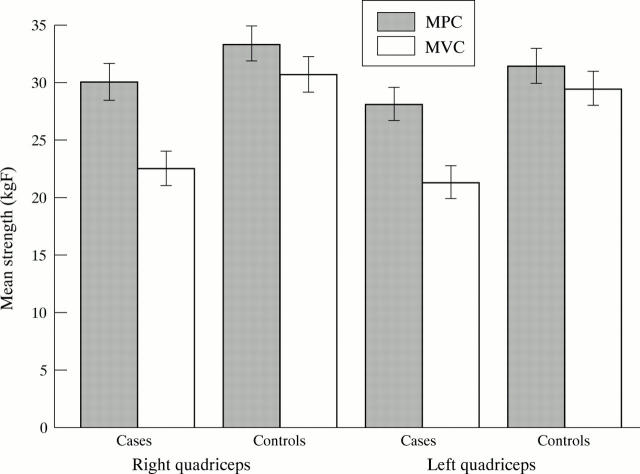
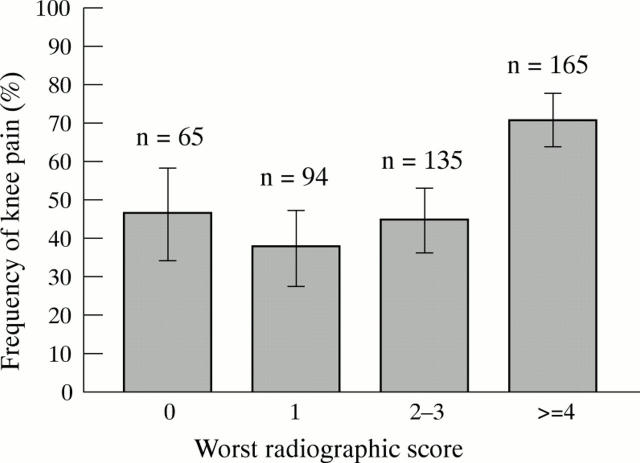
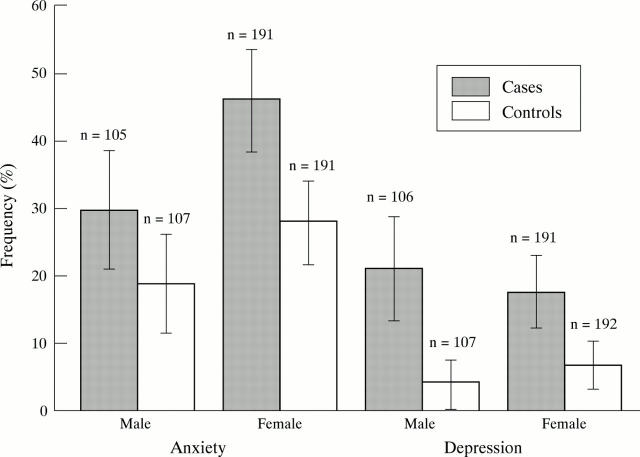
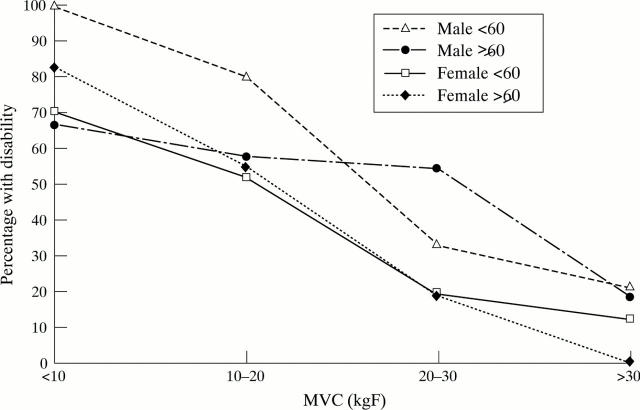
Results: Subjects with knee pain had lower voluntary quadriceps strength than those without pain (p < 0.005). Quadriceps activation was also lower (p < 0.005), but did not fully explain the reduction in strength. When analysed by multiple logistic regression: quadriceps strength (odds ratio 18.8, CI 4.8, 74.1 for MVC < or = 10 kgF); depression (odds ratio 2.4, CI 1.0, 5.5 for HAD score > or = 8); and radiographic change (odds ratio 4.1, CI 1.9, 8.6 for radiographic score > or = 4) were independently associated with pain. In those with knee pain, disability was independently associated with quadriceps strength (odds ratio 8.2, CI 1.5, 44.4 for MVC < or = 10 kgF) and depression (odds ratio 6.2, CI 2.1, 18.0 for HAD score > or = 8); but not with radiographic score.
Conclusions: Quadriceps strength is strongly associated with knee pain and disability in the community, even when activation and psychological factors are taken into account. This has important therapeutic implications.
Figures
References
Publication types
MeSH terms
LinkOut - more resources
Full Text Sources
