


Urokinase-type plasminogen activator in inflammatory cell recruitment and host defense against Pneumocystis carinii in mice
- PMID: 9916103
- PMCID: PMC96399
- DOI: 10.1128/IAI.67.2.879-884.1999
Urokinase-type plasminogen activator in inflammatory cell recruitment and host defense against Pneumocystis carinii in mice
Abstract
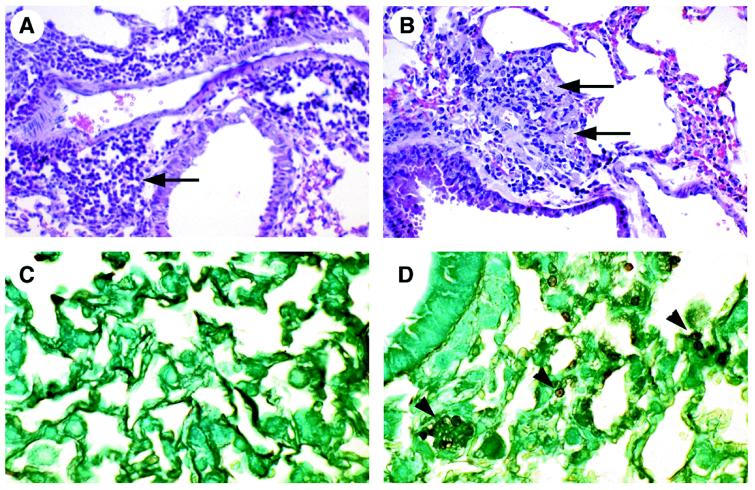
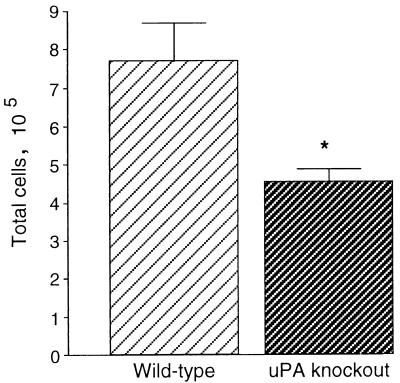
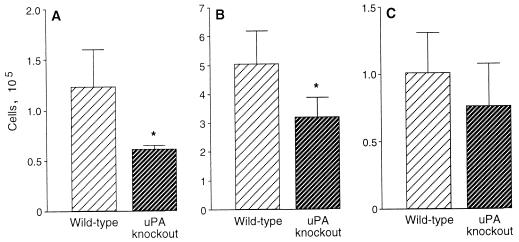
Effective host defense against Pneumocystis carinii depends upon the integrated actions of inflammatory cells and mediators in the lungs. Using immunocompetent and immunosuppressed mice, our laboratory has defined inflammatory changes in the lungs in response to P. carinii. However, the essential molecules and mechanisms required for cellular recruitment and for host defense against P. carinii are undefined. We hypothesized that urokinase-type plasminogen activator (uPA), a protease intimately involved in inflammatory cell migration and activation, is required for clearance of P. carinii. To test this hypothesis in vivo, we compared the intensity of P. carinii infection and inflammation in the lungs of mice lacking the uPA gene (uPA knockout mice) and in the lungs of wild-type mice. After intratracheal inoculation with P. carinii organisms, uPA knockout mice developed uniformly heavy P. carinii pneumonia while wild-type mice cleared the P. carinii inoculum. Bronchoalveolar lavage fluid from uPA knockout mice contained significantly smaller numbers of cells than did lavage fluid from wild-type mice. We conclude that deletion of the uPA gene prevents the clearance of P. carinii and reduces inflammatory cell recruitment. Therefore, uPA is an important participant in the network of inflammatory events required for the clearance of P. carinii, confirming an important role for this molecule in pulmonary host defense against opportunistic pathogens.
Figures

Similar articles
-
Susceptibility to Pneumocystis carinii in mice is dependent on simultaneous deletion of IFN-gamma and type 1 and 2 TNF receptor genes.J Immunol. 1998 Jul 1;161(1):360-6. J Immunol. 1998. PMID: 9647244
-
Role of CD8+ lymphocytes in host defense against Pneumocystis carinii in mice.J Lab Clin Med. 1996 Nov;128(5):477-87. doi: 10.1016/s0022-2143(96)90044-x. J Lab Clin Med. 1996. PMID: 8900290
-
Inflammatory responses to Pneumocystis carinii in mice selectively depleted of helper T lymphocytes.Am J Respir Cell Mol Biol. 1991 Aug;5(2):186-97. doi: 10.1165/ajrcmb/5.2.186. Am J Respir Cell Mol Biol. 1991. PMID: 1679991
-
Lymphocytes in host defense against Pneumocystis carinii.Semin Respir Infect. 1998 Dec;13(4):330-8. Semin Respir Infect. 1998. PMID: 9872630 Review.
-
The role of inflammation in respiratory impairment during Pneumocystis carinii pneumonia.Semin Respir Infect. 2003 Mar;18(1):40-7. doi: 10.1053/srin.2003.50004. Semin Respir Infect. 2003. PMID: 12652453 Review.
Cited by
-
Purification of a 68-kDa cysteine proteinase from crude extract of Pneumocystis carinii.Korean J Parasitol. 2000 Sep;38(3):159-66. doi: 10.3347/kjp.2000.38.3.159. Korean J Parasitol. 2000. PMID: 11002651 Free PMC article.
-
Urokinase-deficient mice fail to generate a type 2 immune response following schistosomal antigen challenge.Infect Immun. 2004 Jan;72(1):461-7. doi: 10.1128/IAI.72.1.461-467.2004. Infect Immun. 2004. PMID: 14688127 Free PMC article.
-
The fibrinolytic system in dissemination and matrix protein deposition during a mycobacterium infection.Am J Pathol. 2003 Aug;163(2):517-31. doi: 10.1016/S0002-9440(10)63680-2. Am J Pathol. 2003. PMID: 12875972 Free PMC article.
-
Urokinase-type plasminogen activator deficiency promotes neoplasmatogenesis in the colon of mice.Transl Oncol. 2014 Apr;7(2):174-187.e5. doi: 10.1016/j.tranon.2014.02.002. Epub 2014 Mar 4. Transl Oncol. 2014. PMID: 24913672 Free PMC article.
-
4G/5G plasminogen activator inhibitor-1 polymorphisms and haplotypes are associated with pneumonia.Am J Respir Crit Care Med. 2007 Dec 1;176(11):1129-37. doi: 10.1164/rccm.200605-644OC. Epub 2007 Aug 29. Am J Respir Crit Care Med. 2007. PMID: 17761618 Free PMC article.
References
-
- Angelici E, Contini C, Romani R, Epifano O, Serra P, Canipari R. Production of plasminogen activator and plasminogen activator inhibitors by alveolar macrophages in control subjects and AIDS patients. AIDS. 1996;10:283–290. - PubMed
-
- Beck J M, Newbury R L, Palmer B E, Warnock M L, Byrd P K, Kaltreider H B. Role of CD8+ lymphocytes in host defense against Pneumocystis carinii in mice. J Lab Clin Med. 1996;128:477–487. - PubMed
-
- Beck J M, Warnock M L, Curtis J L, Sniezek M J, Arraj-Peffer S M, Kaltreider H B, Shellito J E. Inflammatory responses to Pneumocystis carinii in mice selectively depleted of helper T lymphocytes. Am J Respir Cell Mol Biol. 1991;5:186–197. - PubMed
-
- Beck J M, Warnock M L, Kaltreider H B, Shellito J E. Host defense against Pneumocystis carinii in mice selectively depleted of CD4+ lymphocytes. Chest. 1993;103:116S–118S. - PubMed
Publication types
MeSH terms
Substances
Grants and funding
LinkOut - more resources
Full Text Sources
Miscellaneous
