. 1999 Feb;65(2):359-66.
doi: 10.1128/AEM.65.2.359-366.1999.

Biophysical characterization of fungal phytases (myo-inositol hexakisphosphate phosphohydrolases): molecular size, glycosylation pattern, and engineering of proteolytic resistance

Affiliations

Biophysical characterization of fungal phytases (myo-inositol hexakisphosphate phosphohydrolases): molecular size, glycosylation pattern, and engineering of proteolytic resistance

M Wyss et al. Appl Environ Microbiol. 1999 Feb.

Abstract

Phytases (myo-inositol hexakisphosphate phosphohydrolases) are found naturally in plants and microorganisms, particularly fungi. Interest in these enzymes has been stimulated by the fact that phytase supplements increase the availability of phosphorus in pig and poultry feed and thereby reduce environmental pollution due to excess phosphate excretion in areas where there is intensive livestock production. The wild-type phytases from six different fungi, Aspergillus niger, Aspergillus terreus, Aspergillus fumigatus, Emericella nidulans, Myceliophthora thermophila, and Talaromyces thermophilus, were overexpressed in either filamentous fungi or yeasts and purified, and their biophysical properties were compared with those of a phytase from Escherichia coli. All of the phytases examined are monomeric proteins. While E. coli phytase is a nonglycosylated enzyme, the glycosylation patterns of the fungal phytases proved to be highly variable, differing for individual phytases, for a given phytase produced in different expression systems, and for individual batches of a given phytase produced in a particular expression system. Whereas the extents of glycosylation were moderate when the fungal phytases were expressed in filamentous fungi, they were excessive when the phytases were expressed in yeasts. However, the different extents of glycosylation had no effect on the specific activity, the thermostability, or the refolding properties of individual phytases. When expressed in A. niger, several fungal phytases were susceptible to limited proteolysis by proteases present in the culture supernatant. N-terminal sequencing of the fragments revealed that cleavage invariably occurred at exposed loops on the surface of the molecule. Site-directed mutagenesis of A. fumigatus and E. nidulans phytases at the cleavage sites yielded mutants that were considerably more resistant to proteolytic attack. Therefore, engineering of exposed surface loops may be a strategy for improving phytase stability during feed processing and in the digestive tract.


Figures
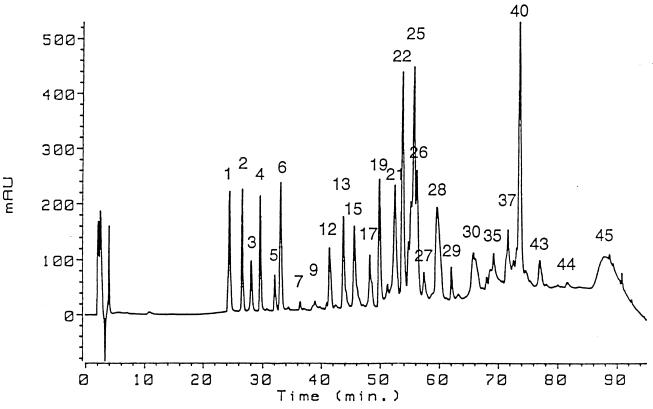
FIG. 1
FIG. 1
Separation of A. niger phytase fragments by reversed-phase HPLC after carboxymethylation and trypsin digestion of the protein. For experimental details see the text. AU, arbitrary units.
FIG. 2
FIG. 2
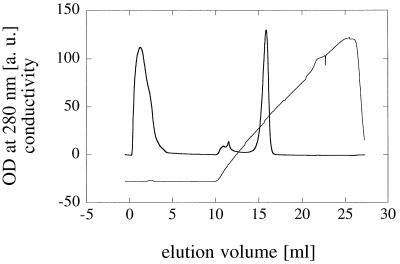
Purification of A. fumigatus phytase by cation-exchange chromatography. An aliquot of a concentrated A. niger culture supernatant containing A. fumigatus phytase was loaded onto a 1.7-ml Poros HS/M cation-exchange chromatography column and eluted with a linear sodium chloride gradient. A. fumigatus phytase eluted as a symmetrical peak at an elution volume of approximately 15.5 ml. OD, optical density; a.u., arbitrary units.
FIG. 3
FIG. 3
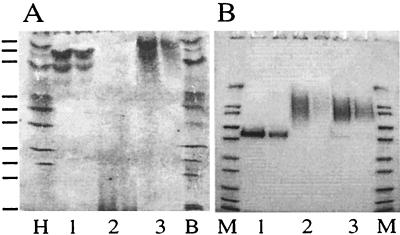
Extent of glycosylation and its effect on the isoelectric point of A. fumigatus phytase in different expression systems. (A) IEF pH 3 to 10 gel. (B) SDS-PAGE gel. Purified A. fumigatus phytase was expressed in A. niger (lanes 1), H. polymorpha (lanes 2), or S. cerevisiae (lanes 3) (two lanes with different protein concentrations were used for each expression system). Lane H, high-pI kit (Pharmacia Biotech); lane B, broad-pI kit (Pharmacia Biotech) (from top to bottom, pI 8.65, 8.45, 8.15, 7.35, 6.85, 6.55, 5.85, 5.20, 4.55, and 3.50); lanes M, Mark 12 molecular weight standard (Novex) containing myosin (Mr, 200,000), β-galactosidase (116,300), phosphorylase b (97,400), albumin (66,300), glutamic dehydrogenase (55,400), lactate dehydrogenase (36,500), carbonic anhydrase (31,000), trypsin inhibitor (21,500), lysozyme (14,400), and aprotinin (6,000).
FIG. 4
FIG. 4
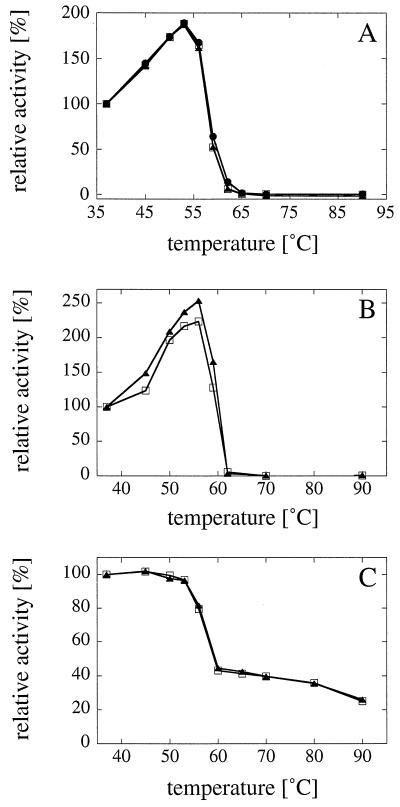
Different extents of glycosylation do not affect the thermostability and refolding of phytase. The enzymatic activity of A. fumigatus phytase (A) expressed in A. niger (□), H. polymorpha (•), or S. cerevisiae (▴) and the enzymatic activity of A. niger CB phytase (B) expressed in A. niger (□) or S. cerevisiae (▴) were measured at a series of temperatures between 37 and 90°C. (C) A. niger CB phytase expressed in A. niger (□) or S. cerevisiae (▴) was incubated for 20 min at 37, 45, 50, 53, 56, 60, 65, 70, 80, or 90°C and then for 1 h at 4°C. Subsequently, phytase activity was measured at 37°C. It is evident that the different extents of glycosylation had no or only minor effects on the thermostability and refolding properties of the phytases.
FIG. 5
FIG. 5
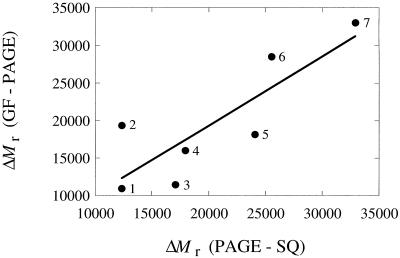
Gel filtration artifacts due to protein glycosylation. Gel permeation chromatography of the glycosylated phytases resulted in higher Mrs than expected on the basis of SDS-PAGE, mass spectrometry, or analytical ultracentrifugation data. The overestimation, as expressed by the difference between the Mrs obtained by gel filtration and SDS-PAGE (y axis), increased with the extent of protein glycosylation, as expressed by the difference between the Mrs obtained by SDS-PAGE and amino acid sequence analysis (x axis). The regression line has the equation y = 904.1 + 0.9203x and an R value of 0.837. The data were obtained from Table 3. Data point 1, M. thermophila phytase; data point 2, A. terreus 9A1 phytase; data point 3, E. nidulans phytase; data point 4, A. niger phytase (Natuphos); data point 5, A. fumigatus phytase; data point 6, A. niger CB phytase; data point 7, A. terreus CBS phytase. GF, gel filtration; SQ, sequence analysis.
FIG. 6
FIG. 6
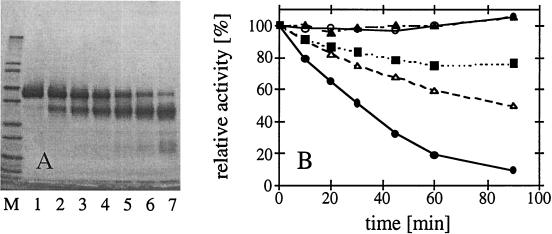
Proteolytic susceptibility of A. fumigatus phytase expressed in A. niger. (A) Purified A. fumigatus phytase was incubated at 50°C with a diluted A. niger NW205 culture supernatant containing proteolytic activity. After 0, 10, 20, 30, 45, 60, and 90 min of incubation, aliquots were subjected to SDS-PAGE (lanes 1 to 7, respectively). Lane M contained the Mark 12 molecular weight standard (see the legend to Fig. 3). (B) A. fumigatus wild-type phytase (•), A. fumigatus S126N (■), and A. fumigatus R125L/S126N (▵) were incubated with diluted NW205 culture supernatant at 50°C for 0, 10, 20, 30, 45, 60, and 90 min, and then phytase activity was measured at 37°C. As controls, A. fumigatus wild-type phytase was incubated under the same conditions without NW205 culture supernatant (○) or with NW205 culture supernatant that had been pretreated for 20 min at 90°C in order to inactivate the protease(s) (▴). The decreased rate of inactivation of the mutants was paralleled by much slower accumulation of degradation products on SDS-PAGE gels (data not shown).

References

    1. Andrews P. The gel-filtration behaviour of proteins related to their molecular weights over a wide range. Biochem J. 1965;96:595–606. - PMC - PubMed
    1. Dassa J, Marck C, Boquet P L. The complete nucleotide sequence of the Escherichia coli gene appA reveals significant homology between pH 2.5 acid phosphatase and glucose-1-phosphatase. J Bacteriol. 1990;172:5497–5500. - PMC - PubMed
    1. Davis R W, Botstein D, Roth J R. A manual for genetic engineering: advanced bacterial genetics. Cold Spring Harbor, N.Y: Cold Spring Harbor Laboratory; 1980. pp. 120–123.
    1. Gellissen G, Janowicz Z A, Merckelbach A, Piontek M, Keup P, Weydemann U, Hollenberg C P, Strasser A W M. Heterologous gene expression in Hansenula polymorpha: efficient secretion of glucoamylase. Bio/Technology. 1991;9:291–295. - PubMed
    1. Gibson D M, Ullah A H J. Purification and characterization of phytase from cotyledons of germinating soybean seeds. Arch Biochem Biophys. 1988;260:503–513. - PubMed

LinkOut - more resources