


Estimating bacterial growth parameters by means of detection times
- PMID: 9925608
- PMCID: PMC91087
- DOI: 10.1128/AEM.65.2.732-736.1999
Estimating bacterial growth parameters by means of detection times
Abstract
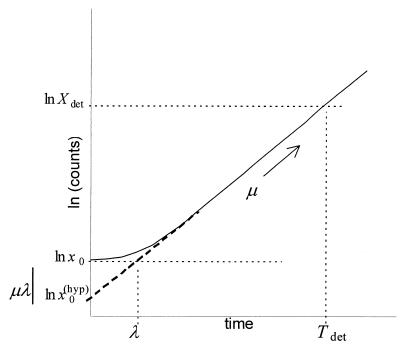
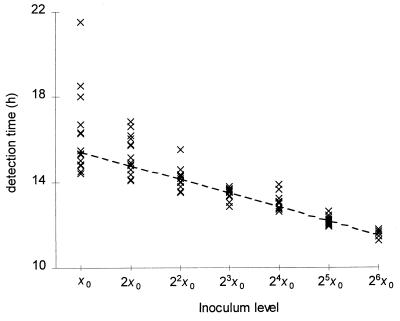
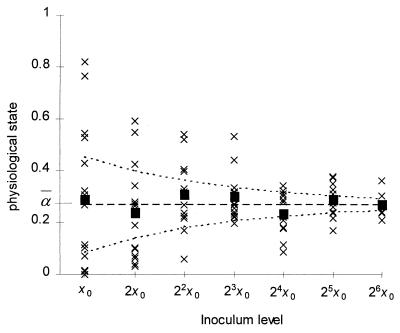
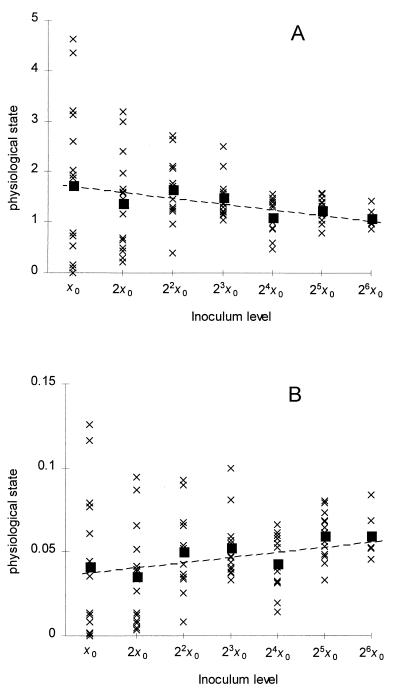
We developed a new numerical method to estimate bacterial growth parameters by means of detection times generated by different initial counts. The observed detection times are subjected to a transformation involving the (unknown) maximum specific growth rate and the (known) ratios between the different inoculum sizes and the constant detectable level of counts. We present an analysis of variance (ANOVA) protocol based on a theoretical result according to which, if the specific rate used for the transformation is correct, the transformed values are scattered around the same mean irrespective of the original inoculum sizes. That mean, termed the physiological state of the inoculum, âlpha, and the maximum specific growth rate, mu, can be estimated by minimizing the variance ratio of the ANOVA procedure. The lag time of the population can be calculated as lambda = -ln âlpha/mu; i.e. the lag is inversely proportional to the maximum specific growth rate and depends on the initial physiological state of the population. The more accurately the cell number at the detection level is known, the better the estimate for the variance of the lag times of the individual cells.
Figures
References
-
- Arseny S K, Kell D B. Do bacteria need to communicate with each other for growth? Trends Microbiol. 1996;4:237–241. - PubMed
-
- Baranyi J, Roberts T A. Mathematics of predictive food microbiology. Int J Food Microbiol. 1995;26:199–218. - PubMed
-
- Baranyi J. Comparison of stochastic and deterministic concepts of bacterial lag. J Theor Biol. 1998;192:403–408. - PubMed
-
- Mackey B M, Derrick C M. Conductance measurements of the lag phase of injured Salmonella typhimurium. J Appl Bacteriol. 1984;57:299–308. - PubMed
-
- McMeekin T A, Olley J N, Ross T, Ratkowsky D A. Predictive microbiology. Chichester, United Kingdom: John Wiley & Sons Ltd.; 1993.
Publication types
MeSH terms
LinkOut - more resources
Full Text Sources
Other Literature Sources
Research Materials
