


Pro- and anti-inflammatory cytokine balance in strenuous exercise in humans
- PMID: 9925898
- PMCID: PMC2269132
- DOI: 10.1111/j.1469-7793.1999.287ad.x
Pro- and anti-inflammatory cytokine balance in strenuous exercise in humans
Abstract
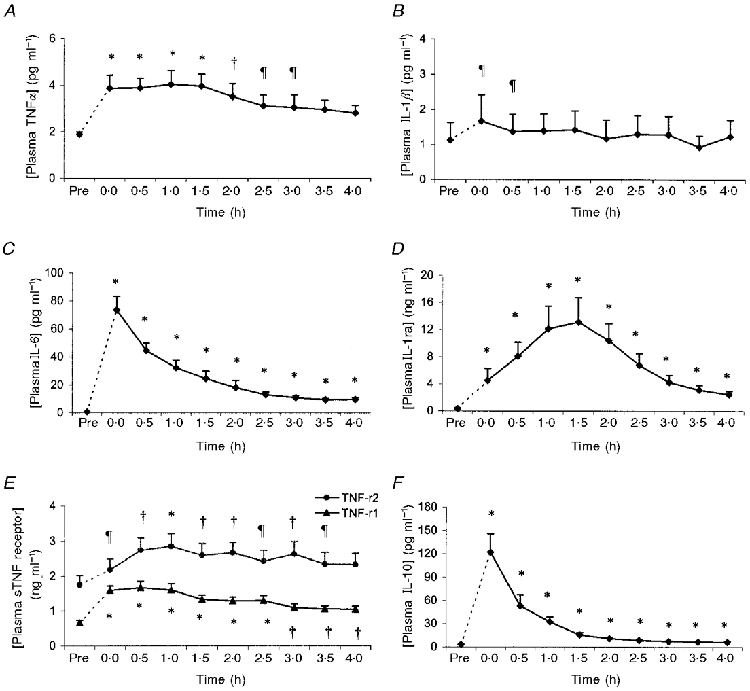
1. The present study investigates to what extent and by which time course prolonged strenuous exercise influences the plasma concentration of pro-inflammatory and inflammation responsive cytokines as well as cytokine inhibitors and anti-inflammatory cytokines. 2. Ten male subjects (median age 27.5 years, range 24-37) completed the Copenhagen Marathon 1997 (median running time 3 : 26 (h : min), range 2 : 40-4 : 20). Blood samples were obtained before, immediately after and then every 30 min in a 4 h post-exercise recovery period. 3. The plasma concentrations of tumour necrosis factor (TNF)alpha, interleukin (IL)-1beta, IL-6, IL-1ra, sTNF-r1, sTNF-r2 and IL-10 were measured by enzyme-linked immunosorbent assay (ELISA). The highest concentration of IL-6 was found immediately after the race, whereas IL-1ra peaked 1 h post exercise (128-fold and 39-fold increase, respectively, as compared with the pre-exercise values). The plasma level of IL-1beta, TNFalpha, sTNF-r1 and sTNF-r2 peaked in the first hour after the exercise (2. 1-, 2.3-, 2.7- and 1.6-fold, respectively). The plasma level of IL-10 showed a 27-fold increase immediately post exercise. 4. In conclusion, strenuous exercise induces an increase in the pro-inflammatory cytokines TNFalpha and IL-1beta and a dramatic increase in the inflammation responsive cytokine IL-6. This is balanced by the release of cytokine inhibitors (IL-1ra, sTNF-r1 and sTNF-r2) and the anti-inflammatory cytokine IL-10. The study suggests that cytokine inhibitors and anti-inflammatory cytokines restrict the magnitude and duration of the inflammatory response to exercise.
Figures
References
-
- Bagby GJ, Crouch LD, Shepherd RE. Exercise and cytokines: Spontaneous and elicited response. In: Hoffman GL, editor. Exercise and Immune function. New York: CRC Press; 1996. pp. 55–78.
-
- Cannon JG, Evans WJ, Hughes VA, Meredith CN, Dinarello CA. Physiological mechanisms contributing to increased interleukin-1 secretion. Journal of Applied Physiology. 1986;61:1869–1874. - PubMed
-
- Cannon JG, Kluger MJ. Endogenous pyrogen activity in human plasma after exercise. Science. 1983;220:617–619. - PubMed
Publication types
MeSH terms
Substances
LinkOut - more resources
Full Text Sources
Other Literature Sources
Medical
