. 1999 Feb 2;96(3):846-51.
doi: 10.1073/pnas.96.3.846.

Mitochondrial disease in superoxide dismutase 2 mutant mice

Affiliations

Mitochondrial disease in superoxide dismutase 2 mutant mice

S Melov et al. Proc Natl Acad Sci U S A. .

Abstract

Oxidative stress has been implicated in many diseases. The chief source of reactive oxygen species within the cell is the mitochondrion. We have characterized a variety of the biochemical and metabolic effects of inactivation of the mouse gene for the mitochondrial superoxide dismutase (CD1-Sod2(tm1Cje)). The Sod2 mutant mice exhibit a tissue-specific inhibition of the respiratory chain enzymes NADH-dehydrogenase (complex I) and succinate dehydrogenase (complex II), inactivation of the tricarboxylic acid cycle enzyme aconitase, development of a urine organic aciduria in conjunction with a partial defect in 3-hydroxy-3-methylglutaryl-CoA lyase, and accumulation of oxidative DNA damage. These results indicate that the increase in mitochondrial reactive oxygen species can result in biochemical aberrations with features reminiscent of mitochondrial myopathy, Friedreich ataxia, and 3-hydroxy-3-methylglutaryl-CoA lyase deficiency.


Figures
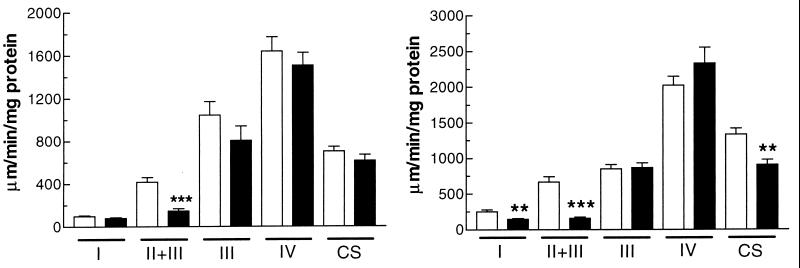
Figure 1
Figure 1
OXPHOS analysis of 4- to 6-day-old Sod2−/− mice vs. controls. Open bars, Sod2+/+ and -±; closed bars, Sod2−/−. Complexes I, II+III, III, and IV and citrate synthase (CS) are shown for mitochondria isolated from skeletal muscle and heart. SEMs are shown. n = 11 for controls; n = 9 for Sod2−/− mice. (a) OXPHOS enzymology from skeletal muscle. (b) OXPHOS enzymology from heart.
Figure 2
Figure 2
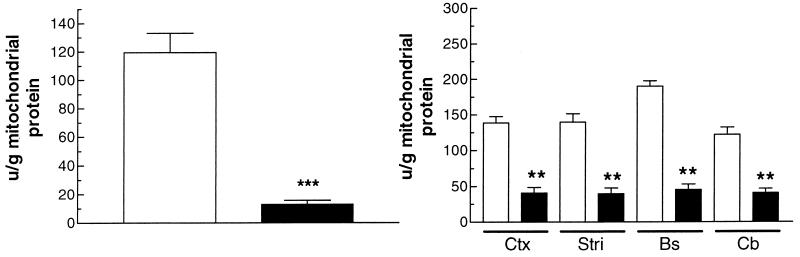
Mitochondrial aconitase activity in isolated mitochondria from heart and different regions of the brain. Open bars, Sod2+/+ and -±; closed bars, Sod2−/−. (a) Mitochondrial aconitase activity in hearts of 4- to 5-day-old mice. n = 13 for control hearts; n = 9 for Sod2−/− hearts. (b) Mitochondrial aconitase activity of brain in 9- to 10-day-old mice. Ctx, Cortex; Str, striatum; Bs, brainstem; Cb, cerebellum. SEMs are shown. n = 5 for controls; n = 6 for Sod2−/−.
Figure 3
Figure 3
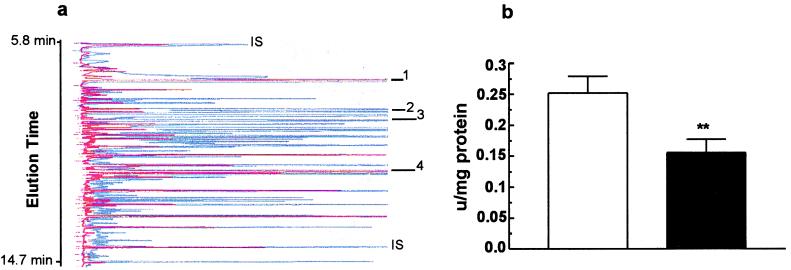
Organic aciduria and HMG-CoA lyase deficiency in Sod2−/− mice. (a) Representative gas chromatogram of a 9-day-old Sod2−/− mouse urine (blue) superimposed on a chromatogram from a 9-day-old control (red). Two of the abnormal metabolites associated with HMG-CoA lyase deficiency are indicated (peaks 2 and 3), and the increased levels of succinic and citric acids are shown (peaks 1 and 4). IS, internal standards; peak 1, succinic acid; peak 2, 3-OH-3-methyl glutaric acid; peak 3, 3-methyl glutaconic acid; peak 4, citric acid. Peak identities were confirmed by MS. (b) HMG-CoA lyase activity in isolated mitochondria from livers of 9- to 10-day-old Sod2−/− mice. n = 5 for Sod2−/− animals (closed bars); n = 6 for wild-type animals (open bars).
Figure 4
Figure 4
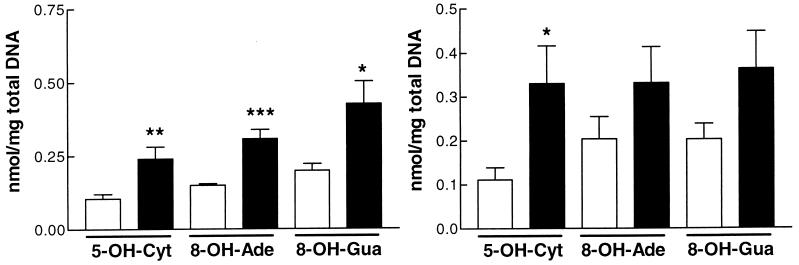
Levels of modified DNA bases in total DNA from brain and hearts of Sod2−/− mice. Open bars, Sod2+/+ and ±; closed bars, Sod2−/−. (a) Modified bases in heart of Sod2−/− mice. n = 6 for control and mutant brains. (b) Modified bases in brain of Sod2−/− mice. n = 6 for controls; n = 7 for mutants.

References

    1. Boveris A. Methods Enzymol. 1984;105:429–435. - PubMed
    1. Chance B, Sies H, Boveris A. Physiol Rev. 1979;59:527–605. - PubMed
    1. Turrens J F, Boveris A. Biochem J. 1980;191:421–427. - PMC - PubMed
    1. Turrens J F, Alexandre A, Lehninger A L. Arch Biochem Biophys. 1985;237:408–414. - PubMed
    1. Hansford R G, Hogue B A, Mildaziene V. J Bioenerg Biomembr. 1997;29:89–95. - PubMed

Publication types

MeSH terms