. 1999 Feb 2;96(3):1152-6.
doi: 10.1073/pnas.96.3.1152.

The relationship between the volume of antimicrobial consumption in human communities and the frequency of resistance

Affiliations

The relationship between the volume of antimicrobial consumption in human communities and the frequency of resistance

D J Austin et al. Proc Natl Acad Sci U S A. .

Abstract

The threat to human health posed by antibiotic resistance is of growing concern. Many commensal and pathogenic organisms have developed resistance to well established and newer antibiotics. The major selection pressure driving changes in the frequency of antibiotic resistance is the volume of drug use. However, establishing a quantitative relationship between the frequency of resistance and volume of drug use has proved difficult. Using population genetic methods and epidemiological observations, we report an analysis of the influence of the selective pressure imposed by the volume of drug use on temporal changes in resistance. Analytical expressions are derived to delineate key relationships between resistance and drug consumption. The analyses indicate that the time scale for emergence of resistance under a constant selective pressure is typically much shorter than the decay time after cessation or decline in the volume of drug use and that significant reductions in resistance require equally significant reductions in drug consumption. These results highlight the need for early intervention once resistance is detected.


Figures
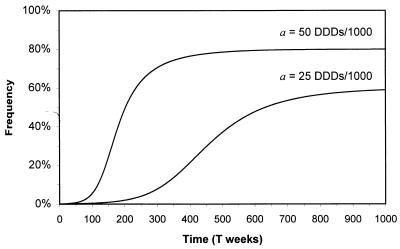
Figure 1
Figure 1
Change in the frequency of resistance pt after frequency-dependent selection in which antibiotic consumption falls as resistance rises (w𝒮(qt) = 1 − aqt, w = 0.99, and p0 = 10−3).
Figure 2
Figure 2
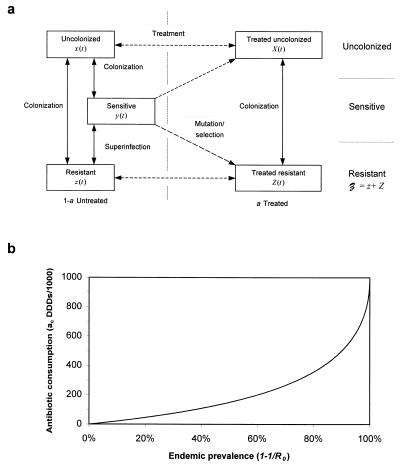
(a) Theoretical model of bacterial colonization and antibiotic consumption. Individuals may be uncolonized (x and X), colonized with sensitive bacteria (y), or colonized with resistant bacteria (𝒵 = z + Z), x + X + y + 𝒵 = 1 (10). Antibiotic treatment is independent of colonization, and a proportion a of individuals receive treatment at any time. Treatment either clears sensitive bacteria with a probability 1 − σ or selects for mutations or preexisting resistant strains. (b) Threshold antibiotic consumption, ac, required for eradication of a commensal with endemic prevalence 1 − 1/R0. Highly prevalent commensals require sustained antibiotic consumption for eradication.
Figure 3
Figure 3
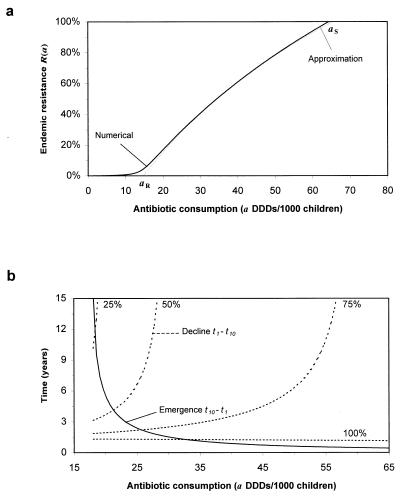
(a) Endemic resistance as a function of antibiotic consumption ℛ(a). Below the threshold a, transmission of resistant strains cannot become established. Above the threshold a𝒮, sensitive strains are eradicated. Mutation/selection maintains resistant strains below the threshold a, although transmission is not possible (σ = 10−2). (b) Time taken for resistance to increase from 1–10% (solid line) and fall again after instantaneous reductions in antibiotic consumption of 25, 50, 75 and 100%. Emergence is typically more rapid than decline, highlighting the need for early intervention. Parameters are estimated from the Finland study and are given in Table 1.
Figure 4
Figure 4
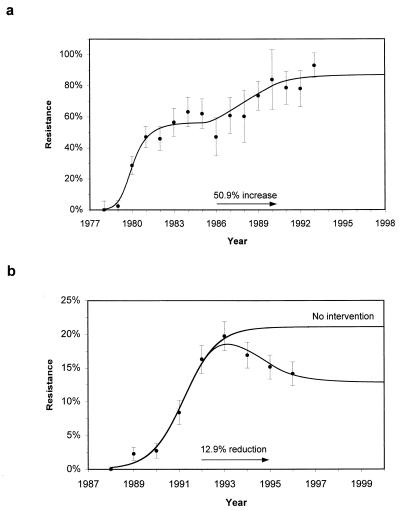
(a) Prediction of a two-step rise in the frequency of β-lactamase-producing isolates of M. catarrhalis from children aged <6 years in Finland. (b) Prediction of a rise and subsequent decline in the frequency of penicillin-resistant pneumococcal isolates carried by children aged <7 years in Iceland. Prompt intervention has substantially reduced the likely endemic level of resistance. All parameters used are given in Table 1. Error bars show 95% confidence intervals for the observed data.

Comment in

References

    1. Cohen M L. Science. 1992;257:1050–1055. - PubMed
    1. Neu H C. Science. 1992;237:1064–1073. - PubMed
    1. Greenwood D. Lancet. 1995;345:1371. - PubMed
    1. Tenover F C, McGowan J E., Jr Am J Med Sci. 1996;311:9–16. - PubMed
    1. Tabaqchali S. Lancet. 1997;350:1644–1645. - PubMed

Publication types

Substances