National cross sectional study of detection of congenital and infantile cataract in the United Kingdom: role of childhood screening and surveillance. The British Congenital Cataract Interest Group
- PMID: 9933197
- PMCID: PMC27722
- DOI: 10.1136/bmj.318.7180.362
National cross sectional study of detection of congenital and infantile cataract in the United Kingdom: role of childhood screening and surveillance. The British Congenital Cataract Interest Group
Abstract
Objectives: To determine the mode of detection and timing of ophthalmic assessment of a nationally representative group of children with congenital and infantile cataract.
Design: Cross sectional study.
Setting: United Kingdom.
Subjects: All children born in the United Kingdom and aged 15 years or under in whom congenital or infantile cataract was newly diagnosed between October 1995 and September 1996.
Main outcome measures: Proportion of cases detected through routine ocular examination and proportion assessed by an ophthalmologist by 3 months and 1 year of age.
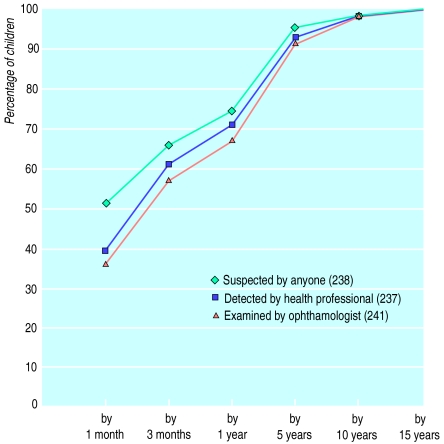
Results: Data were complete for 235 (95%) of 248 children identified. Of these, 83 (35%) were detected at the routine newborn examination and 30 (12%) at the 6-8 week examination; 82 children presented symptomatically. 137 (57%) children had been assessed by an ophthalmologist by the age of 3 months but 78 (33%) were not examined until after 1 year of age. In 91 cases the child's carers suspected an eye defect before cataract was diagnosed.
Conclusions: A substantial proportion of children with congenital and infantile cataract are not diagnosed by 3 months of age, although routine ocular examination of all newborn and young infants is recommended nationally. Strategies to achieve earlier detection through screening and surveillance are required.
Figures
References
-
- Foster A, Gilbert C. Epidemiology of visual impairment in children. In: Taylor D, editor. Paediatric ophthalmology. 2nd ed. London: Blackwell Science; 1997. pp. 3–12.
-
- Taylor D. Congenital cataract: the history, the nature and the practice. The Doyne lecture. Eye. 1998;12:9–36. - PubMed
-
- Taylor D. Developments in the treatment of cataract. Trans Ophthalmol Soc UK. 1982;102:441–452. - PubMed
-
- Campos E. Amblyopia. Surv Ophthalmol. 1995;40:23–39. - PubMed
MeSH terms
LinkOut - more resources
Full Text Sources
Medical