. 1999 Mar;73(3):2442-9.
doi: 10.1128/JVI.73.3.2442-2449.1999.

Interclass transmission and phyletic host tracking in murine leukemia virus-related retroviruses

Affiliations

Interclass transmission and phyletic host tracking in murine leukemia virus-related retroviruses

J Martin et al. J Virol. 1999 Mar.

Abstract

Retroviruses are capable of infectious horizontal transmission between hosts, usually between individuals within a single species, although a number of probable zoonotic infections resulting from transmission between different species of placental mammals have also been reported. Despite these data, it remains unclear how often interspecies transmission events occur or whether their frequency is influenced by the evolutionary distance between host taxa. To address this problem we used PCR to amplify and characterize endogenous retroviruses related to the murine leukemia viruses. We show that members of this retroviral genus are harbored by considerably more organisms than previously thought and that phylogenetic analysis demonstrates that viruses isolated from a particular host class generally cluster together, suggesting that infectious virus horizontal transfer between vertebrate classes occurs only rarely. However, two recent instances of transmission of zoonotic infections between distantly related host organisms were identified. One, from mammals to birds, has led to a rapid adaptive radiation into other avian hosts. The other, between placental and marsupial mammals, involves viruses clustering with recently described porcine retroviruses, adding to concerns regarding the xenotransplantation of pig organs to humans.


Figures

FIG. 1
FIG. 1
Multiple alignment of a representative sample of the MLV-related viruses used in subsequent phylogenetic analyses. The values in brackets are the numbers of amino acid residues omitted from the alignment. Asterisks represent stop codons, whereas question marks indicate missing data (due either to postinsertion deletion events or, in the cases of RV Rh. caecilian, RV Natterjack toad, and RV Pit viper, to the use of alternative oligonucleotide primers in the amplification reactions). Rh., rhinatrematid.
FIG. 2
FIG. 2
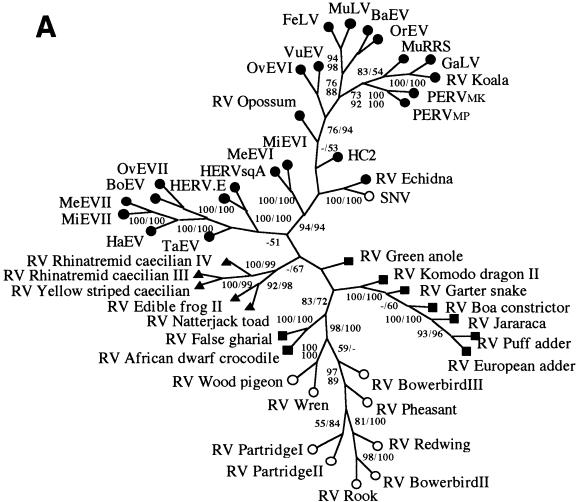
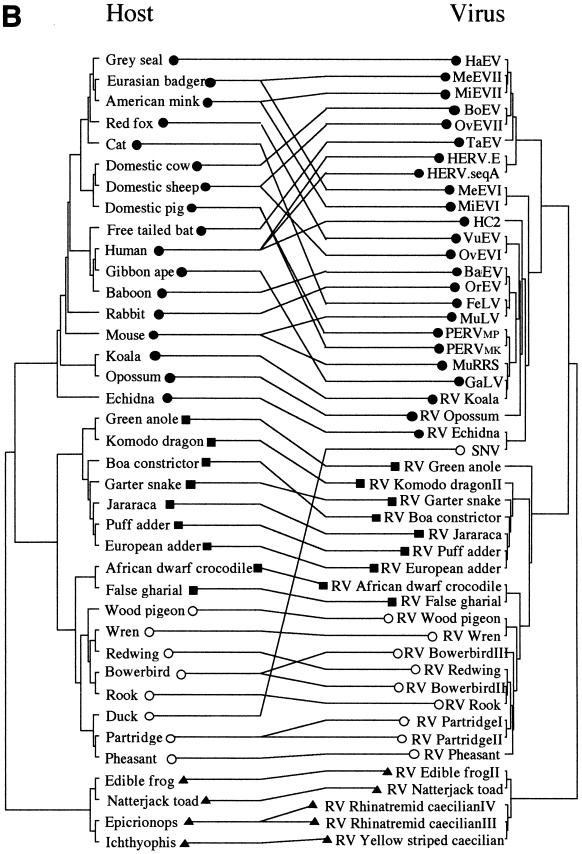
(A) Unrooted maximum-parsimony tree based on a 280-amino-acid region of retroviral protease and reverse transcriptase proteins. Symbols on each terminal branch represent the host class from which the virus was isolated, as follows: ●, mammals; ○, birds; ■, reptiles; ▴, amphibians. The values on each branch represent percentage bootstrap support determined by using the maximum-parsimony (to the left or top) and neighbor-joining (to the right or bottom) approaches. (B) Virus versus host species phylogeny. The viral phylogeny is the same as that shown in panel A; the host phylogeny was derived from the literature. OvEV, ovine endogenous retrovirus; BoEV, bovine endogenous retrovirus; MiEV, mink endogenous retrovirus; MeEV, Meles endogenous retrovirus; VuEV, Vulpes endogenous retrovirus; FeLV, feline leukemia retrovirus; HaEV, Halichoerus endogenous retrovirus; TaEV, Tadarida endogenous retrovirus; BaEV, baboon endogenous retrovirus; OrEV, Oryctolagus endogenous retrovirus; and HC2, HERV HC2.
FIG. 2
FIG. 2
(A) Unrooted maximum-parsimony tree based on a 280-amino-acid region of retroviral protease and reverse transcriptase proteins. Symbols on each terminal branch represent the host class from which the virus was isolated, as follows: ●, mammals; ○, birds; ■, reptiles; ▴, amphibians. The values on each branch represent percentage bootstrap support determined by using the maximum-parsimony (to the left or top) and neighbor-joining (to the right or bottom) approaches. (B) Virus versus host species phylogeny. The viral phylogeny is the same as that shown in panel A; the host phylogeny was derived from the literature. OvEV, ovine endogenous retrovirus; BoEV, bovine endogenous retrovirus; MiEV, mink endogenous retrovirus; MeEV, Meles endogenous retrovirus; VuEV, Vulpes endogenous retrovirus; FeLV, feline leukemia retrovirus; HaEV, Halichoerus endogenous retrovirus; TaEV, Tadarida endogenous retrovirus; BaEV, baboon endogenous retrovirus; OrEV, Oryctolagus endogenous retrovirus; and HC2, HERV HC2.
FIG. 3
FIG. 3
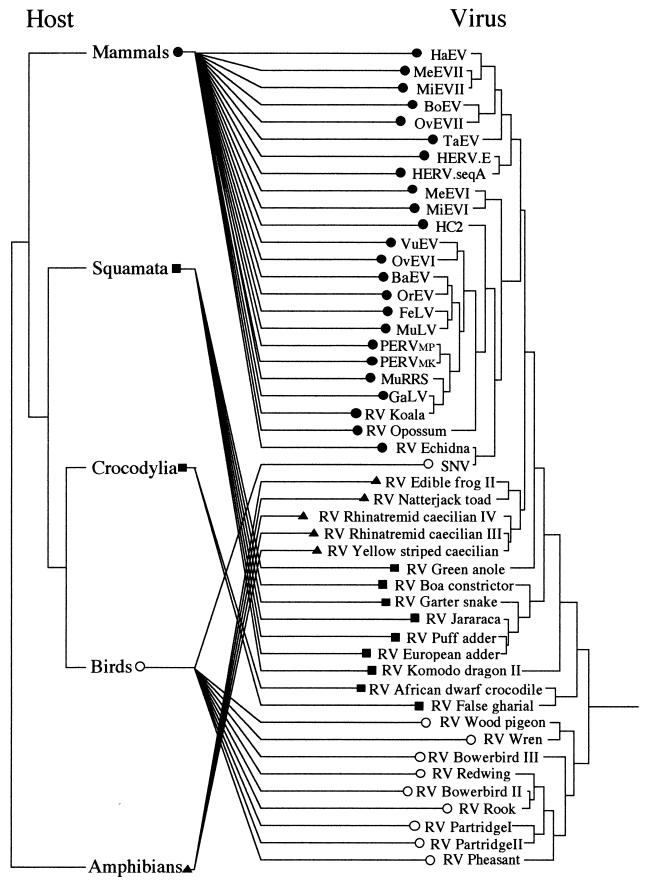
Rooted virus versus host class phylogeny. A viral tree like that shown in Fig. 2 but with the addition of a number of other retroviral sequences for rooting purposes was generated. Symbols represent host classes as described in the legend for Fig. 2. Viral branch lengths are proportional to the degree of divergence between the sequences. Abbreviations are as defined in the legend for Fig. 2.
FIG. 4
FIG. 4
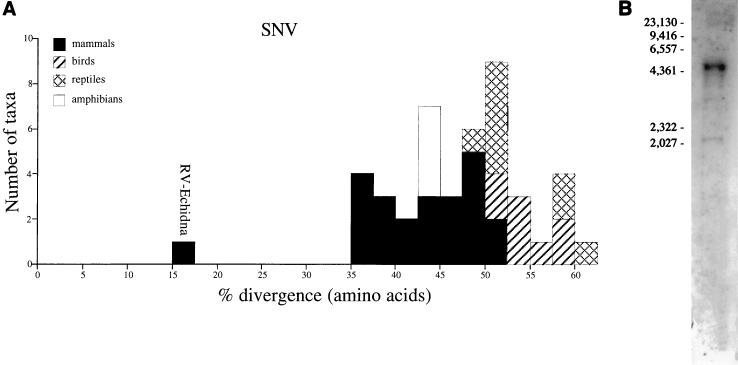
(A) Bar chart showing the percentage of amino acid divergence between SNV and other retroviral sequences, calculated from the same regions as were used for phylogenetic reconstruction. (B) Southern hybridization of EcoRI-digested genomic DNA of short-beaked echidna performed by using RV Echidna as the probe. The filter was hybridized overnight at 65°C and washed with 0.5% sodium dodecyl sulfate–0.5× SSC (1× SSC is 0.15 M NaCl plus 0.015 M sodium citrate) at 63°C. Marker sizes are expressed in kilobase pairs.
FIG. 5
FIG. 5
(A) RV Koala compared with other MLV-related viruses, highlighting the position of the pig endogenous isolates PERVMP and PERVMK. Percentage identity was calculated as described for Fig. 4A. (B) Southern hybridization of BglII-digested koala genomic DNA performed by using RV Koala as the probe. The filter was hybridized by using Church and Gilbert buffer at 55°C and washed down to 1× SSC–0.1% sodium dodecyl sulfate, also at 55°C. Marker sizes are expressed in kilobase pairs. Negative results were obtained after hybridization to the following eight additional marsupial and monotreme species: stripe faced dunnart (Sminthopsis macroura), tammar (Macropus eugenii), Godman’s Rock wallaby (Petrogale godmani), common brushtail possum (Trichosaurus vulpecula), brindled bandicoot (Isoodon macrourus), opossum (Monodelphis sp.), short-beaked echidna (Tachyglossus aculeatus), and platypus (Ornithorhynchus anatinus) (unpublished data).

References

    1. Bach F H, Fishman J A, Daniels N, Proimos J, Anderson B, Carpenter C B, Forrow L, Robson S C, Fineberg H V. Uncertainty in xenotransplantation: individual benefit versus collective risk. Nat Med. 1998;4:141–142. - PubMed
    1. Baltimore D. RNA-dependent DNA polymerase in virions of RNA tumor viruses. Nature. 1970;226:1209–1211. - PubMed
    1. Benveniste R E, Todaro G J. Evolution of C-type viral genes: inheritance of exogenously acquired viral genes. Nature. 1974;252:456–459. - PubMed
    1. Canfield P J, Brown A S, Kelly W R, Sutton R H. Spontaneous lymphoid neoplasia in the koala (Phascolarctos cinereus) J Comp Pathol. 1987;97:171–178. - PubMed
    1. Canfield P J, Sabine J M, Love D N. Virus particles associated with leukaemia in a koala. Aust Vet J. 1988;65:327–328. - PubMed

Publication types

MeSH terms

Associated data

LinkOut - more resources