


The virulence plasmid of Salmonella typhimurium is self-transmissible
- PMID: 9973370
- PMCID: PMC93521
- DOI: 10.1128/JB.181.4.1364-1368.1999
The virulence plasmid of Salmonella typhimurium is self-transmissible
Abstract
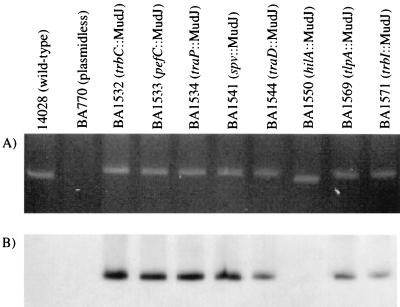
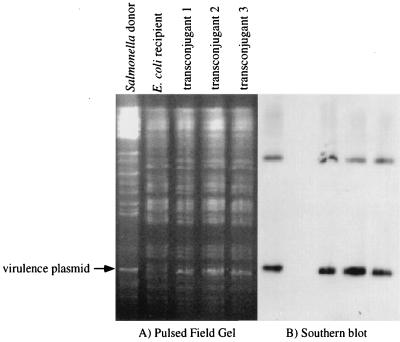
Most isolates of Salmonella enterica serovar Typhimurium contain a 90-kb virulence plasmid. This plasmid is reported to be mobilizable but nonconjugative. However, we have determined that the virulence plasmid of strains LT2, 14028, and SR-11 is indeed self-transmissible. The plasmid of strain SL1344 is not. Optimal conjugation frequency requires filter matings on M9 minimal glucose plates with a recipient strain lacking the virulence plasmid. These conditions result in a frequency of 2.9 x 10(-4) transconjugants/donor. Matings on Luria-Bertani plates, liquid matings, or matings with a recipient strain carrying the virulence plasmid reduce the efficiency by up to 400-fold. Homologs of the F plasmid conjugation genes are physically located on the virulence plasmid and are required for the conjugative phenotype.
Figures
References
-
- Ahmer B M M, van Reeuwijk J, Watson P R, Wallis T S, Heffron F. Salmonella SirA is a global regulator of genes mediating enteropathogenesis. Mol Microbiol. 1999;31:971–982. - PubMed
Publication types
MeSH terms
Grants and funding
LinkOut - more resources
Full Text Sources
Molecular Biology Databases
Research Materials
