


TechLab and alexon Giardia enzyme-linked immunosorbent assay kits detect cyst wall protein 1
- PMID: 9986821
- PMCID: PMC84490
- DOI: 10.1128/JCM.37.3.611-614.1999
TechLab and alexon Giardia enzyme-linked immunosorbent assay kits detect cyst wall protein 1
Abstract
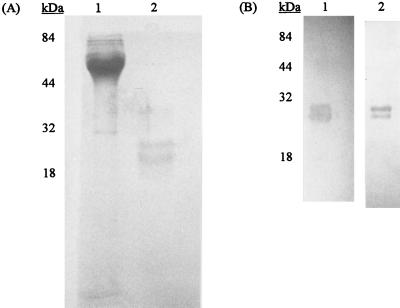
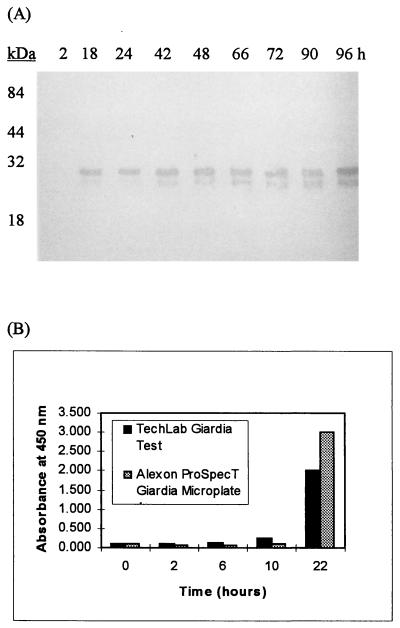
A Giardia lamblia antigen detected by the TechLab Giardia Test (TechLab, Inc., Blacksburg, Va.) and the Alexon ProSpecT Giardia microplate assay (Alexon, Inc., Sunnyvale, Calif.) was purified by immunoaffinity chromatography from supernatant fluids of encystment cultures. Two major proteins (Mr 22,000 and 26,000) were observed by sodium dodecyl sulfate-polyacrylamide gel electrophoresis and Coomassie staining that did not resemble the GSA65 antigen reportedly detected by the Alexon test. These proteins reacted intensely with the monoclonal antibodies used in both commercial enzyme-linked immunosorbent assays (ELISAs). Both proteins had identical N-terminal amino acid sequences and were identified as cyst wall protein 1 (CWP1). The 26-kDa form appeared early during encystment followed by the appearance of the 22-kDa form. Recombinant CWP1 (Mr 26,000) was strongly positive in both commercial tests. CWP1 was stable in human stool specimens, resistant to degradation by proteases and N- and O-glycanases, and unaffected by oxidation with sodium periodate. Two minor proteins with Mrs of 32,000 and 39,000 were detected in CWP1 preparations by using a sensitive fluorescent protein stain. Both were identified as CWP2, and neither reacted with the monoclonal antibodies from the commercial tests. We analyzed 535 stool specimens for CWP1 by using both commercial ELISAs and resolved discrepant results by using routine ova and parasite examination (O&P) and on immunofluorescence antibody assay. The presence of CWP1 correlated well between both ELISAs (98.7% correlation). Our results demonstrate that both commercial ELISAs detect CWP1, which is a useful diagnostic marker because it is highly stable, is secreted in large amounts by encysting trophozoites, and correlates well with O&P.
Figures
References
-
- Bradford M M. A rapid and sensitive method for the quantitation of microgram quantities of protein utilizing the principle of protein-dye binding. Anal Biochem. 1976;72:248–254. - PubMed
-
- Campbell J D, Faubert G M. Recognition of Giardia lamblia cyst-specific antigens by monoclonal antibodies. Parasite Immunol. 1994;16:211–219. - PubMed
-
- Charney J, Tomarelli R M. A colorimetric method for the determination of the proteolytic activity of duodenal juice. J Biol Chem. 1947;171:501–505. - PubMed
-
- Erlandsen S L, Macechko P T, Van Keulen H, Jarroll E L. Formation of the Giardia cyst wall: studies on extracellular assembly using immunogold labeling and high resolution field emission SEM. J Eukaryot Microbiol. 1996;43:416–429. - PubMed
-
- Garcia L S, Bruckner D. Diagnostic medical parasitology. Washington, D.C: American Society for Microbiology; 1993. pp. 31–48.
Publication types
MeSH terms
Substances
LinkOut - more resources
Full Text Sources
Other Literature Sources
Medical
Research Materials
