


Application of pbp1A PCR in identification of penicillin-resistant Streptococcus pneumoniae
- PMID: 9986824
- PMCID: PMC84499
- DOI: 10.1128/JCM.37.3.628-632.1999
Application of pbp1A PCR in identification of penicillin-resistant Streptococcus pneumoniae
Abstract
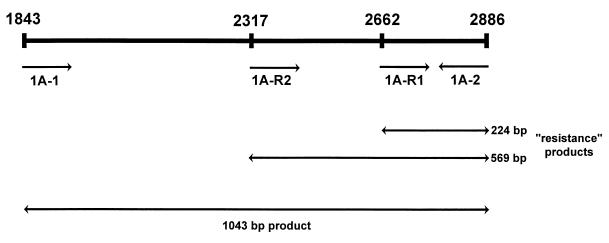
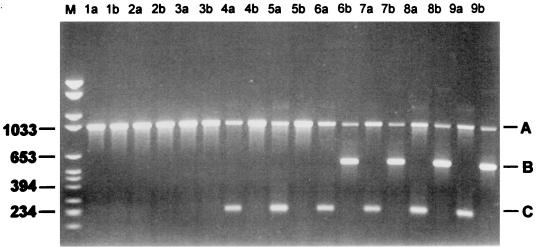
A seminested PCR assay, based on the amplification of the pneumococcal pbp1A gene, was developed for the detection of penicillin resistance in clinical isolates of Streptococcus pneumoniae. The assay was able to differentiate between intermediate (MICs = 0.25 to 0.5 microgram/ml) and higher-level (MICs = >/=1 microgram/ml) resistance. Two species-specific primers, 1A-1 and 1A-2, which amplified a 1,043-bp region of the pbp1A penicillin-binding region, were used for pneumococcal detection. Two resistance primers, 1A-R1 and 1A-R2, were designed to bind to altered areas of the pbp1A gene which, together with the downstream primer 1A-2, amplify DNA from isolates with penicillin MICs of >/=0.25 and >/=1 microgram/ml, respectively. A total of 183 clinical isolates were tested with the pbp1A assay. For 98.3% (180 of 183) of these isolates, the PCR results obtained were in agreement with the MIC data. The positive and negative predictive values of the assay were 100 and 91%, respectively, for detecting strains for which the MICs were >/=0.25 microgram/ml and were both 100% for strains for which the MICs were >/=1 microgram/ml.
Figures
References
-
- Barcus V A, Ghanekar K, Yeo M, Coffey T J, Dowson C G. Genetics of high-level penicillin resistance in clinical isolates of Streptococcus pneumoniae. FEMS Microbiol Lett. 1995;126:299–304. - PubMed
-
- Chalkley L J, Koornhof H J. Intra- and interspecific transformation of S. pneumoniae to penicillin resistance. J Antimicrob Chemother. 1990;26:21–28. - PubMed
-
- Coffey T J, Dowson C G, Daniels M, Spratt B G. Genetics and molecular biology of β-lactam-resistant pneumococci. Microb Drug Resist. 1995;1:29–34. - PubMed
MeSH terms
Substances
LinkOut - more resources
Full Text Sources
Other Literature Sources
