. 1999 Feb 16;96(4):1433-8.
doi: 10.1073/pnas.96.4.1433.

Identification of the cyclin D1 gene as a target of activating transcription factor 2 in chondrocytes

Affiliations

Identification of the cyclin D1 gene as a target of activating transcription factor 2 in chondrocytes

F Beier et al. Proc Natl Acad Sci U S A. .

Abstract

Endochondral bone growth is regulated by the rates of chondrocyte proliferation and differentiation. However, the intracellular mechanisms regulating these processes are poorly understood. Recently, interruption of the gene encoding the transcription factor activating transcription factor 2 (ATF-2) was shown to inhibit proliferation of chondrocytes in mice [Reimold, A. M., et al. (1996) Nature (London) 379, 262-265]. The target genes of ATF-2 that are responsible for this phenotype remain unknown. Here we report that the cyclin D1 gene is a direct target of ATF-2 in chondrocytes. ATF-2 is present in nuclear extracts from chondrogenic cell lines and binds, as a complex with a CRE-binding protein (CREB)/CRE modulator protein, to the cAMP response element (CRE) in the cyclin D1 promoter. Mutation of the cyclin D1 CRE caused a 78% reduction in the activity of the promoter in chondrocytes. Overexpression of ATF-2 in chondrocytes enhanced activity of the cyclin D1 promoter 3. 5-fold. In contrast, inhibition of endogenous ATF-2 or CREB by expression of dominant-negative inhibitors of CREB and ATF-2 significantly reduced the activity of the promoter in chondrocytes through the CRE. In addition, levels of cyclin D1 protein are greatly reduced in the chondrocytes of ATF-2-deficient mice. These data identify the cyclin D1 gene as a direct target of ATF-2 in chondrocytes and suggest that reduced expression of cyclin D1 contributes to the defective cartilage development of these mice.


Figures
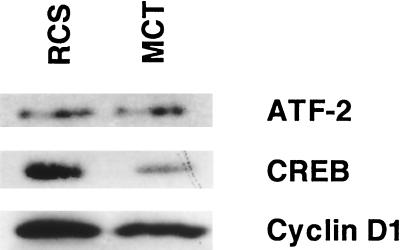
Figure 1
Figure 1
ATF-2, CREB, and cyclin D1 are coexpressed in chondrocytes. Expression of ATF-2, CREB, and cyclin D1 was examined in RCS and MCT cells with Western blot analyses and specific antibodies. All three proteins were expressed in both cell types.
Figure 2
Figure 2
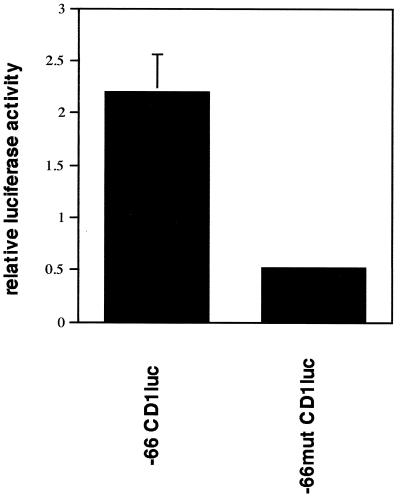
The CRE is necessary for the activity of the cyclin D1 promoter in chondrocytes. MCT cells were transiently transfected with −66CD1LUC (wild-type promoter) or −66 mut CD1LUC (containing a mutated CRE) and pRlSV40 (for standardization). after transfection (30 h), cells were harvested, firefly luciferase activity was measured, and standardized to Renilla luciferase activity to yield the relative luciferase activity. −66 mut CD1LUC conferred 22% of the activity of −66 CD1LUC.
Figure 3
Figure 3
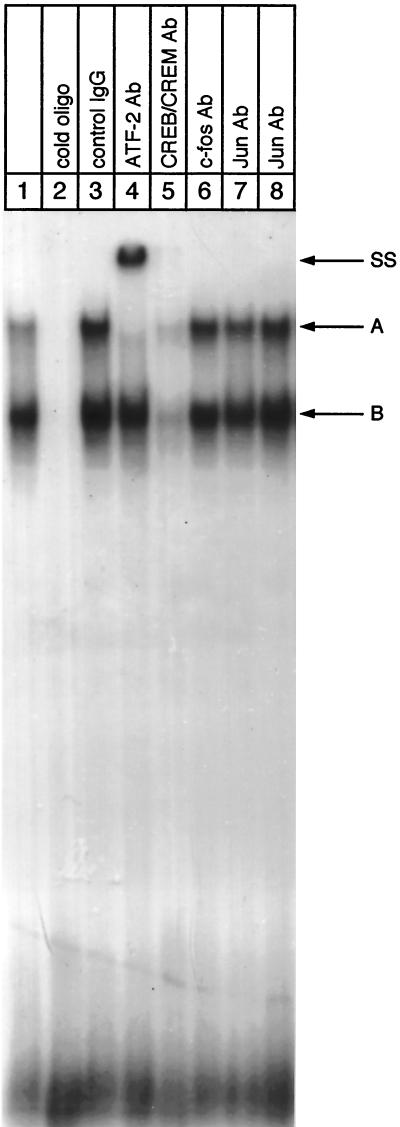
ATF-2 and a CREB/CREM protein bind to the cyclin D1 CRE in chondrocytes. Nuclear extracts from MCT cells were incubated with 32P-labeled double-stranded oligonucleotides corresponding to the cyclin D1 CRE sequence. The resulting complexes (lane 1) could be blocked by a 100-fold excess of unlabeled CRE oligonucleotides (lane 2). Incubation of extracts with an unrelated oligonucleotide did not produce a complex (data not shown). Addition of an ATF-2 antibody (lane 4) resulted in slower migration of the upper complex (ss, supershift), whereas incubation with a CREB/CREM antiserum (lane 5) reduced the abundance of both complexes. Addition of control IgG (lane 3) or antibodies (Ab) against c-Fos (lane 6) or different Jun proteins (lanes 7 and 8) did not affect the formation or migration of the complexes.
Figure 4
Figure 4
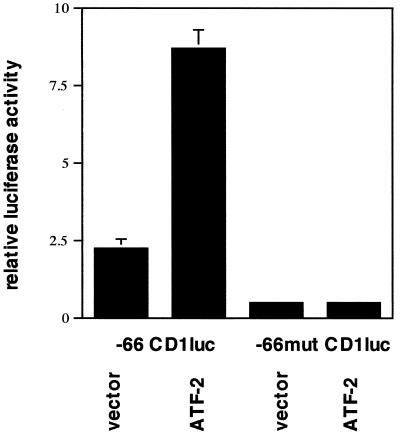
Overexpression of ATF-2 increases the activity of the cyclin D1 CRE. MCT cells were cotransfected with −66CD1LUC or −66 mut CD1LUC, either empty expression vector or an expression vector for ATF-2, and pRlSV40. After transfection (30 h), cells were harvested, and firefly luciferase activity was measured and standardized to Renilla luciferase activity to yield the relative luciferase activity. Overexpression of ATF-2 increases the activity of −66 CD1LUC 3.5-fold, whereas it had no effect on the activity of −66 mut CD1LUC.
Figure 5
Figure 5
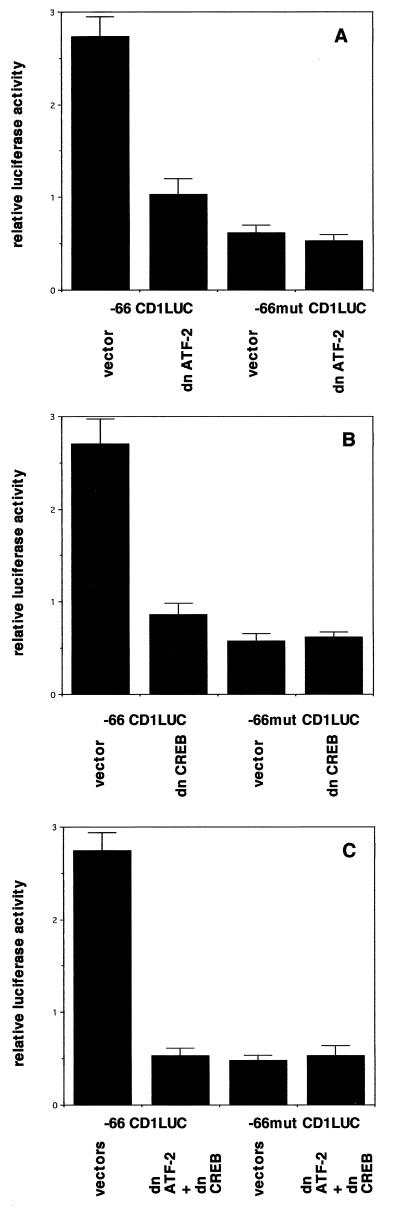
ATF-2 and CREB activity are necessary for the activity of the cyclin D1 CRE in chondrocytes. MCT cells were cotransfected with −66CD1LUC or −66 mut CD1LUC, either empty expression vector or expression vectors for dominant-negative ATF-2 (a), dominant-negative CREB (b), or both (c), and pRlSV40. After transfection (30 h), cells were harvested, and firefly luciferase activity was measured and standardized to Renilla luciferase activity to yield the relative luciferase activity. Dominant-negative ATF-2 or CREB alone reduced the activity of −66 CD1LUC 2.5- to 3.5-fold; in combination, they reduced the activity to the levels of −66 mut CD1LUC. The activity of −66 mut CD1LUC was not affected by either dominant-negative expression vector.
Figure 6
Figure 6
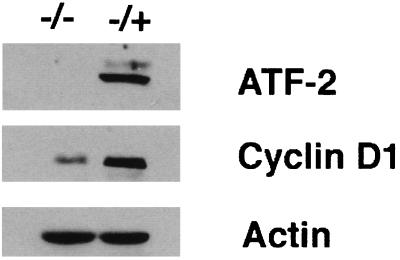
Cyclin D1 protein levels are reduced in ATF-2-deficient chondrocytes. Total protein from chondrocytes isolated from heterozygous (−/+) or homozygous (−/−) ATF-2-deficent mice were analyzed by Western blot. As expected, chondrocytes from −/− mice do not express ATF-2, in contrast to −/+ chondrocytes. The level of cyclin D1 is greatly reduced in homozygote mice. Loading of equal amounts of protein was demonstrated with an anti-actin antibody.

References

    1. Mundlos S, Olsen B R. FASEB J. 1997;11:227–233. - PubMed
    1. Mundlos S, Olsen B R. FASEB J. 1997;11:125–132. - PubMed
    1. Reimold A M, Grusby M J, Kosaras B, Fries J W V, Mori R, Maniwa S, Clauss I M, Collins T, Sidman R L, Glimcher M J, et al. Nature (London) 1996;379:262–265. - PubMed
    1. Maekawa T, Sakura H, Kanei-Ishii C, Sudo T, Yoshimura T, Fujisawa J-I, Yoshida M, Ishii S. EMBO J. 1989;8:2023–2028. - PMC - PubMed
    1. Landshultz W H, Johnson P F, McKnight S L. Science. 1988;240:1759–1764. - PubMed

Publication types

MeSH terms