. 1999 Feb 16;96(4):1480-5.
doi: 10.1073/pnas.96.4.1480.

The Arabidopsis thaliana proton transporters, AtNhx1 and Avp1, can function in cation detoxification in yeast

Affiliations

The Arabidopsis thaliana proton transporters, AtNhx1 and Avp1, can function in cation detoxification in yeast

R A Gaxiola et al. Proc Natl Acad Sci U S A. .

Abstract

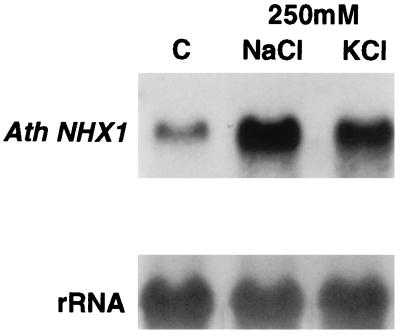
Overexpression of the Arabidopsis thaliana vacuolar H+-pyrophosphatase (AVP1) confers salt tolerance to the salt-sensitive ena1 mutant of Saccharomyces cerevisiae. Suppression of salt sensitivity requires two ion transporters, the Gef1 Cl- channel and the Nhx1 Na+/H+ exchanger. These two proteins colocalize to the prevacuolar compartment of yeast and are thought to be required for optimal acidification of this compartment. Overexpression of AtNHX1, the plant homologue of the yeast Na+/H+ exchanger, suppresses some of the mutant phenotypes of the yeast nhx1 mutant. Moreover, the level of AtNHX1 mRNA in Arabidopsis is increased in the presence of NaCl. The regulation of AtNHX1 by NaCl and the ability of the plant gene to suppress the yeast nhx1 mutant suggest that the mechanism by which cations are detoxified in yeast and plants may be similar.


Figures
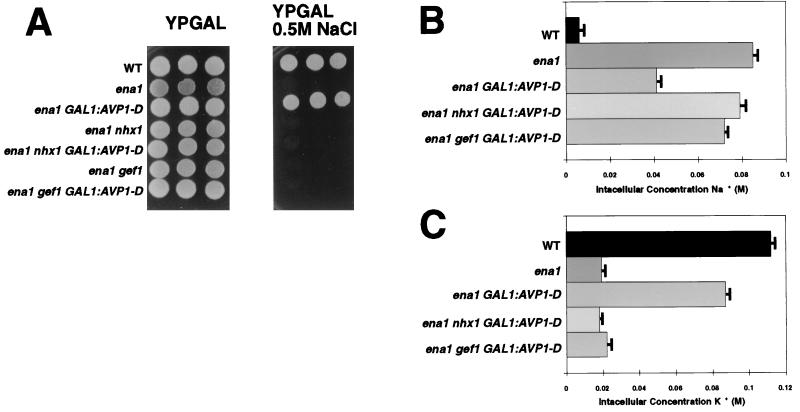
Figure 1
Figure 1
Expression of Arabidopsis vacuolar pyrophosphatase AVP1 in ena1 mutants. (A) Vector pYES2 (Invitrogen) was introduced into wild-type, ena1, ena1 nhx1, and ena1 gef1 mutants. Plasmid pYes2-AVP1-D (13) was introduced into ena1, ena1 nhx1, and ena1 gef1 mutants. Five-fold serial dilutions (starting at 105 cells) of each strain were plated on YPGAL (1% yeast extract/2% peptone/2% galactose) with or without 0.5 M NaCl and incubated at 30°C for 2 days. (B and C) Intracellular concentrations of Na+ and K+. Exponentially growing cells (wild-type and ena1 transformed with pYES2 vector and ena1,ena1 nhx1, and ena1 gef1 mutants carrying pYes2-AVP1-D) were exposed to 0.7 M NaCl for 6 h. Total cell extracts were prepared (see Materials and Methods), and Na+ and K+ concentrations were determined. Values are the mean of two determinations, and bars represent the standard deviations. There is a consistent reduction in total cell Na+ in the ena1 AVP-D strain. The reason for this reduction is unknown.
Figure 2
Figure 2
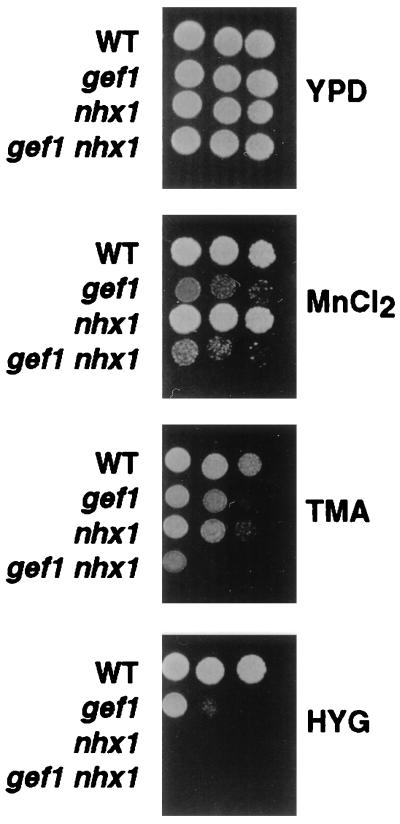
Growth of gef1 and nhx1 mutants in the presence of toxic cations. Five-fold serial dilutions (starting at 105 cells) of the indicated strains were grown at 30°C for 2 days on YPD (1% yeast extract/2% peptone/2% dextrose) with the addition of either 3 mM MnCl2, 0.45 M tetramethylammonium (TMA), or 0.05 mg/ml hygromycin B (HYG) as indicated.
Figure 3
Figure 3
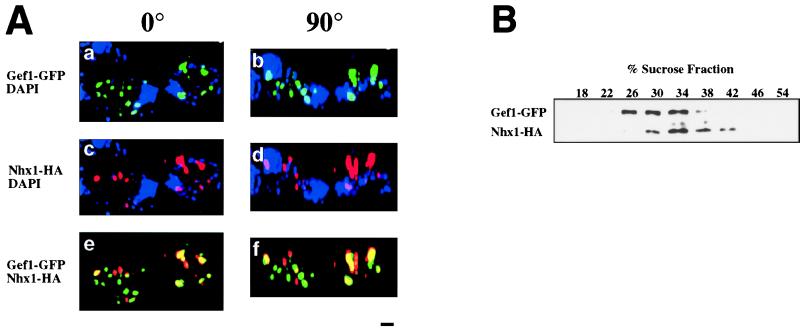
Distribution of fluorescence and immunodetection of subcellular fractions in gef1 nhx1 cells transformed with two constructs: a GEF1-GFP fusion and a NHX1-(HA)3-tagged fusion. (A) The strain RGY419 (gef1 nhx1) was transformed with plasmids pRG151; GEF1-GFP and pRIN73; NHX1-(HA)3. Transformants were grown in SD (Difco; synthetic medium with 2% dextrose). When the cells reached OD600 = 0.5, hygromycin B (Sigma) was added to a final concentration of 0.1 mg/ml and the cells were incubated for 40 min at 30°C. Cells were fixed and stained with antibodies to HA epitope and 4′,6-diamidino-2-phenylindole (DAPI). Cells were viewed by charge-coupled device microscopy and optically sectioned by using a deconvolution algorithm (Scanalytics, Billerica, MA) (31). (Bar = 1 μm.) (a) Image obtained from Gef1-GFP fluorescence. (b) The same image rotated 90°. (c) Image obtained from the immunodetection of Nhx1-(HA)3. (d) The same image rotated 90°. (e) Image obtained from the superimposition of a and c. (f) Image obtained from the superimposition of b and d. 4′,6-Diamidino-2-phenylindole was omitted from images e and f. (B) The strain RGY419 (gef1 nhx1) transformed with plasmids pRG151; GEF1-GFP and pRIN73; NHX1-(HA)3 was grown in APG medium (12), converted to spheroplasts, lysed, and fractionated on a 10-step sucrose gradient (18–54%) as described (32, 33). Western blots show the distribution of Gef1-GFP and Nhx1-HA (see Materials and Methods).
Figure 4
Figure 4
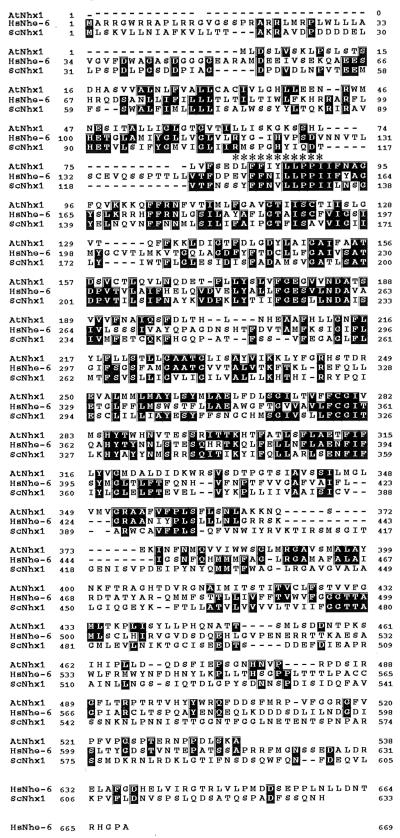
Comparison of AtNHX1 with human and yeast homologues. Alignment of the deduced amino acid sequences of AtNHX1, HsNHE-6 and ScNHX1. Identical residues are in black boxes, and dashes indicate gaps in the sequence. ∗ above alignment denote putative amiloride binding site from human NHE1 (163DVFFLFLLPPI173).
Figure 5
Figure 5
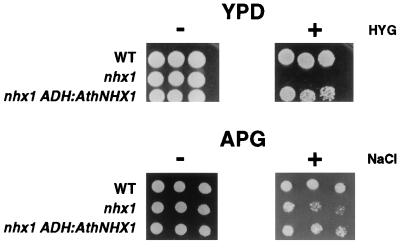
Expression of A. thaliana NHX1 in nhx1 yeast mutants. (A) Vector pAD4 (14) was introduced into wild-type and nhx1 strains. Plasmid pRG308; ADH: AtNHX1 was introduced into nhx1 mutant as indicated. Five-fold serial dilutions (starting at 105 cells) of the indicated strains were grown at 30°C for 2 days on YPD (−) or on YPD supplemented with 0.05 mg/ml hygromycin (+). Serial dilutions of the same strains were grown on APG medium (see Materials and Methods) (−) or on APG supplemented with 0.4 M NaCl (+) (12).
Figure 6
Figure 6
Analysis of AtNHX1 expression under salt stress. RNA tissue blot hybridized with AtNHX1. Ten micrograms of total RNA from 15-day-old plants exposed to 250 mM NaCl or KCl for 6 h and a control grown without salt was subjected to electrophoresis on a denaturing formaldehyde gel. The blot was hybridized with a probe internal to AtNHX1 ORF. An 18S ribosomal probe was used as loading control.

References

    1. Haro R, Garciadeblas B, Rodriguez-Navarro A. FEBS Lett. 1991;291:189–191. - PubMed
    1. Rios G, Ferrando A, Serrano R. Yeast. 1997;13:515–528. - PubMed
    1. Prior C, Potier S, Souciet J L, Sychrova H. FEBS Lett. 1996;387:89–93. - PubMed
    1. Hahnenberger K M, Jia Z, Young P G. Proc Natl Acad Sci USA. 1996;93:5031–5036. - PMC - PubMed
    1. Dibrov P, Smith J J, Young P G, Fliegel L. FEBS Lett. 1997;405:119–124. - PubMed

Publication types

MeSH terms

Associated data