. 1999 Feb 16;96(4):1516-21.
doi: 10.1073/pnas.96.4.1516.

Trapping cDNAs encoding secreted proteins from the salivary glands of the malaria vector Anopheles gambiae

Affiliations

Trapping cDNAs encoding secreted proteins from the salivary glands of the malaria vector Anopheles gambiae

B Arcá et al. Proc Natl Acad Sci U S A. .

Abstract

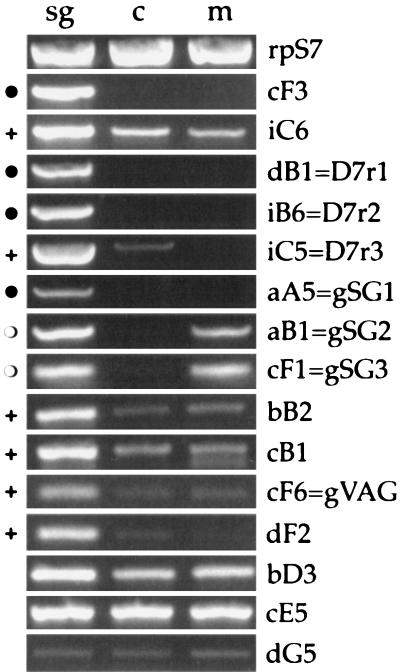
The signal sequence trap method was used to isolate cDNAs corresponding to proteins containing secretory leader peptides and whose genes are expressed specifically in the salivary glands of the malaria vector Anopheles gambiae. Fifteen unique cDNA fragments, ranging in size from 150 to 550 bp, were isolated and sequenced in a first round of immunoscreening in COS-7 cells. All but one of the cDNAs contained putative signal sequences at their 5' ends, suggesting that they were likely to encode secreted or transmembrane proteins. Expression analysis by reverse transcription-PCR showed that at least six cDNA fragments were expressed specifically in the salivary glands. Fragments showing a high degree of similarity to D7 and apyrase, two salivary gland-specific genes previously found in Aedes aegypti, were identified. Of interest, three different D7-related cDNAs that are likely to represent a new gene family were found in An. gambiae. Moreover, three salivary gland-specific cDNA fragments that do not show similarity to known proteins in the databases were identified, and the corresponding full length cDNAs were cloned and sequenced. RNA in situ hybridization to whole female salivary glands showed patterns of expression that overlap only in part those observed in the culicine mosquito A. aegypti.


Figures
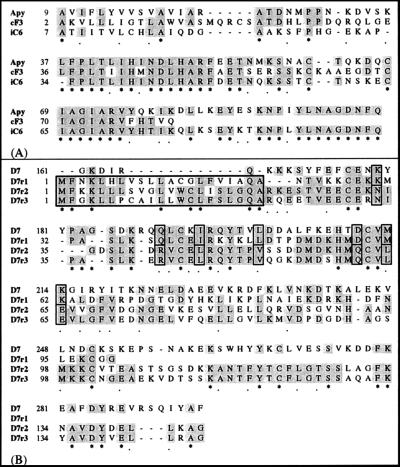
Figure 1
Figure 1
Alignment of the Ae. aegypti apyrase (A) and D7 (B) proteins to the translated An. gambiae cDNA fragments identified by the SST. Asterisks mark identities in all of the sequences. Dots identify conservative substitutions. Identities in at least two of the aligned sequences are shaded. In B, the putative signal peptides of the D7-related cDNA fragments are boxed with a thick line.
Figure 2
Figure 2
RT-PCR analysis of the 15 An. gambiae cDNA fragments. sg, salivary glands of adult females; c, carcasses (adult females with salivary glands removed); m, adult males. The different cDNA clones are indicated on the right side. rpS7, ribosomal protein S7. The specificity of expression is annotated as follows: ●, specifically in female salivary glands; ○, in female salivary glands and males; +, enriched in female salivary glands.
Figure 3
Figure 3
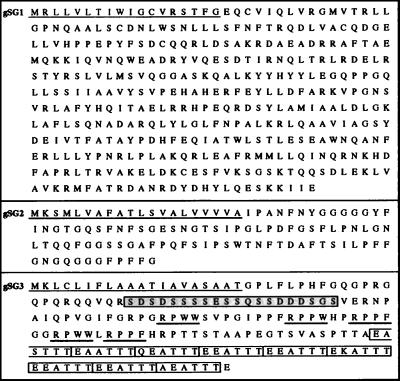
Peptide sequences deduced from the gSG1, gSG2, and gSG3 cDNA clones are shown from the top to the bottom. The putative signal peptides at the amino terminus are underlined. In the gSG3 sequence, the serine-rich region is boxed and shaded, the motif RP(P/W)(F/W) is underlined by a thick line, and the repeated motifs at the carboxy terminus are boxed.
Figure 4
Figure 4
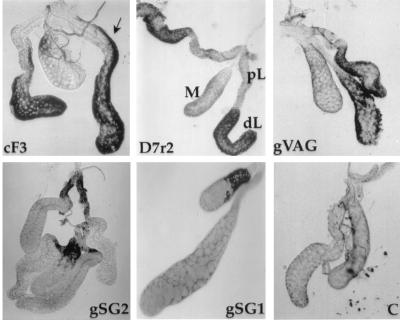
Hybridizations in situ to adult female salivary glands with antisense probes as indicated. C, control glands hybridized with a sense probe; pL, proximal-lateral lobes; dL, distal-lateral lobes; M, medial lobe. The arrow points to the region of the proximal–lateral lobes that hybridizes to the apyrase-like cF3 probe. The gSG2 probe hybridizes to the proximal–lateral lobes (upper gland) and to the proximal–medial lobe (lower gland). Note limited signal over the medial lobe in the hybridization with the gSG1 probe.

References

    1. Collins F H, Paskewitz S M. Annu Rev Entomol. 1995;40:195–219. - PubMed
    1. O’Brochta D A, Atkinson P W. Parasitol Today. 1997;13:99–104. - PubMed
    1. Jasinskiene N, Craig J, Coates C J, Benedict M Q, Cornel A J, Rafferty C S, James A A, Collins F H. Proc Natl Acad Sci USA. 1998;95:3743–3747. - PMC - PubMed
    1. Coates C J, Jasinskiene N, Miyashiro L, James A A. Proc Natl Acad Sci USA. 1998;95:3748–3751. - PMC - PubMed
    1. Touray M G, Warburg A, Laughinghouse A, Krettli A U, Miller L H. J Exp Med. 1992;175:1607–1612. - PMC - PubMed

Publication types

MeSH terms

LinkOut - more resources