. 1999 Feb 16;96(4):1794-9.
doi: 10.1073/pnas.96.4.1794.

Task-related and item-related brain processes of memory retrieval

Affiliations

Task-related and item-related brain processes of memory retrieval

E Düzel et al. Proc Natl Acad Sci U S A. .

Abstract

In all cognitive tasks, general task-related processes operate throughout a given task on all items, whereas specific item-related processes operate differentially on individual items. In typical functional neuroimaging experiments, these two sets of processes have usually been confounded. Herein we report a combined positron emission tomography and event-related potential (ERP) experiment that was designed to distinguish between neural correlates of task-related and item-related processes of memory retrieval. Two retrieval tasks, episodic and semantic, were crossed with episodic (old/new) and semantic (living/nonliving) properties of individual items to yield evidence of regional brain activity associated with task-related processes, item-related processes, and their interaction. The results showed that episodic retrieval task was associated with increased blood flow in right prefrontal and posterior cingulate cortex, as well as with a sustained right-frontopolar-positive ERP, but that the semantic retrieval task was associated with left frontal and temporal lobe activity. Retrieval of old items was associated with increased blood flow in the left medial temporal lobe and with a brief late positive ERP component. The results provide converging hemodynamic and electrophysiological evidence for the distinction of task- and item-related processes, show that they map onto spatially and temporally distinct patterns of brain activity, and clarify the hemispheric encoding/retrieval asymmetry (HERA) model of prefrontal encoding and retrieval asymmetry.


Figures
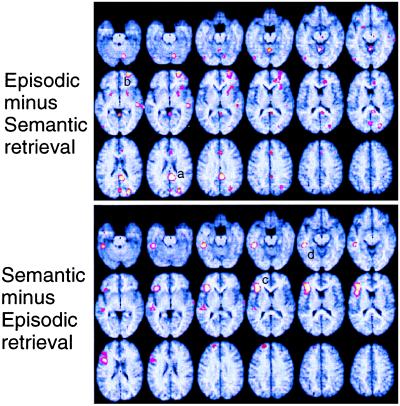
Figure 1
Figure 1
Brain regions showing task-related blood flow differences in the PET study. (Upper) Regions with higher blood flow in the episodic than the semantic retrieval task are depicted. (Lower) Regions showing the opposite pattern are depicted. The horizontal slices are at intervals of 4 mm from −28 mm below the AC-PC line (top-left slice) to 40 mm above the anterior commissure–posterior commissure line (bottom-right slice). Rows: top, −28 to −8 mm; middle, −4 to 16 mm; bottom, 20 to 40 mm.
Figure 2
Figure 2
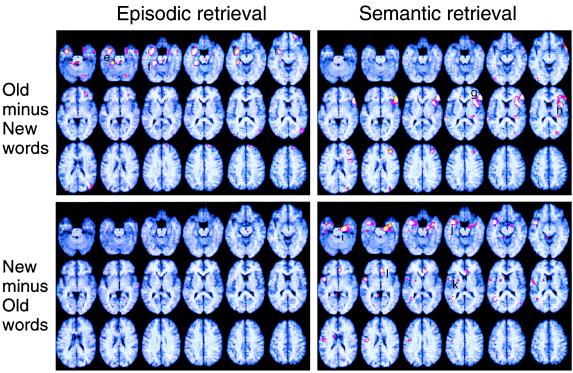
Brain regions showing item-related blood flow differences in the PET study resulting from the subtractions of blood flow elicited by old and new items are depicted separately for episodic (left side) and semantic (right side) retrieval. See Fig. 1.
Figure 3
Figure 3
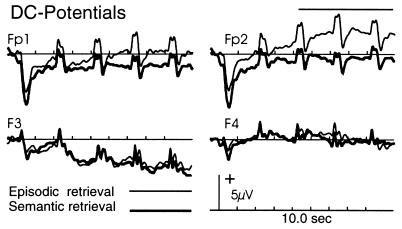
Event-related potential wave forms elicited by lists presented during the episodic (thin lines) and semantic (bold lines) retrieval task. The displayed epoch of 10 sec encompasses the entire list, starting at 500 msec before the onset of task instruction and ending 1,500 msec after the presentation of the fourth (last) item. Traces: Fp1/Fp2, left and right frontopolar; F3/F4, left and right dorsolateral frontal electrodes.
Figure 4
Figure 4
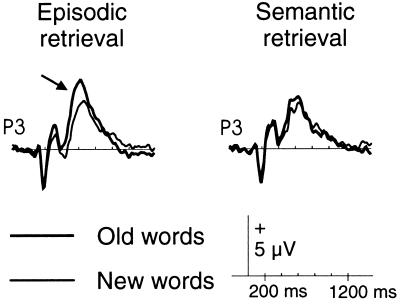
ERPs elicited by old (bold lines) and new (thin lines) items during episodic (Left) and semantic (Right) retrieval. The arrow depicts the LPC. P3, left parietal electrode.

References

    1. Tulving E, Kapur S, Craik F I, Moscovitch M, Houle S. Proc Natl Acad Sci USA. 1994;91:2016–2020. - PMC - PubMed
    1. Nyberg L, Cabeza R, Tulving E. Psychon Bull Rev. 1996;2:134–147. - PubMed
    1. Buckner R L, Raichle M E, Miezin F M, Petersen S E. J Neurosci. 1996;16:6219–6235. - PMC - PubMed
    1. Rugg M D, Fletcher P C, Frith C D, Frackowiak R S, Dolan R J. Brain. 1996;119:2073–2083. - PubMed
    1. Fletcher P C, Shallice T, Frith C D, Frackowiak R S, Dolan R J. Brain. 1998;121:1249–1256. - PubMed

Publication types

MeSH terms

Substances