


Effect of anti-malarial interventions on trends of malaria cases, hospital admissions and deaths, 2005-2015, Ghana
- PMID: 28446198
- PMCID: PMC5406984
- DOI: 10.1186/s12936-017-1828-6
Effect of anti-malarial interventions on trends of malaria cases, hospital admissions and deaths, 2005-2015, Ghana
Abstract
Background: Since 2005, the Government of Ghana and its partners, in concerted efforts to control malaria, scaled up the use of artemisinin-based combination therapy (ACT) and insecticide-treated nets (ITNs). Beginning in 2011, a mass campaign of long-lasting insecticidal nets (LLINs) was implemented, targeting all the population. The impact of these interventions on malaria cases, admissions and deaths was assessed using data from district hospitals.
Methods: Records of malaria cases and deaths and availability of ACT in 88 hospitals, as well as at district level, ITN distribution, and indoor residual spraying were reviewed. Annual proportion of the population potentially protected by ITNs was estimated with the assumption that each LLIN covered 1.8 persons for 3 years. Changes in trends of cases and deaths in 2015 were estimated by segmented log-linear regression, comparing trends in post-scale-up (2011-2015) with that of pre-scale-up (2005-2010) period. Trends of mortality in children under 5 years old from population-based household surveys were also compared with the trends observed in hospitals for the same time period.
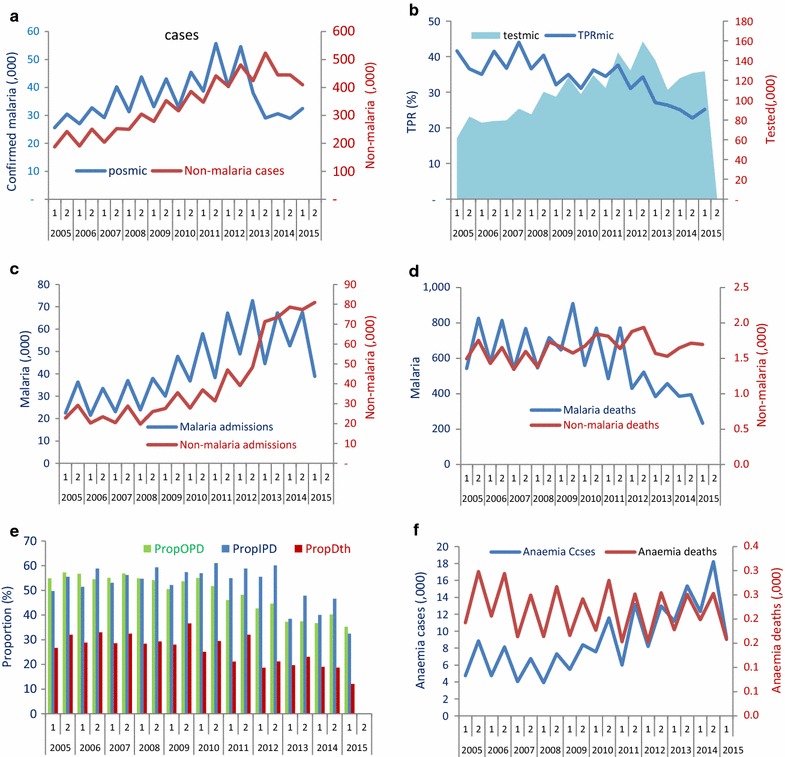
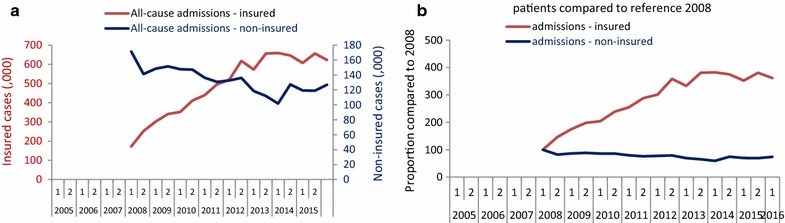
Results: Among all ages, the number of outpatient malaria cases (confirmed and presumed) declined by 57% (95% confidence interval [CI], 47-66%) by first half of 2015 (during the post-scale-up) compared to the pre-scale-up (2005-2010) period. The number of microscopically confirmed cases decreased by 53% (28-69%) while microscopic testing was stable. Test positivity rate (TPR) decreased by 41% (19-57%). The change in malaria admissions was insignificant while malaria deaths fell significantly by 65% (52-75%). In children under 5 years old, total malaria outpatient cases, admissions and deaths decreased by 50% (32-63%), 46% (19-75%) and 70% (49-82%), respectively. The proportion of outpatient malaria cases, admissions and deaths of all-cause conditions in both all ages and children under five also fell significantly by >30%. Similar decreases in the main malaria indicators were observed in the three epidemiological strata (coastal, forest, savannah). All-cause admissions increased significantly in patients covered by the National Health Insurance Scheme (NHIS) compared to the non-insured. The non-malaria cases and non-malaria deaths increased or remained unchanged during the same period. All-cause mortality for children under 5 years old in household surveys, similar to those observed in the hospitals, declined by 43% between 2008 and 2014.
Conclusions: The data provide compelling evidence of impact following LLIN mass campaigns targeting all ages since 2011, while maintaining other anti-malarial interventions. Malaria cases and deaths decreased by over 50 and 65%, respectively. The declines were stronger in children under five. Test positivity rate in all ages decreased by >40%. The decrease in malaria deaths was against a backdrop of increased admissions owing to free access to hospitalization through the NHIS. The study demonstrated that retrospective health facility-based data minimize reporting biases to assess effect of interventions. Malaria control in Ghana is dependent on sustained coverage of effective interventions and strengthened surveillance is vital to monitor progress of these investments.
Keywords: Ghana; Impact; Indoor residual spraying; LLIN mass campaign; Malaria.
Figures



References
-
- United Nations. World Population projections. 2015. Revisions. https://esa.un.org/unpd/wpp/publications/files/key_findings_wpp_2015.pdf. Accessed 20 Feb 2017.
-
- Ghana Ministry of Health (GMoH), 2015.
-
- The Global Fund to fight HIV/AIDS, tuberculosis and malaria. Multi-country independent evaluation report. Independent evaluation of the affordable medicines facility-malaria (AMFm) Phase 1. Final Report September 28, 2012. file:///C:/Users/aregawim/Downloads/AMFm_2012IEPhase1FinalReportWithoutAppendices_Report_en.pdf. Accessed 8 Feb 2017.
-
- Ghana Ministry of Health (GMOH). National Health Insurance Annual report, 2012.
-
- Ghana Statistical Service (2012) 2010 Population Census Summary Report, Ghana Statistical Service. http://www.statsghana.gov.gh/docfiles/2010phc/Census2010_Summary_report_.... Accessed 8 Feb 2017.
MeSH terms
Substances
Grants and funding
LinkOut - more resources
Full Text Sources
Other Literature Sources
Medical
