. 2002 Jul 15;30(14):3273-7.
doi: 10.1093/nar/gkf440.

Vertebrate cells lacking FEN-1 endonuclease are viable but hypersensitive to methylating agents and H2O2

Affiliations

Vertebrate cells lacking FEN-1 endonuclease are viable but hypersensitive to methylating agents and H2O2

Yasuo Matsuzaki et al. Nucleic Acids Res. .

Abstract

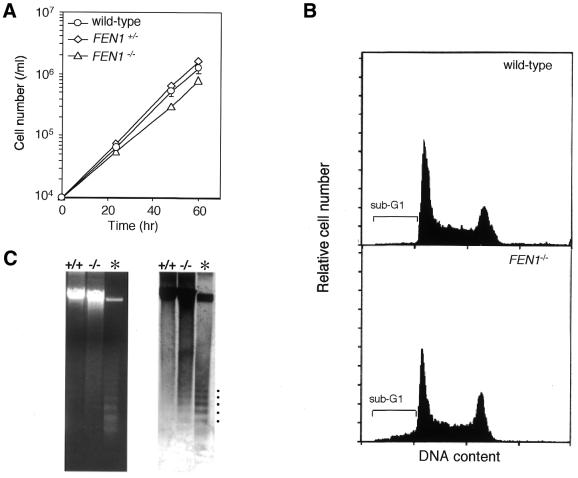
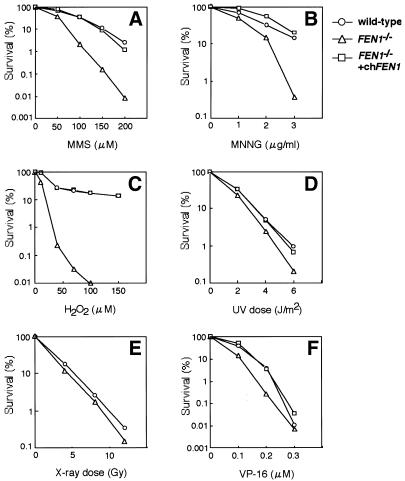
The structure-specific FEN-1 endonuclease has been implicated in various cellular processes, including DNA replication, repair and recombination. In vertebrate cells, however, no in vivo evidence has been provided so far. Here, we knocked out the FEN-1 gene (FEN1) in the chicken DT40 cell line. Surprisingly, homozygous mutant (FEN1-/-) cells were viable, indicating that FEN-1 is not essential for cell proliferation and thus for Okazaki fragment processing during DNA replication. However, compared with wild-type cells, FEN1-/- cells exhibited a slow growth phenotype, probably due to a high rate of cell death. The mutant cells were hypersensitive to methylmethane sulfonate, N-methyl-N'-nitro-N-nitrosoguanidine and H2O2, but not to UV light, X-rays and etoposide, suggesting that FEN-1 functions in base excision repair in vertebrate cells.


Figures
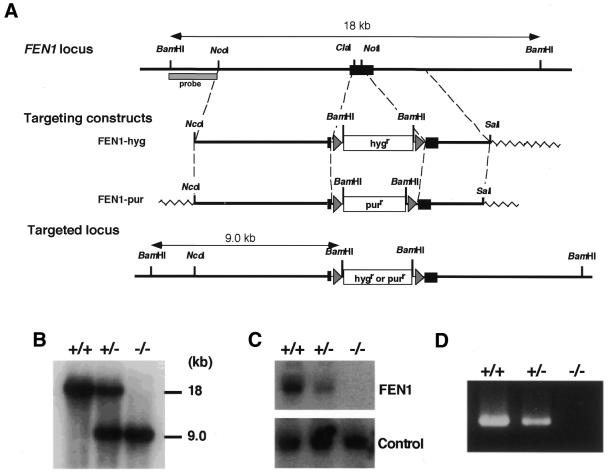
Figure 1
Figure 1
Generation of chicken FEN1–/– cells. (A) Schematic representation of targeted disruption of the chicken FEN1 gene. The chicken FEN1 locus, the two targeting constructs and the resulting targeted locus are shown. The black box indicates the open reading frame of the FEN1 gene. The triangles flanking the hygromycin-resistance (hygr) or puromycin-resistance (purr) gene designate loxP sequences. The figure is not drawn to scale. (B) Southern blot analysis. BamHI-digested genomic DNA of wild-type (+/+), heterozygous mutant (+/–) and homozygous mutant (–/–) cells was hybridized with the probe shown in (A). (C) Northern blot analysis. Total RNA of wild-type, FEN1+/– and FEN1–/– cells was hybridized with a chicken FEN1 cDNA probe. As a control, the same filter was rehybridized with a chicken Ku70 cDNA probe. (D) RT–PCR analysis. Total RNA of wild-type, FEN1+/– and FEN1–/– cells was used as a template to amplify the full-length FEN1 cDNA.
Figure 2
Figure 2
Growth characteristics of FEN1–/– cells. (A) Growth curves of wild-type, FEN1+/– and FEN1–/– cells. Data shown are the means ± SD of four independent experiments. (B) Cell cycle distribution of wild-type and FEN1–/– cells. Asynchronous cell populations in logarithmic growth phase were subjected to flow cytometric analysis. The brackets indicate sub-G1 fractions. Data shown are from one representative of three independent experiments. (C) Agarose gel electrophoresis of genomic DNA isolated from exponentially growing wild-type and FEN1–/– cells. The gel was stained with ethidium bromide (left panel) and then subjected to Southern blotting using DT40 genomic DNA as probe (right panel). For reference (asterisk), apoptotic ladder bands, which occur in genomic DNA from overgrown DT40 cells, are indicated by dots.
Figure 3
Figure 3
Sensitivity of FEN1–/– cells to DNA-damaging agents: MMS (A), MNNG (B), H2O2 (C), UV light (D), X-rays (E) and VP-16 (F). Sensitivity assays were performed as described in Materials and Methods. Data are expressed as mean percentages of survival in three or four independent experiments. chFEN1, an expression plasmid for chicken FEN-1.

References

    1. Harrington J.J., and Lieber,M.R. (1994) The characterization of a mammalian DNA structure-specific endonuclease. EMBO J., 13, 1235–1246. - PMC - PubMed
    1. Murante R.S., Huang,L., Turchi,J.J. and Bambara,R.A. (1994) The calf 5′ to 3′ exonuclease is also an endonuclease with both activities dependent on primers annealed upstream of the point of cleavage. J. Biol. Chem., 269, 1191–1196. - PubMed
    1. Lieber M.R., (1997) The FEN-1 family of structure-specific nucleases in eukaryotic DNA replication, recombination and repair. Bioessays, 19, 233–240. - PubMed
    1. Ishimi Y., Claude,A., Bullock,P. and Hurwitz,J. (1988) Complete enzymatic synthesis of DNA containing the SV40 origin of replication. J. Biol. Chem., 263, 19723–19733. - PubMed
    1. Turchi J.J., and Bambara,R.A. (1993) Completion of mammalian lagging strand DNA replication using purified proteins. J. Biol. Chem., 268, 15136–15141. - PubMed

Publication types

MeSH terms

Associated data