Comparative Study
. 1999 Jan;65(1):270-7.
doi: 10.1128/AEM.65.1.270-277.1999.

Phylogenetic affinity of a wide, vacuolate, nitrate-accumulating Beggiatoa sp. from Monterey Canyon, California, with Thioploca spp

Affiliations
Comparative Study

Phylogenetic affinity of a wide, vacuolate, nitrate-accumulating Beggiatoa sp. from Monterey Canyon, California, with Thioploca spp

A Ahmad et al. Appl Environ Microbiol. 1999 Jan.

Abstract

Environmentally dominant members of the genus Beggiatoa and Thioploca spp. are united by unique morphological and physiological adaptations (S. C. McHatton, J. P. Barry, H. W. Jannasch, and D. C. Nelson, Appl. Environ. Microbiol. 62:954-958, 1996). These adaptations include the presence of very wide filaments (width, 12 to 160 microm), the presence of a central vacuole comprising roughly 80% of the cellular biovolume, and the capacity to internally concentrate nitrate at levels ranging from 150 to 500 mM. Until recently, the genera Beggiatoa and Thioploca were recognized and differentiated on the basis of morphology alone; they were distinguished by the fact that numerous Thioploca filaments are contained within a common polysaccharide sheath, while Beggiatoa filaments occur singly. Vacuolate Beggiatoa or Thioploca spp. can dominate a variety of marine sediments, seeps, and vents, and it has been proposed (H. Fossing, V. A. Gallardo, B. B. Jorgensen, M. Huttel, L. P. Nielsen, H. Schulz, D. E. Canfield, S. Forster, R. N. Glud, J. K. Gundersen, J. Kuver, N. B. Ramsing, A. Teske, B. Thamdrup, and O. Ulloa, Nature [London] 374:713-715, 1995) that members of the genus Thioploca are responsible for a significant portion of total marine denitrification. In order to investigate the phylogeny of an environmentally dominant Beggiatoa sp., we analyzed complete 16S rRNA gene sequence data obtained from a natural population found in Monterey Canyon cold seeps. Restriction fragment length polymorphism analysis of a clone library revealed a dominant clone, which gave rise to a putative Monterey Beggiatoa 16S rRNA sequence. Fluorescent in situ hybridization with a sequence-specific probe confirmed that this sequence originated from wide Beggiatoa filaments (width, 65 to 85 microm). A phylogenetic tree based on evolutionary distances indicated that the Monterey Beggiatoa sp. falls in the gamma subdivision of the class Proteobacteria and is most closely related to the genus Thioploca. This vacuolate Beggiatoa-Thioploca cluster and a more distantly related freshwater Beggiatoa species cluster form a distinct phylogenetic group.


Figures
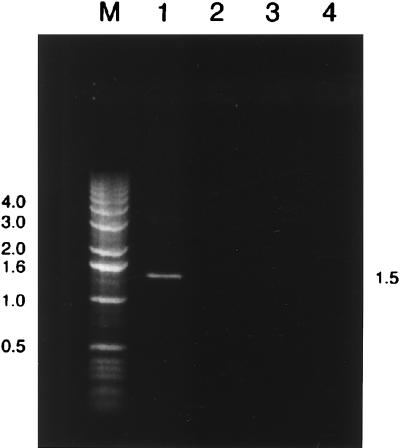
FIG. 1
FIG. 1
PCR amplification products based on chromosomal DNA extracted from Beggiatoa sp. filaments from Monterey Canyon, California, as revealed by ethidium bromide staining and agarose gel electrophoresis. Each PCR mixture contained a 3-μl sample. Lane M, 1.0-kb DNA ladder; lane 1, PCR amplification product obtained with universal eubacterial 16S rRNA gene primers; lanes 2 through 4, three separate control reactions (lane 2, no DNA template; lane 3, no forward primer; lane 4, no reverse primer). DNA sizes (in kilobase pairs) are indicated on the left and right.
FIG. 2
FIG. 2
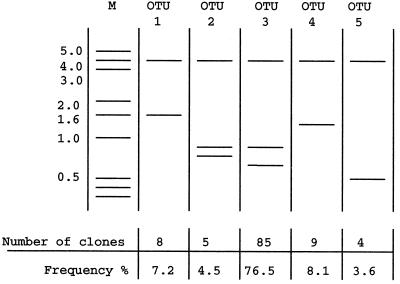
Diagram of RFLP patterns (after EcoRI digestion) of cloned 16S rRNA genes, resolved by agarose gel electrophoresis. All five different restriction patterns obtained, defined as OTUs, are shown along with their proportional representation in the 111 clones screened. Molecular weight standards (lane M) were included for comparison. Fragment sizes (in kilobase pairs) are indicated on the left.
FIG. 3
FIG. 3
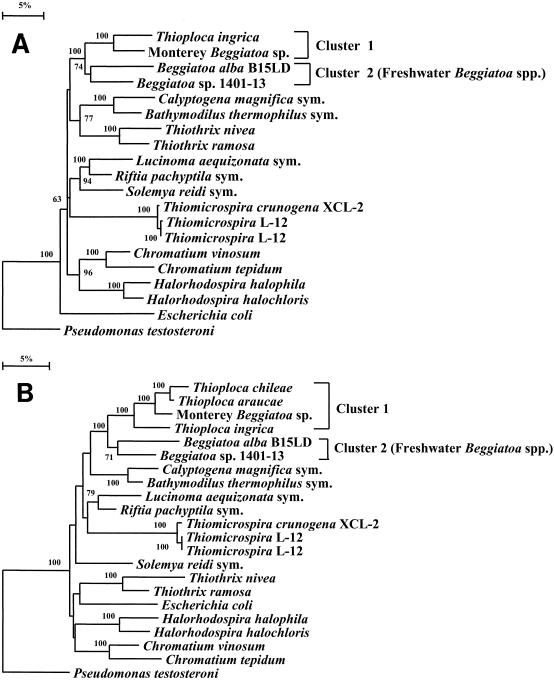
Phylogenetic trees showing the positions of the Monterey Beggiatoa sp. and other representatives of the gamma subgroup of the Proteobacteria, as inferred by the neighbor-joining method. Distances were corrected with Kimura’s two-parameter model. The sequence of Pseudomonas testosteroni (a member of the β subdivision of the Proteobacteria) was used to root the tree. Halorhodospira halophila and Halorhodospira halochloris (9a) sequence data were accessed as data for the corresponding Ectothiorhodospira species. The phylogenetic analyses were performed with programs contained in the PHYLIP package, version 3.5c. There are two main Beggiatoa-Thioploca clusters. Cluster 1 contains the Monterey Beggiatoa sp. sequence and all previously published Thioploca spp. sequences; cluster 2 contains all sequences belonging to freshwater Beggiatoa spp. (A) Small mask tree inferred from 1,203 nucleotide positions. Partial T. araucae and T. chileae sequences were not included. (B) Tree inferred with the full mask by using only 534 positions, which allowed inclusion of partial sequences of T. araucae and T. chileae. All of the sequences used except the new sequences were retrieved from the Ribosomal Database Project (17). Scale bar = 5 substitutions/100 nucleotide positions. Thiomicrospira crunogena XCL-2 and Thiomicrospira sp. strain L-12 were sequenced in this study; the sequence of Thiomicrospira sp. strain L-12 was also determined previously (31). sym, symbiont.
FIG. 4
FIG. 4
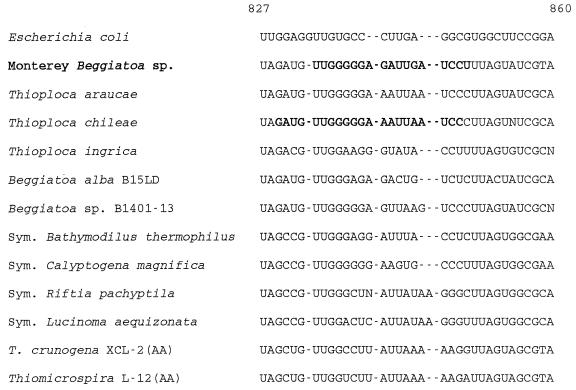
16S rRNA target region for the Monterey Beggiatoa sp.-specific probe (MBSP1RC; length 18 nucleotides) aligned with sequences from selected endosymbiotic and free-living sulfur-oxidizing bacteria. The specific target sequence of the Monterey Beggiatoa sp. (in boldface type) differs from the aligned sequences of all of the other sulfur-oxidizing bacteria by at least two nucleotides. The target of the Thioploca-829 probe is also shown in boldface type for T. chileae. The sequences correspond to variable region helix 29 of the E. coli 16S rRNA secondary structure model predicted by Van de Peer et al. (39). All predict a 12-base stem starting at position 829 and ending at position 857 with a five- to seven-base loop beginning at the aligned gap.
FIG. 5
FIG. 5
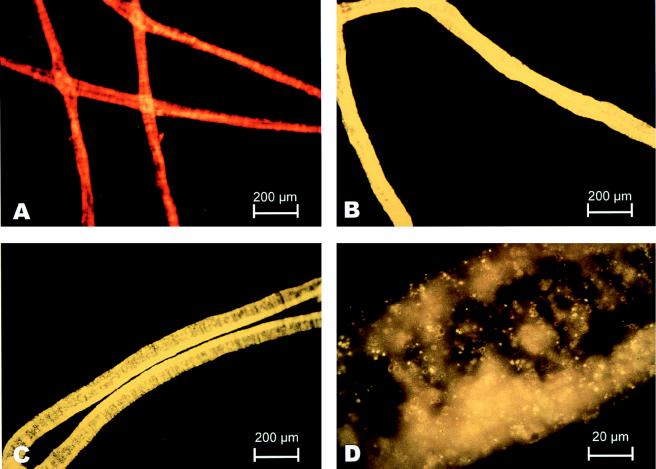
Photomicrographs of fluorescent FISH results. (C and D) Hybridization (37°C, 20% formamide) of the MBSP1RC probe labeled with the fluorophore BODIPY-TMR in a single wide (width, approximately 75 μm) Beggiatoa filament. The intensity of the hybridization signal was comparable to the intensity of the signal obtained when the universal eubacterial probe (Eub-338) was used as a positive control (B). Nonspecific probe did not hybridize with the Beggiatoa rRNA (A). The orange-red coloration (A) (compared with the bright yellow of the probe [B through D]) appeared to be autoflurorescence and was also detected in unstained filaments.

References

    1. Barry J P, Greene H G, Orange D L, Baxter C H, Robinson B H, Kochevar R E, Nybakken J W, Reed D L, McHugh C M. Biologic and geologic characteristics of cold seeps in Monterey Bay, California. Deep Sea Res Part A Oceanogr Res Pap. 1996;43:1739–1762.
    1. Buck, K. Personal communication.
    1. Devereux R, He S H, Doyle C L, Orkland S, Stahl D A, LeGall J, Whitman W B. Diversity and origin of Desulfovibrio species: phylogenetic definition of a family. J Bacteriol. 1990;172:3609–3619. - PMC - PubMed
    1. Felenstein J. PHYLIP—phylogeny inference package. Cladistics. 1989;5:164–166.
    1. Fossing H, Gallardo V A, Jorgensen B B, Huttel M, Nielson L P, Schulz H, Canfield D E, Forster S, Glud R N, Gundersen J K, Kuver J, Ramsing N B, Teske A, Thamdrup B, Ulloa O. Concentration and transport of nitrate by the mat-forming sulphur bacterium Thioploca. Nature (London) 1995;374:713–716.

Publication types

Associated data

LinkOut - more resources