


doi: 10.1073/pnas.96.14.8017.
Diversity of Holocene life forms in fossil glacier ice
Affiliations
- PMID: 10393940
- PMCID: PMC22180
- DOI: 10.1073/pnas.96.14.8017
Item in Clipboard
Diversity of Holocene life forms in fossil glacier ice
Proc Natl Acad Sci U S A.
.
Abstract
Studies of biotic remains of polar ice caps have been limited to morphological identification of plant pollen and spores. By using sensitive molecular techniques, we now demonstrate a much greater range of detectable organisms; from 2000- and 4000-year-old ice-core samples, we obtained and characterized 120 clones that represent at least 57 distinct taxa and reveal a diversity of fungi, plants, algae, and protists. The organisms derive from distant sources as well as from the local arctic environment. Our results suggest that additional taxa may soon be readily identified, providing a plank for future studies of deep ice cores and yielding valuable information about ancient communities and their change over time.
Figures
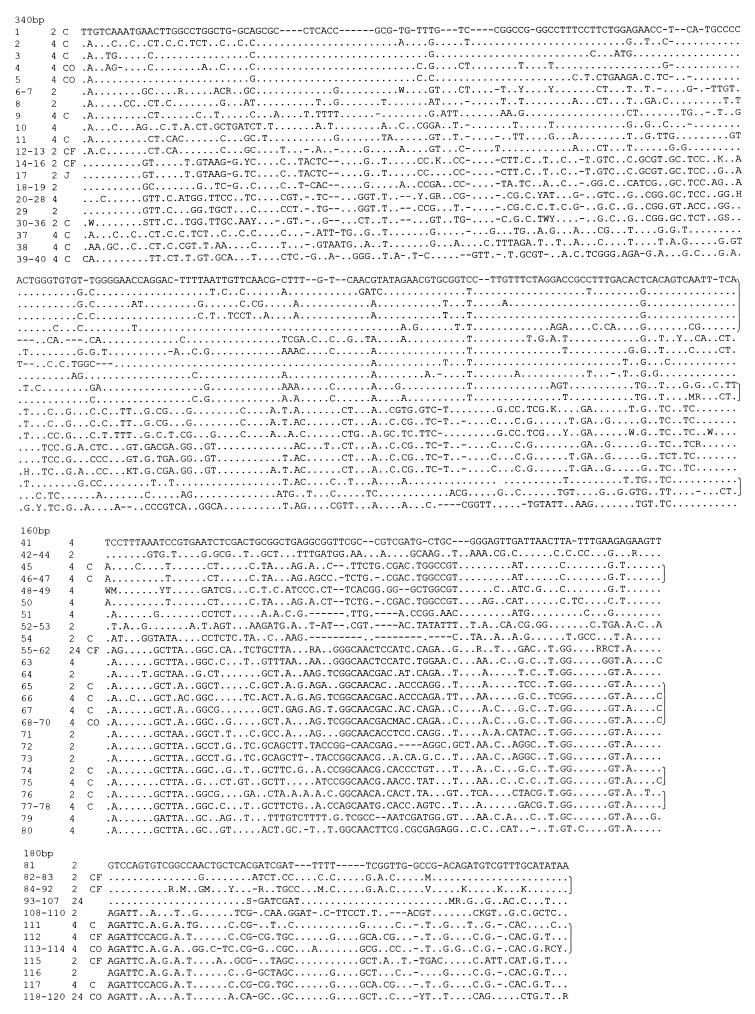
DNA sequences of clones from 3 distinct fragments of the 18S rRNA gene amplified from ice core samples. Only variable sites are shown. Dots indicate identity with sequences on top of each alignment and dashes indicate insertions/deletions. Clones that are less than 4% different from each other are grouped together by using standard abbreviations at nonhomogeneous sites. C, O, and F indicate clones identified to the level of class, order, and family, respectively; J indicates a clone created by possible jumping PCR events. Numbers in first column represent clone number, and nos. 2 and 4 in second column refer to the approximate age (×1000 years) of the clone samples. Brackets at right indicate clones identified to the same class.
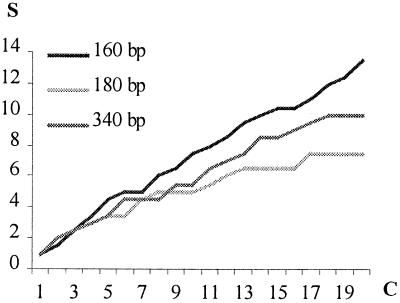
Diversity curves. The number of clone clusters obtained by a single primer set S plotted against the number of clones with different sequences (4% level) for that primer set C. The curves are an average of the values obtained for the 2000- and 4000-year-old samples. Approximate lengths (160, 180, and 340 bp) of amplified fragments are specified for each primer set.
References
-
- Lichti-Federovich S. Geological Survey of Canada. 1975;75-1Part A:441–444.
-
- MacAndrews J H. Quaternary Res. 1984;22:68–73.
-
- Bourgeois J C. Boreas. 1986;15:345–354.
-
- Koerner R M, Bourgeois J C, Fisher D A. Ann Glaciology. 1988;10:85–91.
-
- Fredskild B, Wagner O. Boreas. 1974;3:105–108.
Publication types
MeSH terms
Substances
Associated data
- Actions
- Actions
- Actions
- Actions
- Actions
- Actions
- Actions
- Actions
- Actions
- Actions
- Actions
- Actions
- Actions
- Actions
- Actions
- Actions
- Actions
- Actions
- Actions
- Actions
- Actions
- Actions
- Actions
- Actions
- Actions
- Actions
- Actions
- Actions
- Actions
- Actions
LinkOut - more resources
Full Text Sources
Other Literature Sources
Medical
Molecular Biology Databases
Miscellaneous
