. 1998 Aug;180(16):4068-79.
doi: 10.1128/JB.180.16.4068-4079.1998.

Investigation of the Streptomyces clavuligerus cephamycin C gene cluster and its regulation by the CcaR protein

Affiliations

Investigation of the Streptomyces clavuligerus cephamycin C gene cluster and its regulation by the CcaR protein

D C Alexander et al. J Bacteriol. 1998 Aug.

Abstract

As part of a search for transcriptional regulatory genes, sequence analysis of several previously unsequenced gaps in the cephamycin biosynthetic cluster has revealed the presence in Streptomyces clavuligerus of seven genes not previously described. These include genes encoding an apparent penicillin binding protein and a transport or efflux protein, as well as the CmcI and CmcJ proteins, which catalyze late reactions in the cephamycin biosynthetic pathway. In addition, we discovered a gene, designated pcd, which displays significant homology to genes encoding semialdehyde dehydrogenases and may represent the gene encoding the long-sought-after dehydrogenase involved in the conversion of lysine to alpha-aminoadipate. Finally, two genes, sclU and rhsA, with no obvious function in cephamycin biosynthesis may define the end of the cluster. The previously described CcaR protein displays homology to a number of Streptomyces pathway-specific transcriptional activators. The ccaR gene was shown to be essential for the biosynthesis of cephamycin, clavulanic acid, and non-clavulanic acid clavams. Complementation of a deletion mutant lacking ccaR and the adjacent orf11 and blp genes showed that only ccaR was essential for the biosynthesis of cephamycin, clavulanic acid, and clavams and that mutations in orf11 or blp had no discernible effects. The lack of cephamycin production in ccaR mutants was directly attributable to the absence of biosynthetic enzymes responsible for the early and middle steps of the cephamycin biosynthetic pathway. Complementation of the ccaR deletion mutant resulted in the return of these biosynthetic enzymes and the restoration of cephamycin production.


Figures
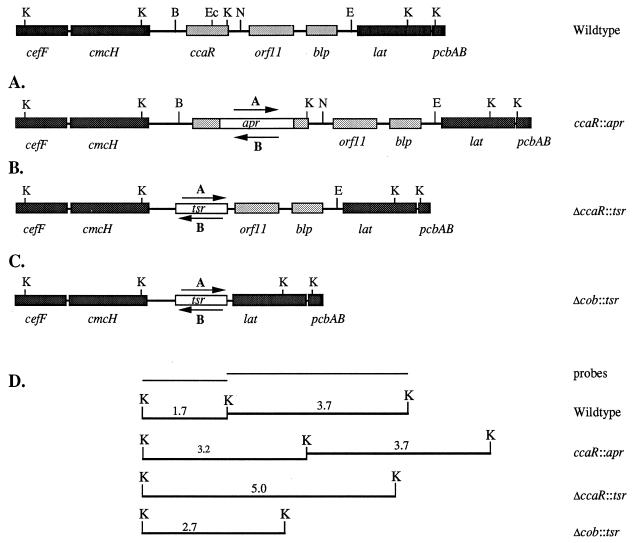
FIG. 1
FIG. 1
Strategy for disruption or deletion of the ccaR gene or deletion of the cob group of genes by gene replacement. The lightly shaded boxes represent the target gene(s), the darker boxes represent other ORFs within the cephamycin cluster, and the clear box represents the antibiotic resistance marker. The antibiotic resistance markers were introduced in both orientations (A and B). (A) Insertion of the apr cassette into the EcoICRI site of the ccaR gene; (B) deletion of the internal BamHI/NruI fragment containing the ccaR gene and replacement with the tsr marker; (C) deletion of the internal BamHI/EcoRI fragment containing the ccaR, orf11, and blp genes and replacement with the tsr marker; (D) Southern hybridization pattern of KpnI-digested genomic DNA from the wild type and ccaR::apr, ΔccaR::tsr, and Δcob::tsr mutants, using the 1.7- and 3.7-kb KpnI fragments as hybridization probes. Abbreviations for restriction sites: B, BamHI; E, EcoRI; Ec, EcoICRI; K, KpnI; N, NruI.
FIG. 2
FIG. 2
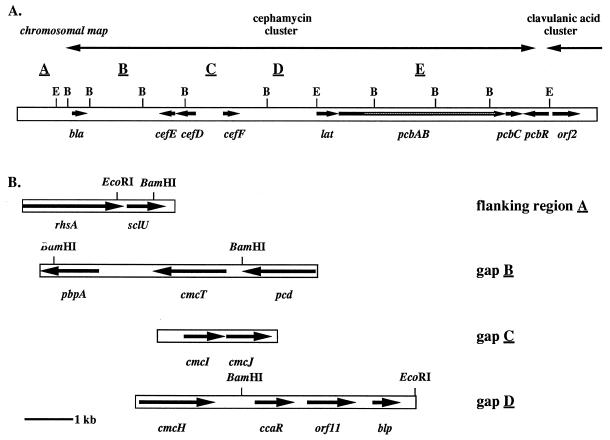
Physical map of the cephamycin biosynthetic gene cluster in S. clavuligerus. (A) The chromosomal restriction map was created by compiling the restriction maps created in other studies (35, 50, 54). E and B, EcoRI and BamHI restriction sites; solid arrows, genes previously sequenced; shaded bar, region of the pcbAB gene which has not been sequenced. Gaps within or regions flanking the known sequence of the cephamycin cluster are noted with underlined letters. (B) Diagrammatic representation of the genes present within the gaps or region flanking the cephamycin biosynthetic gene cluster as determined by sequence analysis. Arrows indicate the direction of transcription for each gene, positions of the EcoRI and BamHI restriction sites within each fragment are shown.
FIG. 3
FIG. 3
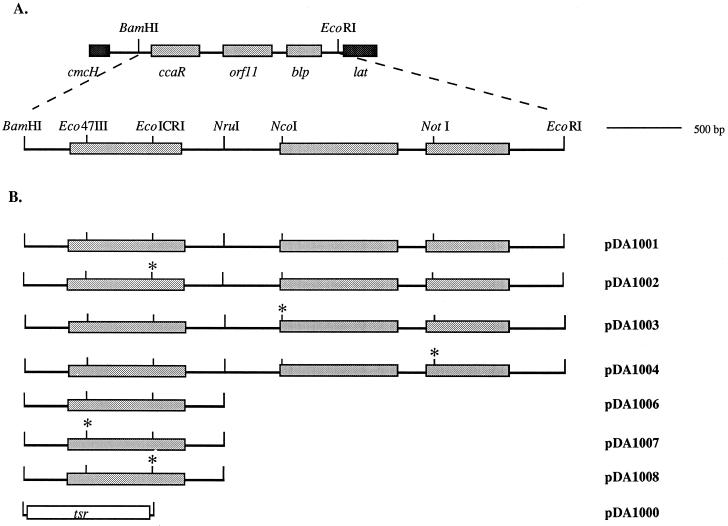
The cob group of genes and pSET152 complementation constructs created with these genes. (A) Restriction map of the region of DNA containing the cob genes and unique restriction sites present within this region; (B) diagram of wild-type and mutant constructs created in pSET152 for the complementation experiments using the ΔccaR::tsr or Δcob::tsr deletion mutant strains. Asterisks represent locations of stop codon-containing TSFs.
FIG. 4
FIG. 4
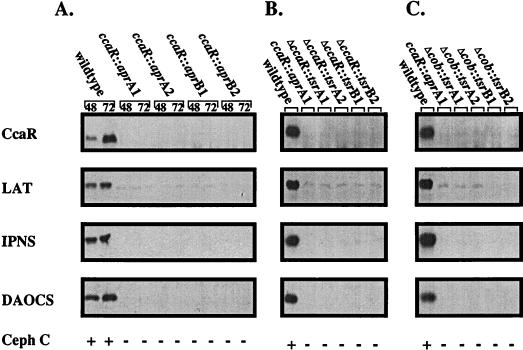
Presence of the CcaR protein and cephamycin C biosynthetic enzymes in ccaR mutant strains. (A) Wild-type and ccaR::apr insertion strains; (B) wild-type and ΔccaR::tsr deletion strains; (C) wild-type and Δcob::tsr deletion strains. Ten micrograms of cell extract protein from each strain, harvested after 72 h of growth unless otherwise noted, was separated by SDS-PAGE (10% gel) and transferred to PVDF membranes. The resulting Western blots were developed with polyclonal antibodies specific for the CcaR, LAT, IPNS, and DAOCS proteins. Each strain’s ability to produce cephamycin (Ceph) C was determined by bioassay, and the results were scored as + (production) and − (lack of production).
FIG. 5
FIG. 5
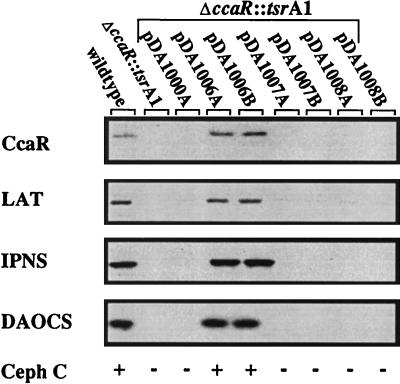
Complementation of the ΔccaR::tsrA1 mutant with pSET152 constructs. Western blot analysis and bioassay for production of cephamycin C were used to assess complementation. The designations A and B represent two independent clones generated during the same transformation. Five micrograms of cell extract protein from each strain, harvested after 48 h of growth, was separated by SDS-PAGE (10% gel) and transferred to PVDF membranes. The resulting Western blots were developed with polyclonal antibodies specific for the CcaR, LAT, IPNS, and DAOCS proteins. Each strain’s ability to produce cephamycin (Ceph) C was determined by bioassay, and the results were scored as + (production) and − (lack of production).

References

    1. Aharonowitz Y, Demain A L. Carbon catabolite regulation of cephalosporin production in Streptomyces clavuligerus. Antimicrob Agents Chemother. 1978;14:159–164. - PMC - PubMed
    1. Aidoo K A, Wong A, Alexander D C, Rittammer R A R, Jensen S E. Cloning, sequencing and disruption of a gene from Streptomyces clavuligerus involved in clavulanic acid biosynthesis. Gene. 1994;147:41–46. - PubMed
    1. Aidoo, K. A., and S. E. Jensen. Unpublished data.
    1. Altschul S F, Gish W, Miller W, Myers E W, Lipman D J. Basic local alignment search tool. J Mol Biol. 1990;215:403–410. - PubMed
    1. Altschul S F, Madden T L, Schäffer A A, Zhang J, Zhang Z, Miller W, Lipman D J. Gapped BLAST and PSI-BLAST: a new generation of protein database search programs. Nucleic Acids Res. 1997;25:3389–3402. - PMC - PubMed

Publication types

Associated data

LinkOut - more resources