. 1998 Dec 22;95(26):15843-8.
doi: 10.1073/pnas.95.26.15843.

Independent deletions of a pathogen-resistance gene in Brassica and Arabidopsis

Affiliations

Independent deletions of a pathogen-resistance gene in Brassica and Arabidopsis

M R Grant et al. Proc Natl Acad Sci U S A. .

Abstract

Plant disease resistance (R) genes confer race-specific resistance to pathogens and are genetically defined on the basis of intra-specific functional polymorphism. Little is known about the evolutionary mechanisms that generate this polymorphism. Most R loci examined to date contain alternate alleles and/or linked homologs even in disease-susceptible plant genotypes. In contrast, the resistance to Pseudomonas syringae pathovar maculicola (RPM1) bacterial resistance gene is completely absent (rpm1-null) in 5/5 Arabidopsis thaliana accessions that lack RPM1 function. The rpm1-null locus contains a 98-bp segment of unknown origin in place of the RPM1 gene. We undertook comparative mapping of RPM1 and flanking genes in Brassica napus to determine the ancestral state of the RPM1 locus. We cloned two B. napus RPM1 homologs encoding hypothetical proteins with approximately 81% amino acid identity to Arabidopsis RPM1. Collinearity of genes flanking RPM1 is conserved between B. napus and Arabidopsis. Surprisingly, we found four additional B. napus loci in which the flanking marker synteny is maintained but RPM1 is absent. These B. napus rpm1-null loci have no detectable nucleotide similarity to the Arabidopsis rpm1-null allele. We conclude that RPM1 evolved before the divergence of the Brassicaceae and has been deleted independently in the Brassica and Arabidopsis lineages. These results suggest that functional polymorphism at R gene loci can arise from gene deletions.


Figures
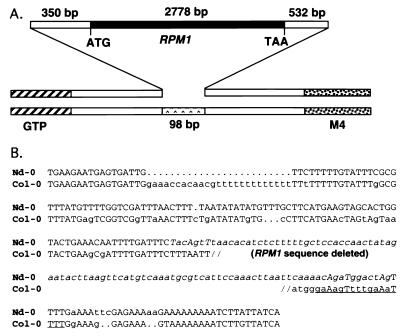
Figure 1
Figure 1
Structure of functional and null RPM1 alleles in A. thaliana. (A) Schematic comparison of RPM1 and rpm1-null structure. The RPM1 locus in resistant and susceptible accessions is closely flanked by two ORFs. GTP and M4. In all susceptible accessions that have been examined, the RPM1 gene has been replaced by a 98-bp sequence of unknown origin. (B) Sequence of the null allele in susceptible Arabidopsis. The sequence of rpm1-null from Nd-0 is aligned with conserved regions that flank the 5′ and 3′ breakpoints of the replacement in Col-0. Conserved nucleotides are capitalized, and the 98-bp filler is emphasized by italics. A direct repeat in Col-0 at the 3′ breakpoint with Nd-0 is underlined.
Figure 2
Figure 2
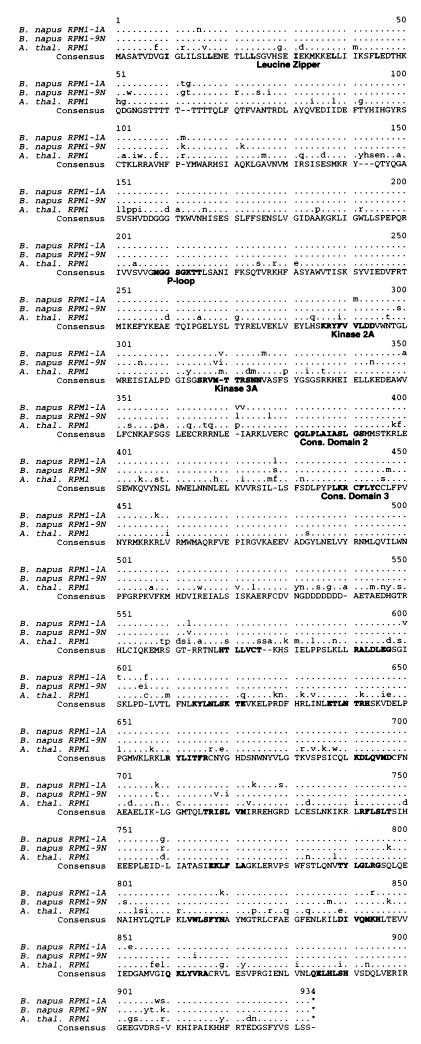
Structural comparison of hypothetical RPM1 proteins from Arabidopsis and B. napus. Putative functional motifs are emphasized in bold. The P-loop, kinase 2A, and kinase 3A motifs constitute a consensus NBS. Conserved domains 2 and 3 are present in all known NBS-LRR resistance genes, but their function is unknown. LRRs are designated by the highlighted XXLXLXX motif.
Figure 3
Figure 3
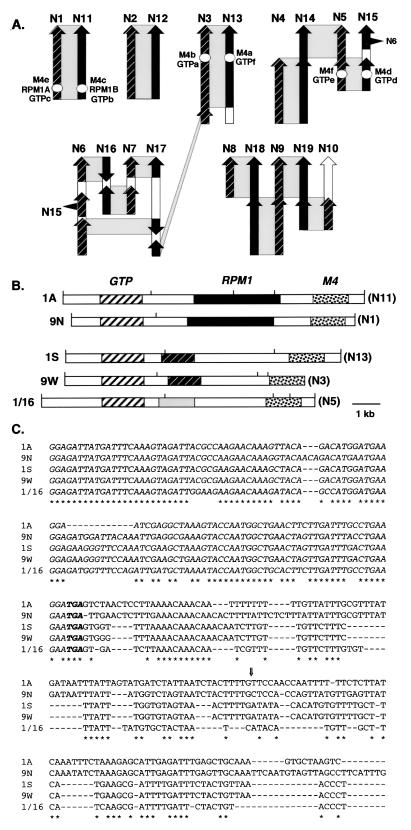
Location and structure of functional and null RPM1 loci in B. napus. (A) Schematic representation of the amphidiploid B. napus genome indicating the loci hybridizing to the Arabidopsis RPM1, M4, and GTP clones. Linkage groups N1 to N10 and N11 to N19 represent the A and C genomes, respectively. Hatched and filled areas of the arrows indicate regions of primary homeology between the A and C genomes. Unfilled areas represent regions for which primary homeology between the genomes has yet to be detected. (B) Schematic representation of RPM1 and rpm1-null loci, based on restriction mapping of phage clones. The locus names are listed on the left and the chromosomes to which they map are listed to the right. 1A and 9N contain RPM1, and the other three phage are rpm1-null. Ticks indicate either XhoI or XbaI restriction enzyme sites. The GTP, RPM1, and M4 genes are indicated above the figure. Equivalently shaded regions crosshybridize. Unshaded regions were not tested. (C) Sequence alignment at the 5′ breakpoint of sequence homology between B. napus RPM1 and rpm1-null. The 3′ ends of the GTP coding sequence are italicized, with stop codons emphasized in bold. Dashes represent gaps, and stars indicate sites that are identical among all five sequences. The arrow indicates the position at which similarity between the RPM1 and rpm1-null loci breaks down completely.
Figure 4
Figure 4
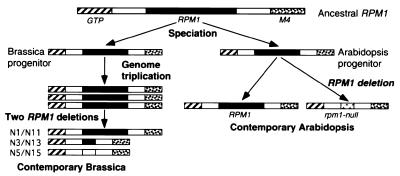
Model for the evolution of RPM1 in the Brassicaceae. The ancestral state of RPM1 is inferred from structural conservation between Arabidopsis and Brassica loci. Subsequent deletion events are hypothesized to have occurred independently in Arabidopsis and Brassica because of structural dissimilarities between the Arabidopsis and Brassica null loci. The structural dissimilarity between the N5 and N3/N13 loci further suggests that RPM1 has been deleted twice in Brassica after the genome triplication.

References

    1. Staskawicz B J, Ausubel F M, Baker B J, Ellis J, Jones J D G. Science. 1995;268:661–667. - PubMed
    1. Crute I R. In: Mechanisms of Resistance to Plant Diseases. Fraser R S S, editor. Dordrecht, Holland: Kluwer Academic Press; 1985. pp. 80–143.
    1. Anderson P A, Lawrence G J, Morrish B C, Ayliffe M A, Finnegan E J, Ellis J G. Plant Cell. 1997;9:641–651. - PMC - PubMed
    1. Jia Y, Loh Y-T, Zhou J, Martin G B. Plant Cell. 1997;9:61–73. - PMC - PubMed
    1. Ori N, Eshed Y, Paran I, Presting G, Aviv D, Tanksley S, Zamir D, Fluhr R. Plant Cell. 1997;9:521–532. - PMC - PubMed

Publication types

MeSH terms

LinkOut - more resources