. 1999 Oct;121(2):517-24.
doi: 10.1104/pp.121.2.517.

Rapid and systemic accumulation of chloroplast mRNA-binding protein transcripts after flame stimulus in tomato

Collaborators, Affiliations

Rapid and systemic accumulation of chloroplast mRNA-binding protein transcripts after flame stimulus in tomato

A Vian et al. Plant Physiol. 1999 Oct.

Abstract

It has been shown that tomato (Lycopersicon esculentum) plants respond to flame wounding and electrical stimulation by a rapid (15 min) and systemic up-regulation of proteinase inhibitor (pin) genes. To find other genes having a similar expression pattern, we used subtractive cDNA screening between flamed and control plants to select clones up-regulated by flame wounding. We report the characterization of one of them, a chloroplast mRNA-binding protein encoded by a single gene and expressed preferentially in the leaves. Systemic gene expression in response to flaming in the youngest terminal leaf exhibited three distinct phases: a rapid and transient increase (5-15 min) in transcript accumulation, a decline to basal levels (15-45 min), and then a second, more prolonged increase (60-90 min). In contrast, after a mechanical wound the rapid, transient increase (5 min) was followed by a rapid decline to basal levels but no later, prolonged accumulation. In the petiole, the initial flame-wound-evoked transient increase (15 min) was followed by a continuous decline for 3 h. The nature of the wound signal(s) causing such rapid changes in transcript abundance is discussed in relation to electrical signaling, which has recently been implicated in plant responses to wounding.


Figures
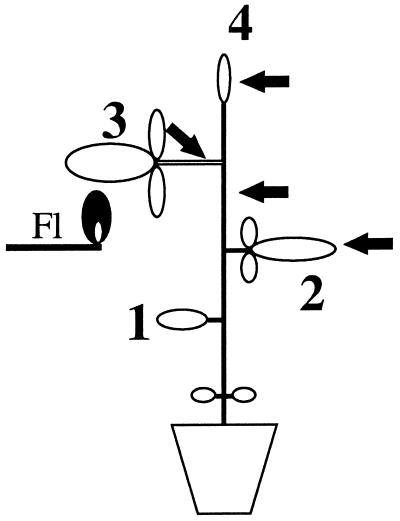
Figure 1
Figure 1
Schematic drawing showing the stimulation treatment. Three-week-old plants (12 cm in height) were used for all experiments. Stimulations were made on leaf 3 by flaming for 2 s with a gas lighter. The effects of this treatment were analyzed in intact, distant tissues (black arrows), including the petiole of the third leaf, the underlying internode, the terminal leaf (leaf 4), and the mature leaf (leaf 2).
Figure 2
Figure 2
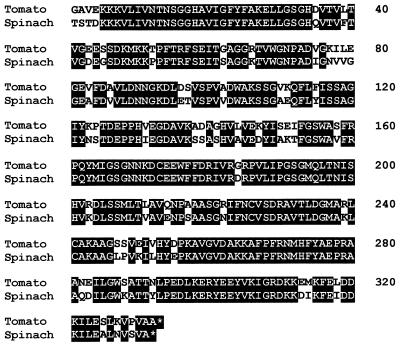
Sequence of clone B1-20. The predicted amino acid sequence of tomato is compared with spinach CMBP (Yang et al., 1996). The tomato CMBP shows an additional terminal amino acid (Ala). An incomplete chloroplast transit signal showing analogies with the spinach counterpart was also identified (data not shown). The complete cDNA sequence is available in GenBank under the accession no. AF106660.
Figure 3
Figure 3
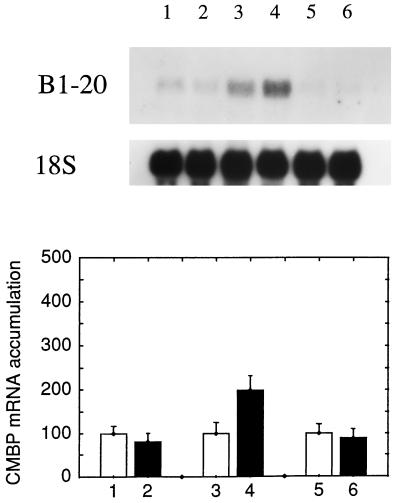
Accumulation of CMBP mRNA in various tissues. RNA was isolated from the petiole of the third (stimulated) leaf (lanes 1 and 2), the mature second leaf (lanes 3 and 4) or the internode (lanes 5 and 6). The plants were either non-stimulated controls (lanes 1, 3, and 5) or plants flamed on the third leaf for 60 min (lanes 2, 4, and 6), which corresponds to the time after flaming chosen for the tester condition in the subtraction procedure. B1-20, Hybridization using B1-20 cDNA as a probe. 18S, Control for equal loading of RNA (5 μg) in each lane using an 18S probe. Treatment values (black bars) are expressed relative to their respective controls (100%, white bars). Each point is the average of five replicates ± se.
Figure 4
Figure 4
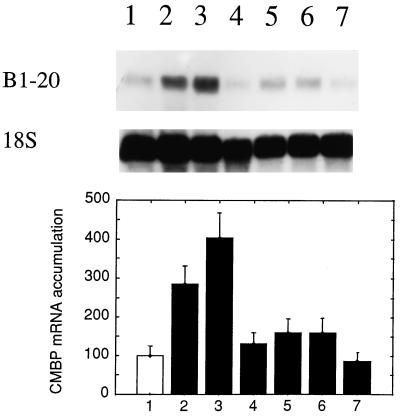
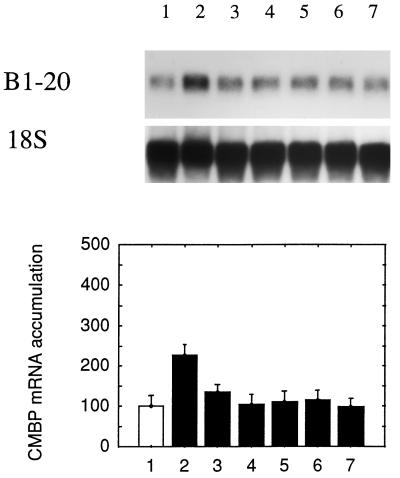
Kinetics of accumulation of CMBP mRNA in the fourth (terminal) leaf after flaming the third leaf. RNA was isolated from the fourth terminal leaf of control plants (lane 1), or 5, 15, 30, 60, 90, and 180 min after flaming the third leaf (lanes 2–7). B1-20, Hybridization using B1-20 cDNA as a probe. 18S, Control for equal loading of RNA (5 μg) in each lane using an 18S probe. Treatment values (black bars) are expressed relative to the control (100%, white bar). Each point is the average of six replicates ± se.
Figure 5
Figure 5
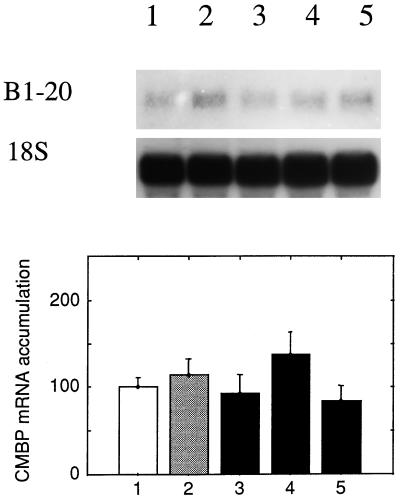
Accumulation of CMBP mRNA after flaming plants in the dark. RNA was isolated from the fourth terminal leaf of unflamed plants subjected to normal light culture conditions (lane 1), from plants placed in the dark for 24 h and harvested without prior treatment (lane 2), or 15, 30, and 60 min after flaming the third leaf (lanes 3–5). B1-20, Hybridization using B1-20 cDNA as a probe. 18S, Control for equal loading of RNA (5 μg) in each lane using an 18S probe. Treatment values (black bars) and the dark control (gray bar) are expressed relative to the light control (100%, white bar). Each point is the average of four replicates ± se.
Figure 6
Figure 6
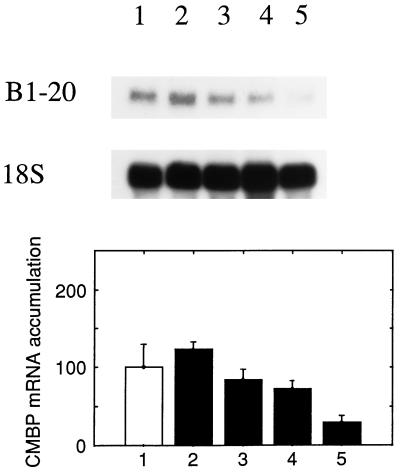
Kinetics of accumulation of CMBP mRNA in the petiole of the third leaf after flaming the third leaf. RNA was isolated from the petiole of the third leaf of control plants (lane 1) 15, 30, 60, and 180 min after flaming (lanes 2–5). B1-20, Hybridization using B1-20 cDNA as a probe. 18S, Control for equal loading of RNA (5 μg) in each lane using an 18S probe. Treatment values (black bars) are expressed relative to the control (100%, white bar). Each point is the average of five replicates ± se.
Figure 7
Figure 7
Kinetics of accumulation of CMBP mRNA in the fourth terminal leaf after mechanical wounding of the third leaf. RNA was isolated from the fourth terminal leaf of intact, non-stimulated plants (lane 1) or after mechanical wounding (crushing the third leaf with metal forceps). Tissue was harvested 5, 15, 30, and 60 min and 2 and 6 h after the treatment (lanes 2–7, respectively). B1-20, Hybridization using B1-20 cDNA as a probe. 18S, Control for equal loading of RNA (5 μg) in each lane using an 18S probe. Treatment values (black bars) are expressed relative to the control (100%, white bar). Each point is the average of five replicates ± se.

References

    1. Bergey DR, Howe GA, Ryan CA. Polypeptide signaling for plant defensive genes exhibits analogies to defense signaling in animals. Proc Natl Acad Sci USA. 1996;93:12053–12058. - PMC - PubMed
    1. Bergey DR, Orozco-Cardenas M, Ryan CA. A wound- and systemin-inducible polygalacturonase in tomato leaves. Proc Natl Acad Sci USA. 1999;96:1756–1760. - PMC - PubMed
    1. Bonaldo M de F, Lennon G, Soares MB. Normalization and subtraction: two approaches to facilitate gene discovery. Genome Res. 1996;6:791–806. - PubMed
    1. Braam J, Davis R W. Rain-, wind-, and touch-induced expression of calmodulin and calmodulin related genes in Arabidopsis. Cell. 1990;60:357–364. - PubMed
    1. Christensen AH, Sharrok RA, Quail PH. Maize polyubiquitin genes: structure, thermal perturbation of expression and transcript splicing, and promoter activity following transfer to protoplasts by electroporation. Plant Mol Biol. 1992;18:675–689. - PubMed

Publication types

MeSH terms

Associated data

LinkOut - more resources