. 2000 Apr;44(4):840-7.
doi: 10.1128/AAC.44.4.840-847.2000.

Horizontal transfer of parC and gyrA in fluoroquinolone-resistant clinical isolates of Streptococcus pneumoniae

Affiliations

Horizontal transfer of parC and gyrA in fluoroquinolone-resistant clinical isolates of Streptococcus pneumoniae

M J Ferrándiz et al. Antimicrob Agents Chemother. 2000 Apr.

Abstract

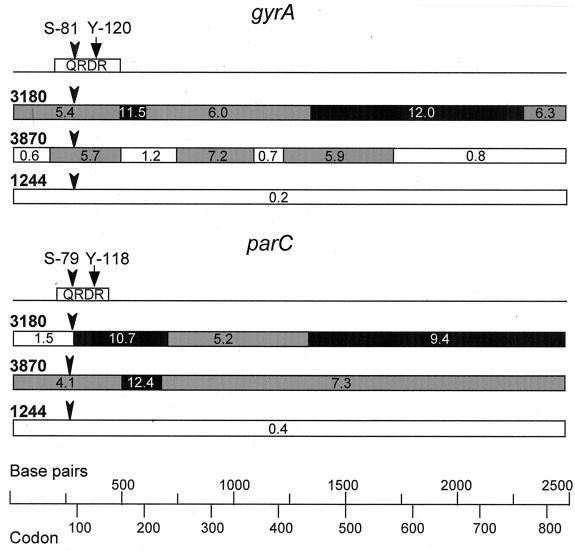
We have analyzed genetically three clinical isolates (3180, 3870, and 1244) of Streptococcus pneumoniae with high-level ciprofloxacin resistance. Isolates 3180 and 3870 were atypical because of their insolubility in deoxycholate. However, they hybridized specifically with pneumococcal autolysin and pneumolysin gene probes and have typical pneumococcal atpC and atpA gene sequences. Analysis of the complete sequences of the parC and gyrA genes revealed total variations of 8 and 8.7% (isolate 3180) and 7.4 and 3.6% (isolate 3870), respectively, compared to the wild-type strain R6 sequence. The variations observed between the sequences of R6 and isolate 1244 were less than 0.9%. The structure of the gyrA and parC genes from isolates 3180 and 3870 was organized in sequence blocks that show different levels of divergence, suggesting a pattern of recombination. These results are evidence for recombination at the fluoroquinolone target genes in clinical isolates of S. pneumoniae. The genetically related viridans group streptococci could act as a reservoir for fluoroquinolone resistance genes.


Figures
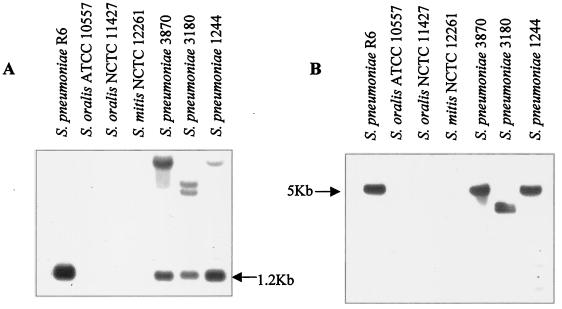
FIG. 1
FIG. 1
Identification of S. pneumoniae isolates by hybridization with specific DNA probes. Chromosomal DNAs from the S. oralis, S. mitis, and S. pneumoniae strains indicated were cleaved with HindIII (A) or ClaI (B), and the fragments were separated in 1% agarose gels. The gels were blotted, and the blots were probed with biotinylated DNA as follows: A, insert of plasmid pCE3 containing the N terminus of the lytA gene; and B, insert of plasmid pJCP191 containing the pnl gene.
FIG. 2
FIG. 2
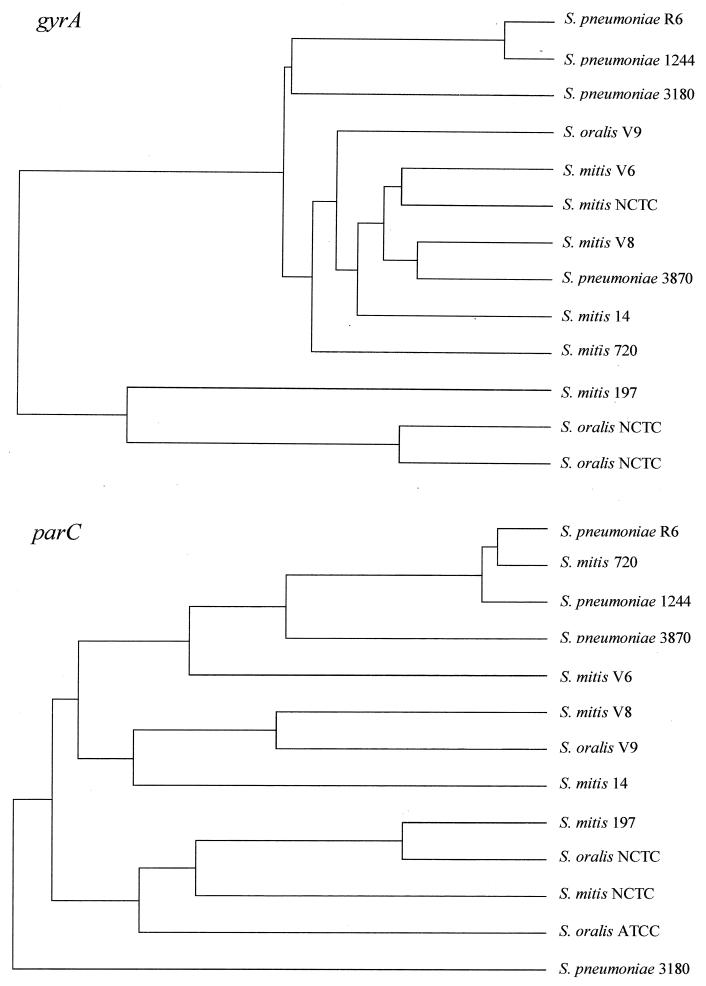
Trees of nucleotide sequences of parC and gyrA QRDRs. The 185-nucleotide parC sequence included positions 213 to 397, and the 280-nucleotide gyrA sequence included positions 175 to 454. Nucleotides are numbered by taking the first gyrA and parC nucleotides as nucleotide 1. The trees were compiled by using the CLUSTAL multiple-alignment program from PCGENE with default parameters. The nucleotide sequences used have been previously reported (20, 22, 36).
FIG. 3
FIG. 3
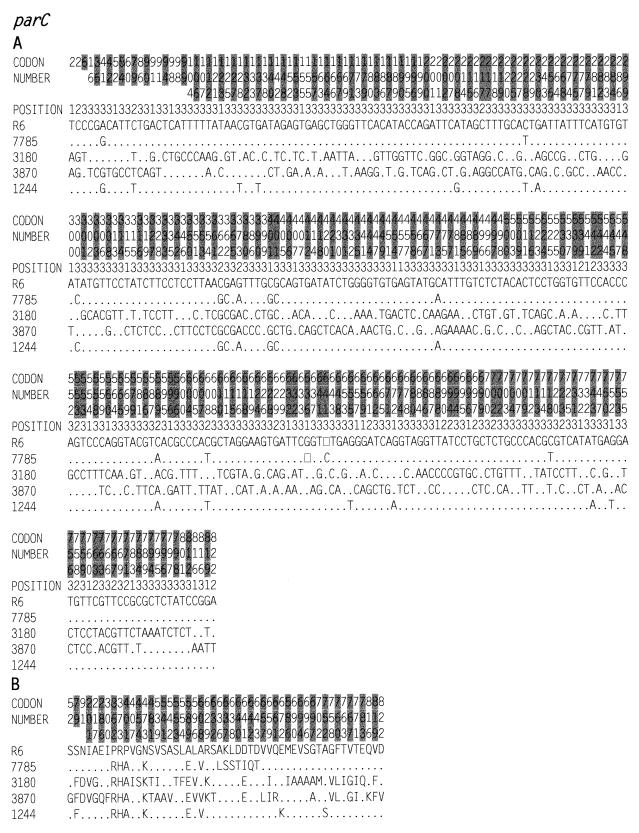
Nucleotide (A) and amino acid (B) sequence variations in the parC genes of S. pneumoniae strains. The nucleotides and amino acids present at each polymorphic site are shown in full for strain R6, but only sites that differ are shown for the other strains. Nucleotides and amino acids that are the same as in R6 are shown by dots. The codon numbers are indicated in vertical format above the sequences. The different codons are alternatively shaded in grey for clarity. Positions 1, 2, and 3 in the fourth row refer to the first, second, and third nucleotides in the codon. The sequence in panel A is numbered from the initiation codon of the parC gene. Open squares denote nucleotide deletions. The strains used were R6 (GenBank accession no. AF170996), 7785 (accession no. Z67739), 3180 (accession no. AF170997), 3870 (accession no. AF170998), and 1244 (accession no. AF170999).
FIG. 4
FIG. 4
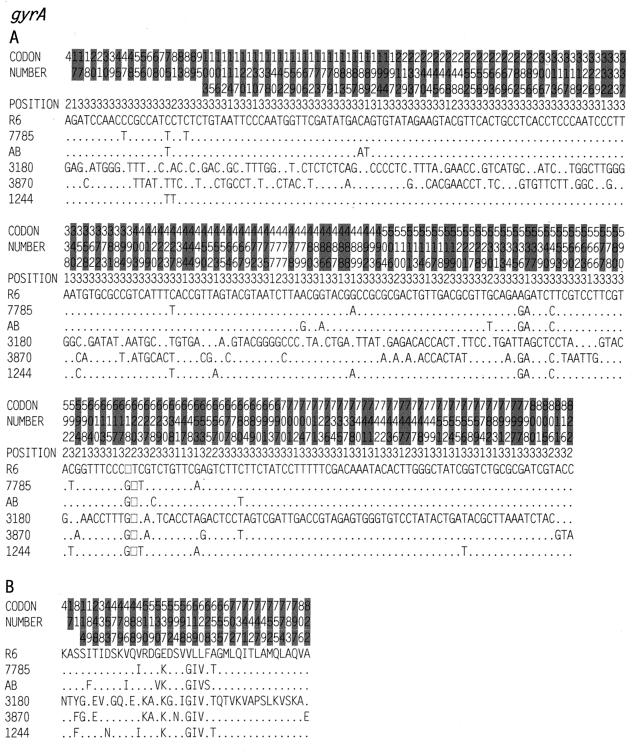
Nucleotide (A) and amino acid (B) sequence variations in the gyrA genes of S. pneumoniae strains. See the legend to Fig. 3 for details. Codons are numbered according to the R6 sequence. The strains used were R6 (GenBank accession no. AF053121), 7785 (accession no. AJ005815), AB (accession no. AB010387), 3180 (accession no. AF170993), 3870 (accession no. AF170994), and 1244 (accession no. AF170993).
FIG. 5
FIG. 5
Mosaic structure of the gyrA and parC genes of Cpr S. pneumoniae isolates 3180 and 3870. The locations of the QRDRs are represented above the gyrA and parC sequences. The positions of the active Tyr residues (Y-120 in GyrA and Y-118 in ParC) that bind DNA and of the Ser residues that are changed in the Cpr strains (S-81 in GyrA and S-79 in ParC) and are involved in resistance are marked. Blocks showing the percent sequence divergence from the corresponding regions in Cps pneumococci are indicated. White boxes, regions of sequence that differ by ≤1.5%; grey boxes, regions that differ by more than 1.5% but less than 9%; black boxes, regions that differ by >9%.

References

    1. Alcaide F, Carratala J, Liñares J, Gudiol F, Martín R. In vitro activities of eight macrolide antibiotics and RP-59500 (quinupristin-dalfopristin) against viridans group streptococci isolated from blood of neutropenic cancer patients. Antimicrob Agents Chemother. 1996;40:2117–2120. - PMC - PubMed
    1. Alcaide F, Liñares J, Pallarés R, Carratala J, Benítez M A, Gudiol F, Martín R. In vitro activity of 22 β-lactam antibiotics against penicillin-resistant and penicillin-susceptible viridans group streptococci isolated from blood. Antimicrob Agents Chemother. 1995;39:2243–2247. - PMC - PubMed
    1. Awada A P, Van der Auwera P, Meunier P, Daneau D, Klastersky J. Streptococcal and enterococcal bacteremia in patients with cancer. Clin Infect Dis. 1992;15:33–48. - PubMed
    1. Balas D, Fernández-Moreira E, de la Campa A G. Molecular characterization of the gene encoding the DNA gyrase A subunit of Streptococcus pneumoniae. J Bacteriol. 1998;180:2854–2861. - PMC - PubMed
    1. Baquero F. Epidemiology and management of penicillin-resistant pneumococci. Curr Opin Infect Dis. 1996;9:372–379.

Publication types

LinkOut - more resources