. 2001 Oct;39(10):3649-55.
doi: 10.1128/JCM.39.10.3649-3655.2001.

Detection of ciprofloxacin-resistant Yersinia pestis by fluorogenic PCR using the LightCycler

Affiliations

Detection of ciprofloxacin-resistant Yersinia pestis by fluorogenic PCR using the LightCycler

L E Lindler et al. J Clin Microbiol. 2001 Oct.

Abstract

We have developed a fluorescence resonance energy transfer (FRET)-based assay to detect ciprofloxacin resistant (Cp(r)) mutants of the biothreat agent Yersinia pestis. We selected spontaneous mutants of the attenuated Y. pestis KIM 5 strain that were resistant to a ciprofloxacin (CIP) concentration of at least 1 microg/ml. DNA sequencing of gyrA encoded by 65 of these mutants revealed that all isolates contained one of four different point mutations within the quinolone resistance-determining region of gyrA. We developed a FRET-based assay that detected all of these mutations by using a single pair of fluorescent probes with sequences complementary to the wild-type Y. pestis gyrA sequence. Melting peak analysis revealed that the probe-PCR product hybrid was less stable when amplification occurred from any of the four mutant templates. This instability resulted in the PCR product obtained from the Cp(r) Y. pestis strains displaying a 4 to 11 degrees C shift in probe melting temperature. Following optimization of the reaction conditions, we were able to detect approximately 10 pg of purified wild-type template DNA or the presence of approximately 4 CFU of wild-type Y. pestis KIM 5 or Cp(r) mutants in crude lysates. Taken together, our results demonstrate the utility of FRET-based assays for detection of Cp(r) mutants of Y. pestis. This method is both sensitive and rapid.


Figures
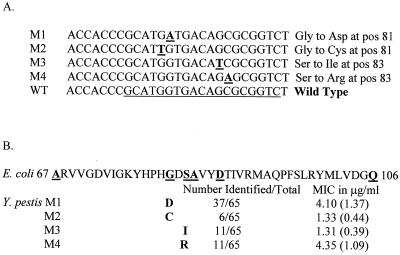
FIG. 1
FIG. 1
Nucleotide sequence and protein changes in Y. pestis Cpr mutants. (A) DNA sequences of wild-type (WT) Y. pestis gyrA and the four point mutants, identified as M1 through M4, corresponding to their designations in the text. Underlined nucleotides in the WT sequence denote the FRET assay probe 1. Nucleotide substitutions in mutants M1 through M4 are boldfaced and underlined. Amino acid substitutions and the position relative to E. coli GyrA (3) are given on the right. (B) Amino acid changes, isolation frequency, and CIP MIC for the various Cpr mutants. Amino acid numbering (67 to 106) is relative to the E. coli GyrA sequence (3) and is indicated to the left and right of the sequence. Boldfaced, underlined letters indicate amino acid changes in the QRDR of E. coli GyrA that have been shown to result in Cpr. MICs for the Y. pestis mutants determined by duplicate E Tests in five independent experiments are shown as averages with standard deviations in parentheses. Amino acid changes for mutants M1 through M4 are shown as boldfaced letters below the corresponding positions in the E. coli QRDR.
FIG. 2
FIG. 2
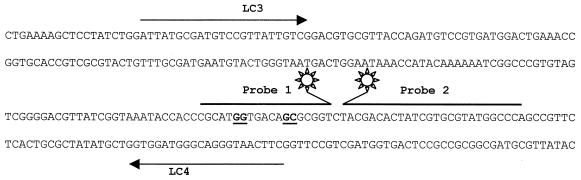
Schematic representation of the hybridization probe assay for Cpr in Y. pestis. PCR primers are represented by arrows above or below the Y. pestis gyrA sequence and are labeled LC3 and LC4. Probe 1 and probe 2 are shown between LC3 and LC4. The starbursts at the 3′ and 5′ termini of probe 1 and probe 2, respectively, indicate light reactive labels. Probe 1 is homologous with the wild-type Y. pestis gyrA sequence. The positions of the four point mutations described in Fig. 1A are indicated (boldfaced, underlined letters) in the wild-type DNA sequence below probe 1. The Tm of probe 1 was chosen to be less than that of probe 2 such that detection of melting of the probes from the PCR product would be dependent on the stability of probe 1 with the product.
FIG. 3
FIG. 3
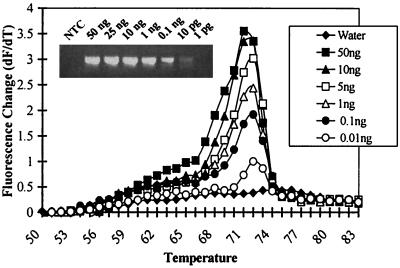
Sensitivity of the hybridization probe CIP assay. The graph shows the melting peak analysis of the probe-PCR product hybrid as the change in fluorescence with the change in time (dF/dT) versus hybrid temperature at the various DNA concentrations. The 0.001-ng template reaction mixture was indistinguishable from the no-template control (water). NTC, no-template control.
FIG. 4
FIG. 4
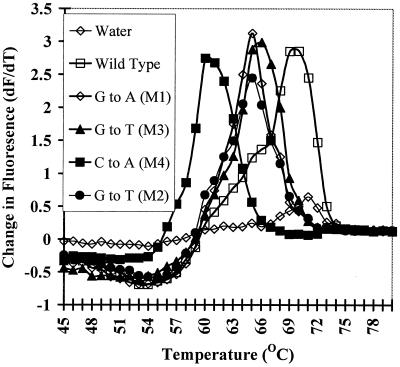
FRET assay for Cpr detection using purified template DNA of mutant and wild-type Y. pestis. Wild-type and mutant templates were used in the PCR amplification followed by melting peak analysis. The graph is of the change in fluorescence as a function of time (dF/dT) versus the temperature of the reaction products. The templates used in the various reactions are given in the key. Mutant designations in parentheses are as shown in Fig. 1A. All mutant templates produced a lower Tm than did the 100% match between probe 1 and the wild-type template. The template concentration was 10 μg/ml for all reactions.
FIG. 5
FIG. 5
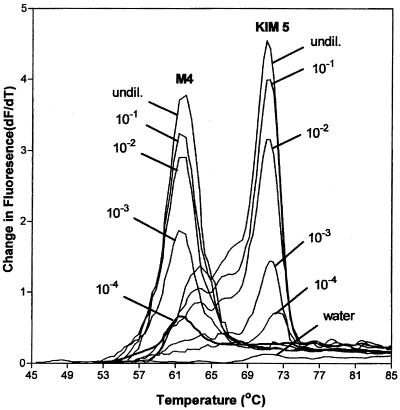
Detection of Cpr mutations in crude whole-cell lysates. Single colonies were grown in broth for 3 h at 30°C before being harvested. Shown is a melting peak analysis of various concentrations of wild-type Y. pestis or Cpr mutant M4. Bacteria used in the reactions are given above each melting peak. Curves obtained with each dilution are labeled. The sample labeled “undil.” represents the reaction obtained with undiluted bacterial suspensions. The 2-μl sample used in the FRET PCR labeled “undil.” contained 4 × 10⁴ CFU. Suspensions of bacteria were diluted before lysis by boiling to simulate different concentrations of organisms that might be obtained after the 3-h growth period. The curve labeled “water” represents the no-template control sample.

References

    1. Altschul S F, Gish W, Miller W, Myers E W, Lipman D J. Basic local alignment search tool. J Mol Biol. 1990;215:403–410. - PubMed
    1. Balfour J A, Faulds D. Oral ciprofloxacin: a pharmacoeconomic evaluation of its use in the treatment of serious infections. Pharmacoeconomics. 1993;3:398–421. - PubMed
    1. Blattner F R, Plunkett III G, Bloch C A, Perna N T, Burland V, Riley M, Collado-Vides J, Glasner J D, Rode C K, Mayhew G F, Gregor J, Davis N W, Kirkpatrick H A, Goeden M A, Rose D J, Mau B, Shao Y. The complete genome sequence of Escherichia coli K-12. Science. 1997;277:1453–1474. - PubMed
    1. Cambau E, Bordon F, Collatz E, Gutmann L. Novel gyrA point mutation in a strain of Escherichia coli resistant to fluoroquinolones but not to nalidixic acid. Antimicrob Agents Chemother. 1993;37:1247–1252. - PMC - PubMed
    1. Caplin B E, Rasmussen R P, Bernard P S, Wittwer C T. LightCycler hybridization probes: the most direct way to monitor PCR amplification for quantitation and mutation detection. Biochemica. 1999;1:5–9.

Publication types