


Influence of sulfide and temperature on species composition and community structure of hot spring microbial mats
- PMID: 10877776
- PMCID: PMC92081
- DOI: 10.1128/AEM.66.7.2835-2841.2000
Influence of sulfide and temperature on species composition and community structure of hot spring microbial mats
Abstract
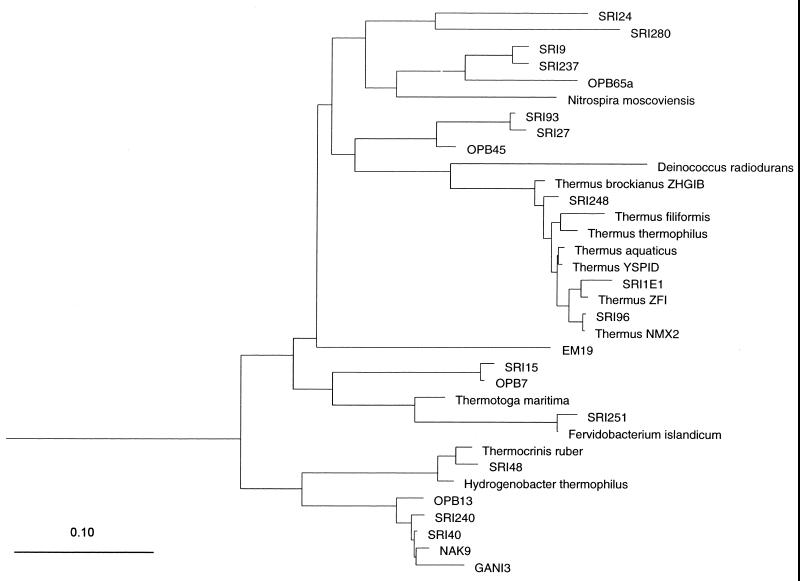
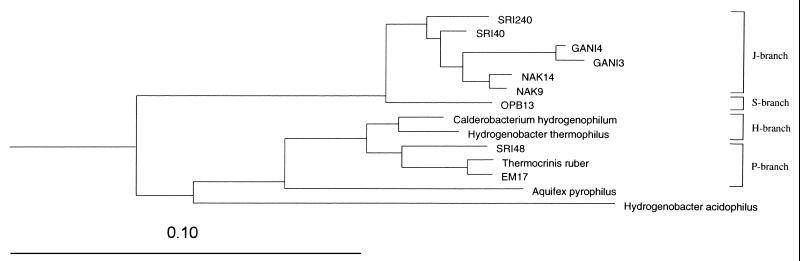
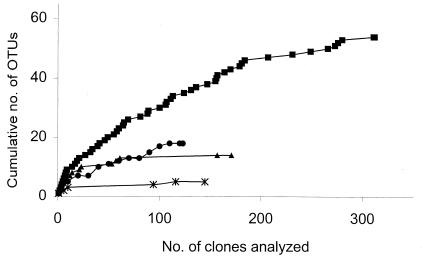
In solfataric fields in southwestern Iceland, neutral and sulfide-rich hot springs are characterized by thick bacterial mats at 60 to 80 degrees C that are white or yellow from precipitated sulfur (sulfur mats). In low-sulfide hot springs in the same area, grey or pink streamers are formed at 80 to 90 degrees C, and a Chloroflexus mat is formed at 65 to 70 degrees C. We have studied the microbial diversity of one sulfur mat (high-sulfide) hot spring and one Chloroflexus mat (low-sulfide) hot spring by cloning and sequencing of small-subunit rRNA genes obtained by PCR amplification from mat DNA. Using 98% sequence identity as a cutoff value, a total of 14 bacterial operational taxonomic units (OTUs) and 5 archaeal OTUs were detected in the sulfur mat; 18 bacterial OTUs were detected in the Chloroflexus mat. Although representatives of novel divisions were found, the majority of the sequences were >95% related to currently known sequences. The molecular diversity analysis showed that Chloroflexus was the dominant mat organism in the low-sulfide spring (1 mg liter(-1)) below 70 degrees C, whereas Aquificales were dominant in the high-sulfide spring (12 mg liter(-1)) at the same temperature. Comparison of the present data to published data indicated that there is a relationship between mat type and composition of Aquificales on the one hand and temperature and sulfide concentration on the other hand.
Figures
References
-
- Aragno M. Aerobic, chemolithoautotrophic, thermophilic bacteria. In: Kristjansson J K, editor; Kristjansson J K, editor. Thermophilic bacteria. Boca Raton, Fla: CRC Press, Inc.; 1992. pp. 77–103.
-
- Arnorsson, S. Isotopic and chemical techniques in geothermal exploration and use, in press. International Atomic Energy Agency.
-
- Atlas R M, Bartha R. Microbial ecology: fundamentals and applications. 3rd ed. Redwood City, Calif: The Benjamin/Cummings Publishing Company; 1993.
Publication types
MeSH terms
Substances
Associated data
- Actions
- Actions
- Actions
- Actions
- Actions
- Actions
- Actions
- Actions
- Actions
- Actions
- Actions
- Actions
- Actions
- Actions
- Actions
- Actions
- Actions
- Actions
- Actions
LinkOut - more resources
Full Text Sources
Molecular Biology Databases
