Comparative Study
. 2000 Jul 5;97(14):8010-4.
doi: 10.1073/pnas.130135897.

Identification of renox, an NAD(P)H oxidase in kidney

Affiliations
Comparative Study

Identification of renox, an NAD(P)H oxidase in kidney

M Geiszt et al. Proc Natl Acad Sci U S A. .

Abstract

Oxygen sensing is essential for homeostasis in all aerobic organisms, but its mechanism is poorly understood. Data suggest that a phagocytic-like NAD(P)H oxidase producing reactive oxygen species serves as a primary sensor for oxygen. We have characterized a source of superoxide anions in the kidney that we refer to as a renal NAD(P)H oxidase or Renox. Renox is homologous to gp91(phox) (91-kDa subunit of the phagocyte oxidase), the electron-transporting subunit of phagocytic NADPH oxidase, and contains all of the structural motifs considered essential for binding of heme, flavin, and nucleotide. In situ RNA hybridization revealed that renox is highly expressed at the site of erythropoietin production in the renal cortex, showing the greatest accumulation of renox mRNA in proximal convoluted tubule epithelial cells. NIH 3T3 fibroblasts overexpressing transfected Renox show increased production of superoxide and develop signs of cellular senescence. Our data suggest that Renox, as a renal source of reactive oxygen species, is a likely candidate for the oxygen sensor function regulating oxygen-dependent gene expression and may also have a role in the development of inflammatory processes in the kidney.


Figures
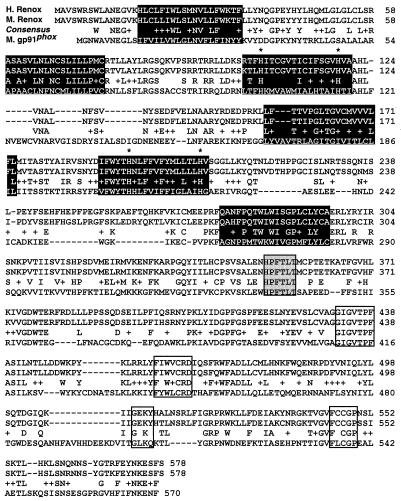
Figure 1
Figure 1
Comparison of the deduced amino acid sequences of murine (M.) and human (H.) Renox (GenBank accession nos. AF261944 and AF261943) with the sequence of the murine phagocyte NADPH oxidase homologue gp91phox. Renox contains all of the conserved structural features considered essential for NADPH oxidase activity in gp91phox, including the six proposed membrane-spanning segments (black boxes), FAD binding site (gray box), NADPH binding motifs (open boxes), and proposed heme binding histidines (asterisks; ref. , references therein, and refs. and 15). Conservative amino acid substitutions in all sequences are indicated in the consensus line by “+”.
Figure 2
Figure 2
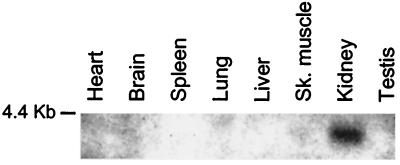
Northern blotting of various murine tissue RNAs with an oligonucleotide probe corresponding to the murine renox cDNA revealed high levels of this transcript in kidney. These results are representative of two independent blotting experiments. Kb, kilobase.
Figure 3
Figure 3
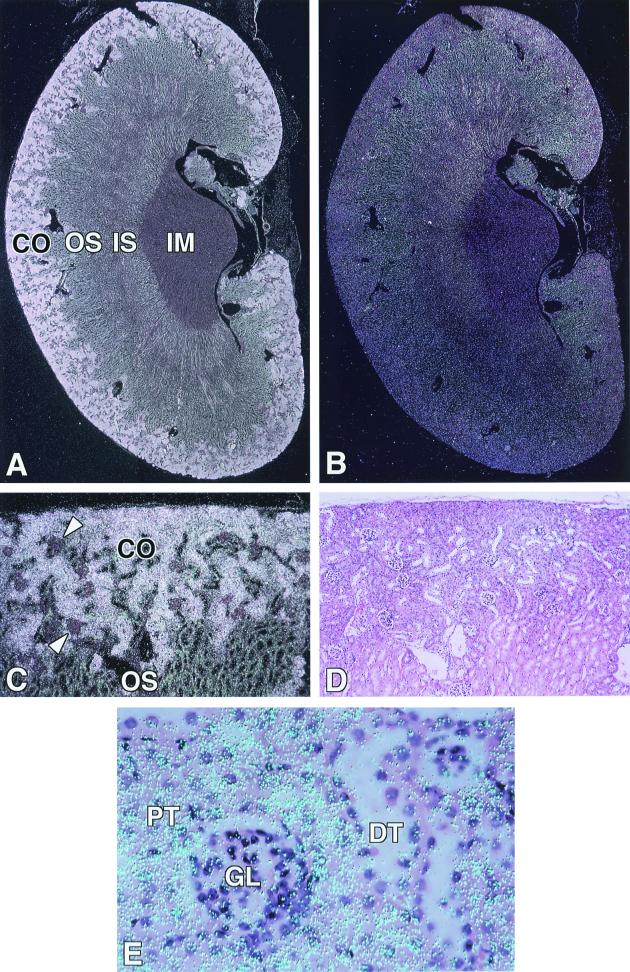
Detection of Renox mRNA in proximal convoluted tubule cells by in situ hybridization. Antisense (A, C, and E) and sense (B) probes demonstrated specific expression of Renox transcripts within the proximal convoluted tubule cells of the renal cortex (CO). (A–C) Dark-field images in which the positive silver grain signal appears white. (D) Hematoxylin/eosin staining of the field shown in C. (E) Superimposed polarized epi-illumination and bright-field images (in which the signal appears green). High magnification in E shows a strong positive signal in proximal tubule (PT) epithelial cells, whereas glomeruli (GL; marked by arrowheads in C) and distal tubule (DT) epithelial cells are negative for Renox mRNA expression. (A and B) ×14.5 magnification; (C and D) ×60; (E) ×500. OS, outer stripe of the medulla; IS, inner stripe of the medulla; IM, inner medulla. The expression patterns shown were confirmed in two other independent hybridization experiments.
Figure 4
Figure 4
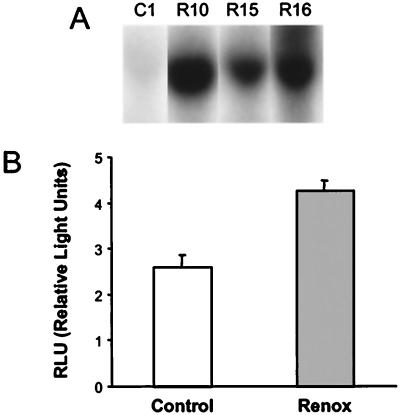
Transfection of NIH 3T3 cells with pcDNA3.1-renox resulted in increased production of superoxide. (A) Detection of the renox message by Northern blotting in transfected NIH 3T3 fibroblasts. Lane C1 represents a control cell line transfected with the empty vector, and R10, R15, and R16 correspond to cloned renox-transfected cell lines. (B) Detection of superoxide production in renox-transfected cell lines. The control bar represents cells transfected with empty pCDNA 3.1 vector. The data represent the average response of three control and three renox-transfected cell lines (shown in A) analyzed in two separate assays.
Figure 5
Figure 5
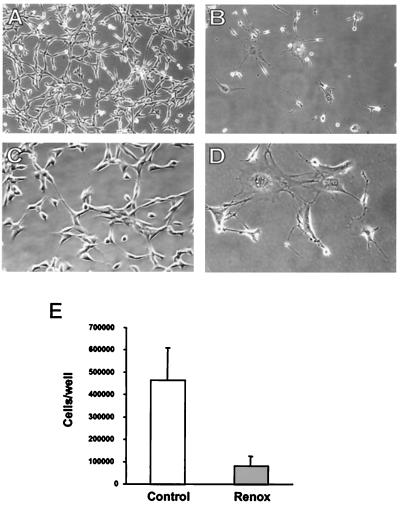
Renox transfection of NIH 3T3 cells resulted in the appearance of a senescent phenotype. (A and C) Control (empty vector-transfected) cells grew faster and exhibited uniform spindle-shaped morphology. (B and D) Renox transfectants were heterogeneous, flattened, and enlarged cells, frequently containing multiple nuclei. (E) Renox transfection inhibits the proliferation of NIH 3T3 cells. On day 1, wells were seeded with 10,000 cells per well of either control or renox-transfected cells. Cells were allowed to grow for 96 h and then counted on day 4. These phenotypic changes were observed in three separate transfection experiments. Data in E represent the average of three control and three renox-transfected cell lines, which were also analyzed in Fig. 4.

References

    1. Leto T L. In: Inflammation Basic Principles and Clinical Correlates. Gallin J I, Snyderman R, editors. Williams & Wilkins, Philadelphia: Lippincott; 1999. pp. 769–787.
    1. Adler V, Yin Z, Tew K D, Ronai Z. Oncogene. 1999;18:6104–6111. - PubMed
    1. Ebert B L, Bunn H F. Blood. 1999;94:1864–1877. - PubMed
    1. Suh Y A, Arnold R S, Lassegue B, Shi J, Xu X, Sorescu D, Chung A B, Griendling K K, Lambeth J D. Nature (London) 1999;401:79–82. - PubMed
    1. Dupuy C, Ohayon R, Valent A, Noel-Hudson M S, Deme D, Virion A. J Biol Chem. 1999;274:37265–37269. - PubMed

Publication types

MeSH terms

Associated data