. 2010 Oct;22(10):3390-409.
doi: 10.1105/tpc.110.078543. Epub 2010 Oct 19.

Clustered transcription factor genes regulate nicotine biosynthesis in tobacco

Affiliations

Clustered transcription factor genes regulate nicotine biosynthesis in tobacco

Tsubasa Shoji et al. Plant Cell. 2010 Oct.

Abstract

Tobacco (Nicotiana tabacum) synthesizes nicotine and related pyridine alkaloids in the root, and their synthesis increases upon herbivory on the leaf via a jasmonate-mediated signaling cascade. Regulatory NIC loci that positively regulate nicotine biosynthesis have been genetically identified, and their mutant alleles have been used to breed low-nicotine tobacco varieties. Here, we report that the NIC2 locus, originally called locus B, comprises clustered transcription factor genes of an ethylene response factor (ERF) subfamily; in the nic2 mutant, at least seven ERF genes are deleted altogether. Overexpression, suppression, and dominant repression experiments using transgenic tobacco roots showed both functional redundancy and divergence among the NIC2-locus ERF genes. These transcription factors recognized a GCC-box element in the promoter of a nicotine pathway gene and specifically activated all known structural genes in the pathway. The NIC2-locus ERF genes are expressed in the root and upregulated by jasmonate with kinetics that are distinct among the members. Thus, gene duplication events generated a cluster of highly homologous transcription factor genes with transcriptional and functional diversity. The NIC2-locus ERFs are close homologs of ORCA3, a jasmonate-responsive transcriptional activator of indole alkaloid biosynthesis in Catharanthus roseus, indicating that the NIC2/ORCA3 ERF subfamily was recruited independently to regulate jasmonate-inducible secondary metabolism in distinct plant lineages.


Figures
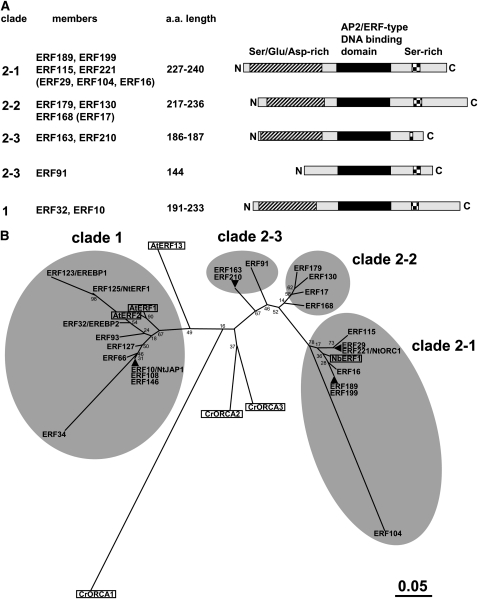
Figure 1.
Figure 1.
Group IXa ERF Members in Tobacco. (A) Structure of tobacco IXa ERFs. Diagrams show the positions of the conserved AP2/ERF DNA binding domain, a Ser/Asp/Glu-rich region, and a short Ser stretch in four clades (1, 2-1, 2-2, and 2-3). Available cDNA clones for ERF29, ERF104, ERF16, and ERF17 (shown in parentheses) do not contain full-length coding sequences. ERF91 is truncated at the N terminus. a.a., amino acid. (B) Phylogenetic tree of tobacco IXa ERFs and other homologous proteins based on the alignment of their AP2/ERF domain sequences (available as Supplemental Data Set 1 online). The tree was generated using MEGA4 software (Tamura et al., 2007) with the neighbor-joining algorithm. Bootstrap values are indicated at branch nodes, and the scale bar indicates the number of amino acid substitutions per site. Two or three ERFs located at the same place (e.g., ERF189 and ERF199) indicate homologous tobacco ERF proteins whose AP2/ERF domains are identical in amino acid sequence. At ERF1 (At4g17500), At ERF2 (At5g47220), and At ERF13 (At2g44840) are from Arabidopsis, Cr ORCA1, Cr ORCA2, and Cr ORCA3 are from C. roseus, and Nb ERF1 is from N. benthamiana.
Figure 2.
Figure 2.
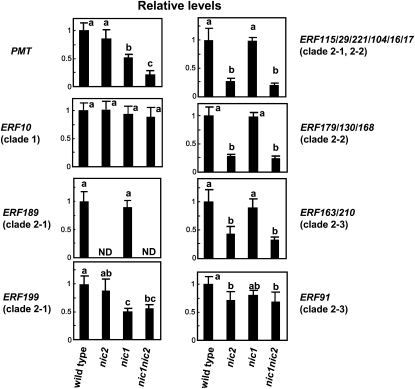
Expression Levels of Clade 2 ERF Genes Are Affected in nic Mutant Roots. Transcript levels of clade 2 ERFs, ERF10 (clade 1), and PMT in the tobacco roots of different NIC genotypes were measured by qRT-PCR and are shown relative to the wild-type levels. ERF115/29/221/104/16/17, ERF179/130/168, and ERF163/210 were collectively amplified by the PCR primers used (see Supplemental Figure 3 online for breakdown of the amplified ERF proportions). Error bars represent sd of three replicates. Significant differences among the genotypes at P < 0.05 were determined by one-way analysis of variance (ANOVA) followed by the Tukey-Kramer test and are indicated by different letters. ND, not detected.
Figure 3.
Figure 3.
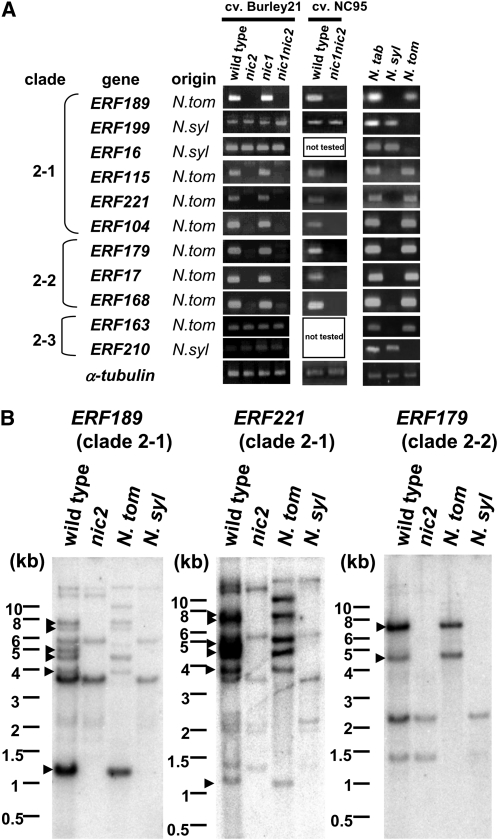
Seven ERF Genes Originating from N. tomentosiformis Are Absent in nic2 Mutants. (A) Genomic PCR analysis of clade 2 ERF genes. Genomic DNA templates from tobacco (N. tabacum; cv Burley 21 of the wild type, nic2, nic1, and nic1 nic2 and cv NC 95 of the wild type and nic1 nic2), N. sylvestris (N. syl), and N. tomentosiformis (N. tom) were amplified with the primers specific to the indicated ERF genes. The tobacco α-tubulin gene was analyzed as a control. (B) Genomic DNA gel bolt analysis of clade 2 ERF genes. Genomic DNA samples from tobacco (the wild type and nic2), N. sylvestris (N. syl), and N. tomentosiformis (N. tom) were digested by HindIII, blotted on a membrane, and probed with cDNA fragments from ERF189, ERF221, or ERF179, which showed high, but not exclusive, specificity to the target genes (see Supplemental Figure 4A online). DNA fragments missing in nic2 are marked by arrowheads. The numbers on the left sides of blots show the sizes of marker fragments in kilobases. The hybridization data for clade 2-3 ERFs are available in Supplemental Figure 4B online.
Figure 4.
Figure 4.
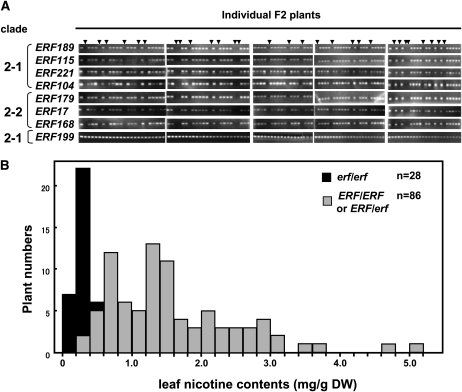
Seven ERF Genes Are Clustered at the NIC2 Locus. (A) Cosegregation of ERF genes. A genetic cross between nic1 and nic1 nic2 produced a population of tobacco F2 plants (n = 114) in which deletions of ERF genes found in nic2 segregated in the nic1 background. The presence or absence of ERF genes was analyzed by genomic PCR. Arrowheads indicate individual F2 plants in which homozygous deletions of ERF genes (erf/erf) were observed. ERF199 was analyzed as a control for nondeleted ERF genes. (B) The low-nicotine phenotype of the nic2 mutation is genetically linked with the ERF deletion. The F2 plants analyzed in (A) (n = 114) were used to determine nicotine levels in the leaves. The plants in which the seven ERF genes were not detected (erf/erf; n = 28) are indicated with black bars, while the plants in which these ERF genes were present (ERF/ERF or ERF/erf; n = 86) are shown with gray bars. DW, dry weight.
Figure 5.
Figure 5.
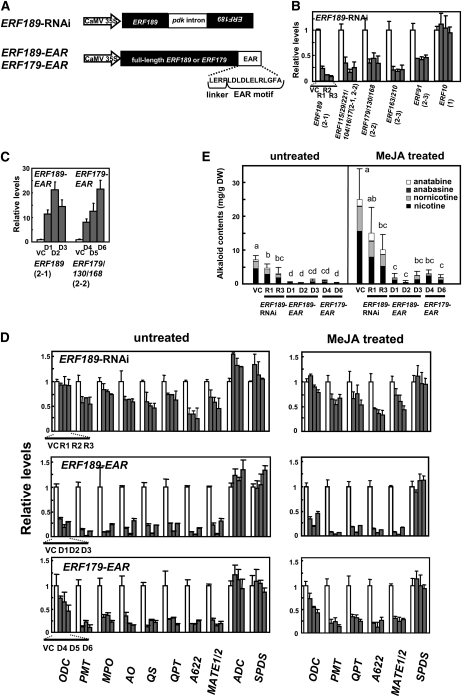
Downregulation or Dominant Repression of NIC2-Locus ERF Genes Inhibits Nicotine Biosynthesis in Transgenic Tobacco Roots. Transcript levels are shown relative to empty vector control values, and error bars indicate the sd for three biological replicates. Clade numbers are indicated in parentheses. (A) Schematic diagrams of the ERF189-RNAi, ERF189-EAR, and ERF179-EAR constructs. The ERF189-RNAi construct contains an intron of PDK (pyruvate orthophosphate dikinase from Flaveria trinerva) and two flanking ERF189 fragments in opposite orientations. ERF189-EAR and ERF179-EAR are fusion proteins with an EAR motif attached to the C termini of ERF189 and ERF179 via a short linker. (B) Transcript levels of ERF genes in three ERF189 lines (R1 to R3; gray bars) and a vector control line (VC; white bars). Expression levels of clade 2 ERFs and clade 1 ERF10 were analyzed by qRT-PCR. (C) Transcript levels of ERF genes in three ERF189-EAR lines (D1 to D3), three ERF179-EAR lines (D4 to D6), and a vector control line (VC). qRT-PCR was used to measure expression levels of both the endogenous ERF genes and the introduced transgenes. (D) Transcript levels of tobacco metabolic enzyme genes. Tobacco hairy roots were cultured in the absence or presence of 100 μM MeJA for 24 h and analyzed for expression of the structural genes of nicotine biosynthesis (ODC, MPO, PMT, AO, QS, QPT, A622, and MATE1/2) and the control genes (ADC and SPDS) by qRT-PCR. In the VC line, MeJA increased the transcript levels as follows: ODC, 5.6-fold; PMT, 9.5-fold; QPT, 8.4-fold; A622, 9.2-fold; MATE1/2, 7.2-fold; and SPDS, 1.1-fold. (E) Alkaloid levels in the transgenic root lines. In one experiment, tobacco hairy roots were treated with 100 μM MeJA for 3 d. Significant differences among the lines were determined at P < 0.05 by one-way analysis of variance, followed by the Tukey-Kramer test, and are indicated by different letters. DW, dry weight.
Figure 6.
Figure 6.
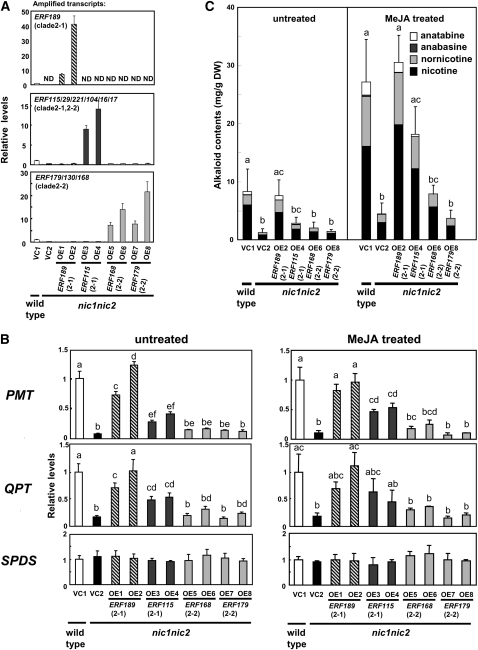
Complementation of nic1 nic2 Roots by Overexpression of ERF Genes. Transcript levels are shown relative to the values for the wild type transformed with the empty vector (VC1), and error bars indicate the sd for three biological replicates. Significant differences among the lines were determined at P < 0.05 by one-way ANOVA, followed by the Tukey-Kramer test, and are indicated by different letters. Clade numbers are indicated in parentheses. (A) Overexpression of ERF189, ERF115, ERF168, or ERF179 in nic1 nic2 tobacco hairy roots. The vector control lines VC1 and VC2 were generated by transforming wild-type and nic1 nic2 plants, respectively, with an empty vector. Transcript levels include both the endogenous genes and the transgenes. ND, not detected. (B) Relative expression levels of PMT, QPT, and SPDS in the transgenic root lines. For MeJA treatment, the hairy roots were elicited with 100 μM MeJA for 24 h. In the VC1 line, MeJA increased the transcript levels as follows: PMT, 8.7-fold; QPT, 7.9-fold; and SPDS, 1.2-fold. (C) Alkaloid levels in the transgenic root lines. The right graph shows data from tobacco hairy roots treated with 100 μM MeJA for 3 d. DW, dry weight.
Figure 7.
Figure 7.
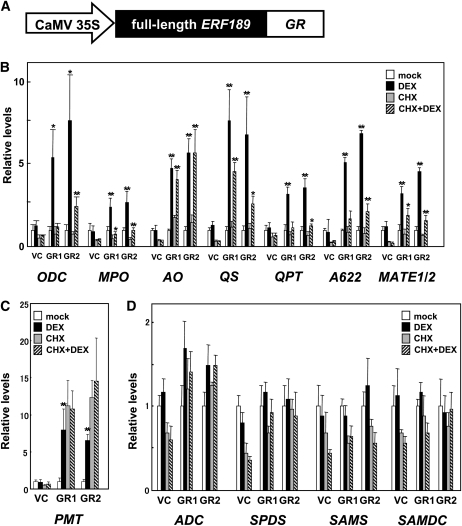
Steroid-Induced Activation of ERF189-GR Increases the Expression of Genes for Nicotine Biosynthesis in Tobacco Roots. Hairy root lines were treated with DEX, CHX, or both (DEX+CHX) at 10 μM for 4 h. Transcript levels are shown relative to the solvent-treated mock values, and error bars indicate the sd for three biological replicates. Significant differences were determined by Student’s t test for DEX treatment versus the mock control and for DEX+CHX treatment versus CHX treatment. *P < 0.05 and **P < 0.01. (A) Schematic diagram of ERF189-GR construct. GR, glucocorticoid receptor. (B) Expression levels of the genes for nicotine biosynthesis in two independent ERF189-GR–transformed lines (GR1 and GR2) and a vector-transformed line (VC). (C) Expression levels of PMT. Transcript levels of PMT increased dramatically after the CHX treatment in the GR lines. (D) Expression levels of the control genes.
Figure 8.
Figure 8.
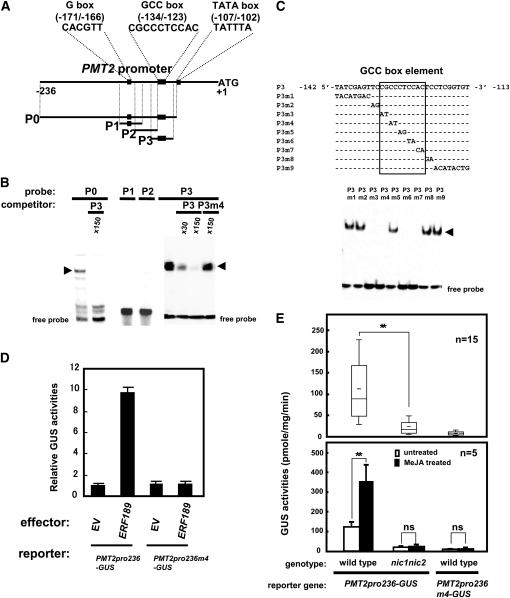
In Vitro Binding of Recombinant ERF189 to the GCC-Box Element in the PMT2 Promoter. (A) Schematic representation of a 236-bp N. sylvestris PMT2 proximal promoter region. Positions of the probes P0 (−236 to −105), P1 (−182 to −153), P2 (−162 to −133), and P3 (−142 to −113) are shown. Core sequences of G-box (−171 to 186), GCC-box (−134 to −123), and TATA-box (−107 to −102) are indicated in black boxes. (B) EMSA of recombinant ERF189 in a complex with P0, P1, P2, or P3. Excess molar amounts (×30 or ×150) of unlabeled probes (P3 or P3m4) were used as competitors. The arrowheads indicate the ERF189-probe complexes. (C) Binding of recombinant ERF189 to a series of mutant P3 probes (P3m1 to P3m9). Substituted nucleotide sequences are shown, while the unchanged sequences are indicated with dashes. A core GCC-box element is boxed. (D) Transactivation of the PMT2pro236-GUS reporter and its mutant PMT2pro236m4-GUS. Cultured tobacco cells were bombarded with a combination of the reporter plasmid, a luciferase-expressing control plasmid, and either an ERF189-expressing effector plasmid or an empty plasmid (EV). GUS activity in the cell extracts is shown relative to the luciferase activity. The error bars indicate the sd for three biological replicates. (E) Activity of the PMT2 promoter depends on the NIC loci and the GCC-box in transgenic tobacco roots. PMT2pro236-GUS and PMT2pro236m4-GUS reporter constructs were expressed in wild-type or nic1 nic2 tobacco hairy roots. Mean (horizontal line segment in box) and 95 (top of bar), 75 (top of box), 50 (horizontal line in box), 25 (bottom of box), and 5 (bottom of bar) percentile values of GUS activity from 15 independent transgenic lines are shown in the top panel. Five lines showing near-mean GUS activity were chosen from each group and then assayed under both untreated and MeJA-treated conditions (bottom panel). Tobacco hairy roots were treated with 100 μM MeJA for 24 h. Error bars represent sd. Significant differences were determined by Student’s t test between the indicated pairs. **P < 0.01; ns, not significant.
Figure 9.
Figure 9.
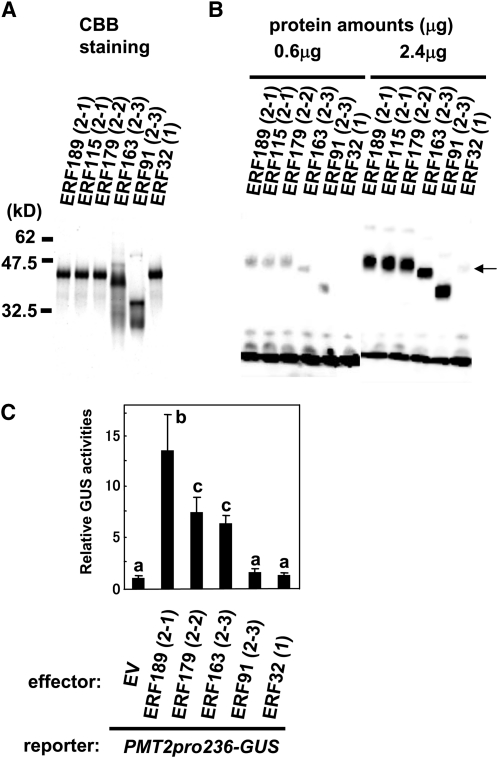
Clade 2 ERFs Differentially Bind and Activate a PMT2 Promoter. (A) The purity of recombinant ERF189, ERF115, ERF179, ERF163, ERF91, and ERF32 proteins was analyzed by separation on a 12% SDS-PAGE gel and subsequent staining with Coomassie Brilliant Blue (CBB). The molecular mass of marker proteins is shown on the left in kilodaltons. Clade numbers are indicated in parentheses. (B) EMSA of recombinant ERF proteins with the probe P3 of the PMT2 promoter (see Figure 8A). Recombinant proteins were used at either 2.4 or 0.6 μg. The arrow on the right indicates a missing ERF32-P3 complex. (C) Transactivation of the PMT2pro236-GUS reporter with various ERF effectors. Cultured tobacco cells were bombarded with a combination of the reporter plasmid, a luciferase-expressing control plasmid, and either an ERF-expressing effector plasmid or an empty plasmid (EV). GUS activities in the cell extracts were shown relative to the luciferase activities. Error bars indicate the sd for three biological replicates. Significant differences among the effectors were determined at P < 0.05 by one-way ANOVA, followed by the Tukey-Kramer test and are indicated by different letters.
Figure 10.
Figure 10.
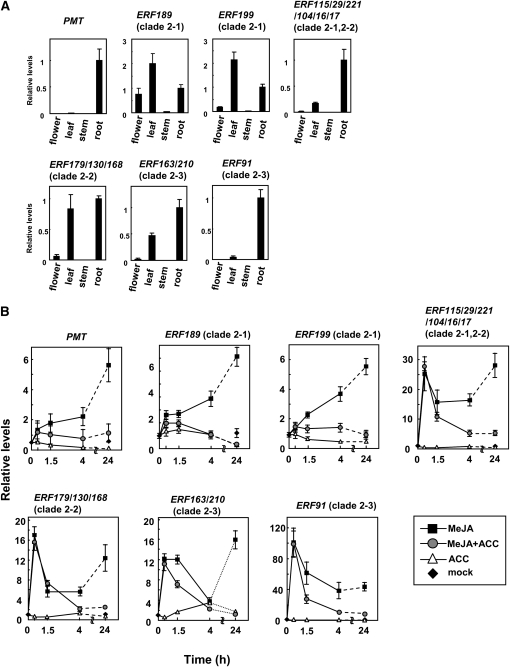
Expression Patterns of Clade 2 ERF Genes. Transcript levels were analyzed by qRT-PCR. The error bars indicate the sd for three biological replicates. Expression patterns of PMT are also shown as references. (A) Organ-specific expression. Expression levels in the flower, leaf, and stem of wild-type tobacco plants are shown relative to levels in the root. (B) Responses to MeJA and ACC. Wild-type tobacco hairy roots were treated with 100 μM MeJA (black square), 100 μM ACC (white triangle), or both (gray circle) for 0.5, 1.5, 4, and 24 h. Transcript levels of mock-treated samples (black diamonds) are shown at 0 and 24 h. All values are relative to the transcript levels at 0 h.

References

    1. Baldwin I.T. (1989). Mechanism of damage-induced alkaloid production in wild tobacco. J. Chem. Ecol. 15: 1661–1680 - PubMed
    1. Bednarek P., Osbourn A. (2009). Plant-microbe interactions: Chemical diversity in plant defense. Science 324: 746–748 - PubMed
    1. Cane K.A., Mayer M., Lidgett A.J., Michael A., Hamill J.D. (2005). Molecular analysis of alkaloid metabolism in AABB v. aabb genotype Nicotiana tabacum in response to wounding of aerial tissues and methyl jasmonate treatment of cultured roots. Funct. Plant Biol. 32: 305–320 - PubMed
    1. Chaplin J.F. (1975). Registration of LAFC 53 tobacco germplasm. Crop Sci. 15: 282
    1. Chini A., Fonseca S., Fernández G., Adie B., Chico J.M., Lorenzo O., García-Casado G., López-Vidriero I., Lozano F.M., Ponce M.R., Micol J.L., Solano R. (2007). The JAZ family of repressors is the missing link in jasmonate signalling. Nature 448: 666–671 - PubMed

Publication types

MeSH terms

LinkOut - more resources