


High resolution melting analysis for the detection of EMS induced mutations in wheat SBEIIa genes
- PMID: 22074448
- PMCID: PMC3228712
- DOI: 10.1186/1471-2229-11-156
High resolution melting analysis for the detection of EMS induced mutations in wheat SBEIIa genes
Abstract
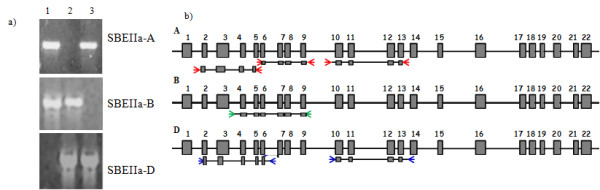
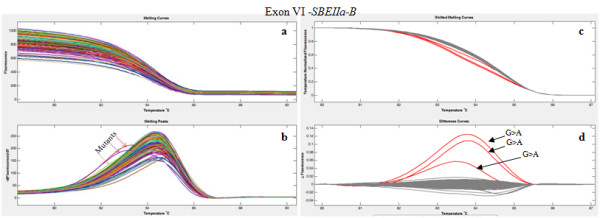
Background: Manipulation of the amylose-amylopectin ratio in cereal starch has been identified as a major target for the production of starches with novel functional properties. In wheat, silencing of starch branching enzyme genes by a transgenic approach reportedly caused an increase of amylose content up to 70% of total starch, exhibiting novel and interesting nutritional characteristics. In this work, the functionality of starch branching enzyme IIa (SBEIIa) has been targeted in bread wheat by TILLING. An EMS-mutagenised wheat population has been screened using High Resolution Melting of PCR products to identify functional SNPs in the three homoeologous genes encoding the target enzyme in the hexaploid genome.
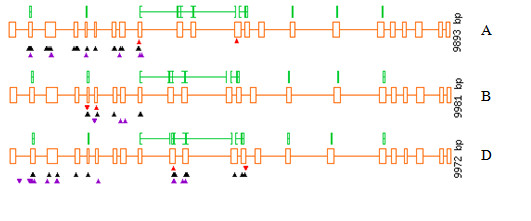
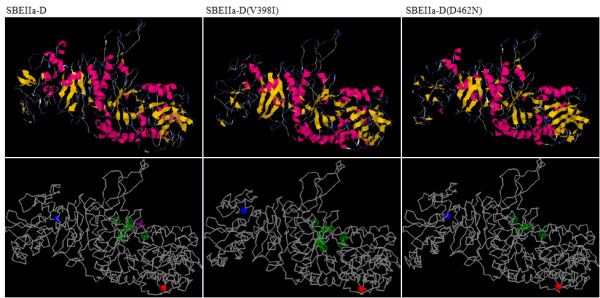
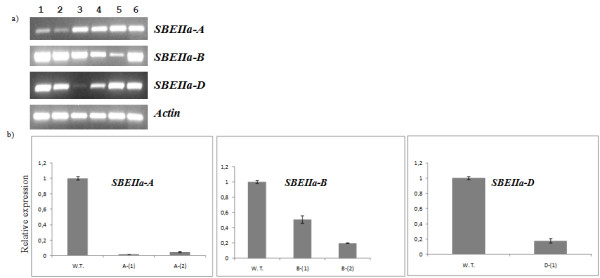
Results: This analysis resulted in the identification of 56, 14 and 53 new allelic variants respectively for SBEIIa-A, SBEIIa-B and SBEIIa-D. The effects of the mutations on protein structure and functionality were evaluated by a bioinformatic approach. Two putative null alleles containing non-sense or splice site mutations were identified for each of the three homoeologous SBEIIa genes; qRT-PCR analysis showed a significant decrease of their gene expression and resulted in increased amylose content. Pyramiding of different single null homoeologous allowed to isolate double null mutants showing an increase of amylose content up to 21% compared to the control.
Conclusion: TILLING has successfully been used to generate novel alleles for SBEIIa genes known to control amylose content in wheat. Single and double null SBEIIa genotypes have been found to show a significant increase in amylose content.
Figures
References
-
- Soh HN, Sisson MJ, Turner M. Effect of starch granule size distribution and elevated amylose content on durum dough rheology and spaghetti cooking quality. Cereal Chem. 2006;83:513–519. doi: 10.1094/CC-83-0513. - DOI
-
- Waring S. Functionality of resistant starch in food applications. 2005. http://eu.foodinnovation.com/pdfs/functresist.pdf
-
- Chanvrier H, Appelqvist IAM, Bird AR, Gilbert E, Htoon A, Li Z, Lillford PJ, Lopez-Rubi A, Morell MK, Topping DL. Processing of novel elevated amylose wheats: functional properties and starch digestibility of extruded products. J Agric Food Chem. 2007;55:10248–10257. doi: 10.1021/jf0718650. - DOI - PubMed
-
- Sajilata MG, Singhal RS, Kulkarni PR. Resistant starch: a review. Compr Rev Food Sci Food Safety. 2006;5:5–17. - PubMed
Publication types
MeSH terms
Substances
Associated data
- Actions
- Actions
- Actions
- Actions
Grants and funding
LinkOut - more resources
Full Text Sources
Other Literature Sources
