


Microbial population structures in soil particle size fractions of a long-term fertilizer field experiment
- PMID: 11526026
- PMCID: PMC93150
- DOI: 10.1128/AEM.67.9.4215-4224.2001
Microbial population structures in soil particle size fractions of a long-term fertilizer field experiment
Abstract
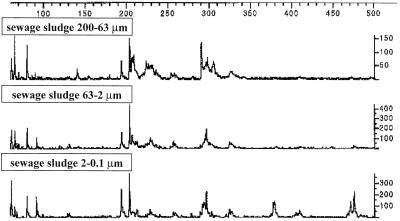
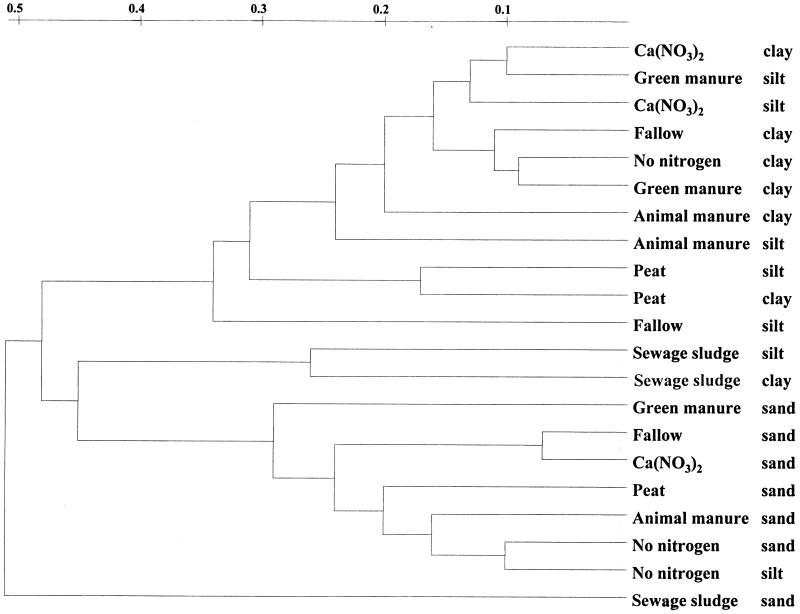
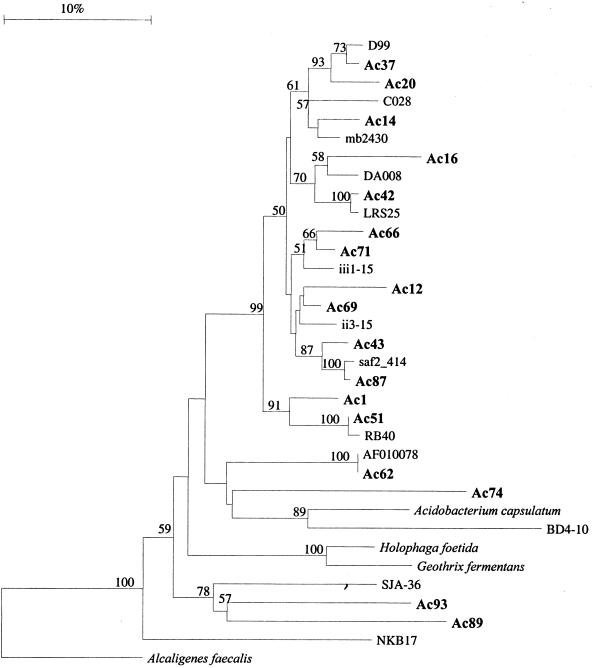
Soil structure depends on the association between mineral soil particles (sand, silt, and clay) and organic matter, in which aggregates of different size and stability are formed. Although the chemistry of organic materials, total microbial biomass, and different enzyme activities in different soil particle size fractions have been well studied, little information is available on the structure of microbial populations in microhabitats. In this study, topsoil samples of different fertilizer treatments of a long-term field experiment were analyzed. Size fractions of 200 to 63 microm (fine sand fraction), 63 to 2 microm (silt fraction), and 2 to 0.1 microm (clay fraction) were obtained by a combination of low-energy sonication, wet sieving, and repeated centrifugation. Terminal restriction fragment length polymorphism analysis and cloning and sequencing of 16S rRNA genes were used to compare bacterial community structures in different particle size fractions. The microbial community structure was significantly affected by particle size, yielding higher diversity of microbes in small size fractions than in coarse size fractions. The higher biomass previously found in silt and clay fractions could be attributed to higher diversity rather than to better colonization of particular species. Low nutrient availability, protozoan grazing, and competition with fungal organisms may have been responsible for reduced diversities in larger size fractions. Furthermore, larger particle sizes were dominated by alpha-Proteobacteria, whereas high abundance and diversity of bacteria belonging to the Holophaga/Acidobacterium division were found in smaller size fractions. Although very contrasting organic amendments (green manure, animal manure, sewage sludge, and peat) were examined, our results demonstrated that the bacterial community structure was affected to a greater extent by the particle size fraction than by the kind of fertilizer applied. Therefore, our results demonstrate specific microbe-particle associations that are affected to only a small extent by external factors.
Figures
References
-
- Altschul S F, Gish W, Miller W, Myers E W, Lipman D J. Basic local alignment tool. J Mol Biol. 1990;215:403–410. - PubMed
-
- Amato M, Ladd J N. Decomposition of 14C-labelled glucose and legume material in soils: properties influencing the accumulation of organic residue C and microbial biomass C. Soil Biol Biochem. 1992;24:455–466.
-
- Brussaard L, Bouwman L A, Geurs M, Hassink J, Zwart K B. Biomass composition and temporal dynamics of soil organisms of a silt loam soil under conventional and integrated management. Neth J Agric Sci. 1990;38:283–302.
Publication types
MeSH terms
Substances
Associated data
- Actions
- Actions
- Actions
- Actions
- Actions
- Actions
- Actions
- Actions
- Actions
- Actions
- Actions
- Actions
- Actions
- Actions
- Actions
- Actions
- Actions
- Actions
- Actions
- Actions
- Actions
- Actions
- Actions
- Actions
- Actions
- Actions
- Actions
- Actions
- Actions
- Actions
- Actions
- Actions
- Actions
- Actions
- Actions
- Actions
- Actions
- Actions
- Actions
- Actions
- Actions
- Actions
- Actions
- Actions
- Actions
- Actions
- Actions
- Actions
- Actions
- Actions
- Actions
- Actions
- Actions
- Actions
- Actions
- Actions
- Actions
- Actions
- Actions
- Actions
- Actions
- Actions
- Actions
- Actions
LinkOut - more resources
Full Text Sources
Other Literature Sources
Molecular Biology Databases
