. 2002 Apr;12(4):543-54.
doi: 10.1101/gr.224102.

A genome-wide screen for normally methylated human CpG islands that can identify novel imprinted genes

Affiliations

A genome-wide screen for normally methylated human CpG islands that can identify novel imprinted genes

Liora Z Strichman-Almashanu et al. Genome Res. 2002 Apr.

Abstract

DNA methylation is a covalent modification of the nucleotide cytosine that is stably inherited at the dinucleotide CpG by somatic cells, and 70% of CpG dinucleotides in the genome are methylated. The exception to this pattern of methylation are CpG islands, CpG-rich sequences that are protected from methylation, and generally are thought to be methylated only on the inactive X-chromosome and in tumors, as well as differentially methylated regions (DMRs) in the vicinity of imprinted genes. To identify chromosomal regions that might harbor imprinted genes, we devised a strategy for isolating a library of normally methylated CpG islands. Most of the methylated CpG islands represented high copy number dispersed repeats. However, 62 unique clones in the library were characterized, all of which were methylated and GC-rich, with a GC content >50%. Of these, 43 clones also showed a CpG(obs)/CpG(exp) >0.6, of which 30 were studied in detail. These unique methylated CpG islands mapped to 23 chromosomal regions, and 12 were differentially methylated regions in uniparental tissues of germline origin, i.e., hydatidiform moles (paternal origin) and complete ovarian teratomas (maternal origin), even though many apparently were methylated in somatic tissues. We term these sequences gDMRs, for germline differentially methylated regions. At least two gDMRs mapped near imprinted genes, HYMA1 and a novel homolog of Elongin A and Elongin A2, which we term Elongin A3. Surprisingly, 18 of the methylated CpG islands were methylated in germline tissues of both parental origins, representing a previously uncharacterized class of normally methylated CpG islands in the genome, and which we term similarly methylated regions (SMRs). These SMRs, in contrast to the gDMRs, were significantly associated with telomeric band locations (P =.0008), suggesting a potential role for SMRs in chromosome organization. At least 10 of the methylated CpG islands were on average 85% conserved between mouse and human. These sequences will provide a valuable resource in the search for novel imprinted genes, for defining the molecular substrates of the normal methylome, and for identifying novel targets for mammalian chromatin formation.


Figures

Figure 1
Figure 1
Overall strategy for cloning methylated CpG islands. In step 1, genomic DNA was digested with Mse I (red), which cuts between CpG islands, and Hpa II (blue), which cuts unmethylated CpG islands. Mse I fragments containing methylated CpG islands then are transformed into a bacterial strain that does not cut methylated DNA. However, brief bacterial passage leads to loss of methylation of these previously methylated sequences. In step 2, the library DNA is pooled and digested with Eag I (green), which cuts relatively large fragments within CpG islands, and these fragments are then subcloned.
Figure 2
Figure 2
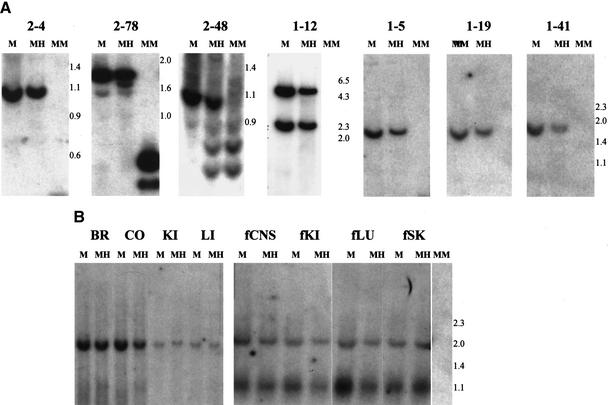
Methylation of CpG islands in normal human DNA. Genomic DNA from peripheral blood lymphocytes (A) or tissues (B) was digested with Mse I (M), Mse I + Hpa II (MH), or Mse I + Msp I (MM). Fragment sizes are indicated to the right. CpG islands used for Southern blot hybridization are indicated in panel A, and CpG island clone 1–19 was used in panel B. Note that there is an Mse I polymorphism in the fetal tissue that is not in the adult tissue, accounting for the presence of two bands in the fetal tissue Mse I digest. Blots were made in duplicate and one set was hybridized to RB to ensure the presence of DNA in the Msp I lane. BR, brain; CO, colon; KI, kidney; LI, liver; fCNS, fetal CNS; fKI, fetal kidney; fLU, fetal lung; fSK, fetal skin.
Figure 3
Figure 3
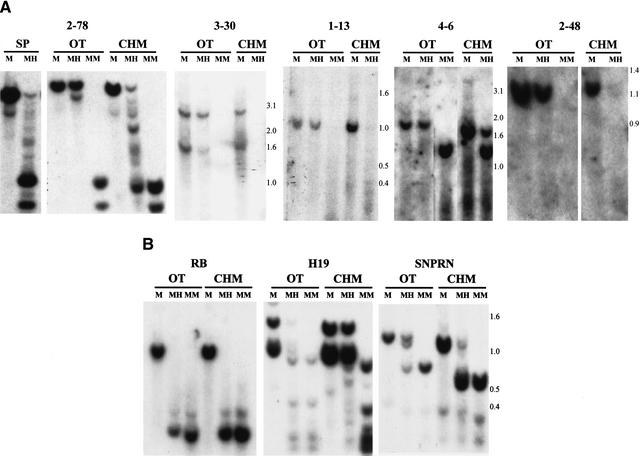
Differential methylation of novel gDMRs in uniparental tissues of germline origin. Fragment sizes (kb) are indicated to the right. (A) Sperm (SP), ovarian teratoma (OT), or complete hydatidiform mole (CHM) was digested, and Southern blot hybridization was performed with the gDMRs indicated, as described in the legend to Figure 2. Multiple OT and CHM were examined with similar results, although only one is shown. (B) Similar experiments were performed with an unmethylated CpG island in the retinoblastoma gene (RB), with a CpG island upstream of H19 that shows preferential methylation of the paternal allele, and with a CpG island within the SNRPN gene that shows preferential methylation of the maternal allele.
Figure 4
Figure 4
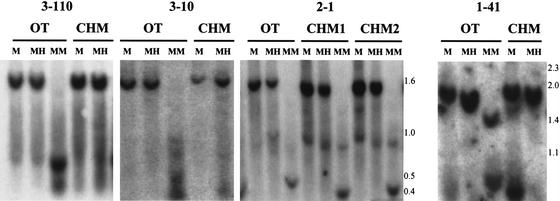
Similar methylation of novel SMRs in uniparental tissues of germline origin. Experiments were performed as described in the legend to Figure 2, using the SMRs indicated. Fragment sizes are indicated to the right.
Figure 5
Figure 5
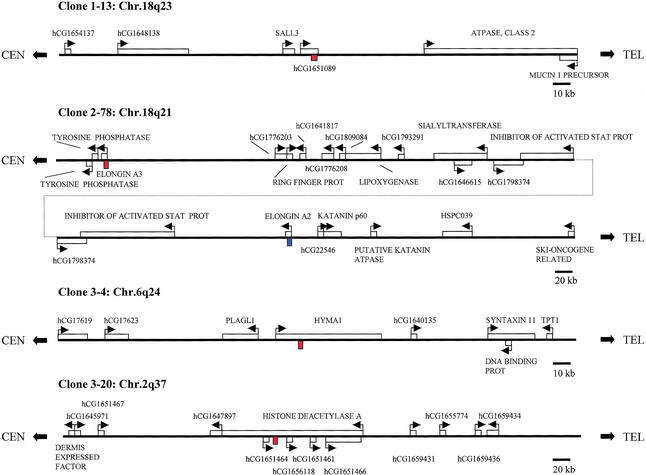
Chromosomal location and relationship of representative methylated CpG islands to nearby genes. Genes are indicated with boxes, and the arrows show transcriptional orientation. The methylated CpG islands are shown in red. In the case of 2–78, the homologous sequence within Elongin A2 is indicated in blue.
Figure 6
Figure 6
Nucleotide and amino acid sequence of Elongin A3. The transcription factor SII similarity motif is shown in red, and the nuclear localization signal is shown in green. The site of the (G/A) polymorphism, at nucleotide 910, used for imprinting analysis is shown in blue, and the PCR primers specific for Elongin A3 are shown in black boldfaced type.
Figure 7
Figure 7
Tissue-specific imprinting of Elongin A3. The (G/A) polymorphism was used to assess allele-specific expression in four heterozygous fetuses denoted A, B, C, and D. Chromatograms of genomic DNA (gDNA) sequence are included to show heterozygosity, as well as the homozygous maternal decidual DNA indicating parental origin. (A) Monoallelic expression of the maternal allele in lung, central nervous system (CNS), and limbs, and biallelic expression in kidney. (B) Monoallelic expression of the maternal allele in placenta and CNS, and biallelic expression in intestine. (C) Monoallelic expression of the maternal allele in CNS, biallelic expression in kidney and liver. (D) Monoallelic expression of the maternal allele in placenta, and biallelic expression in kidney and liver. Sequencing was done bidirectionally in all cases, and monoallelic expression of the maternal allele did not depend on whether that allele was A or G.
Figure 8
Figure 8
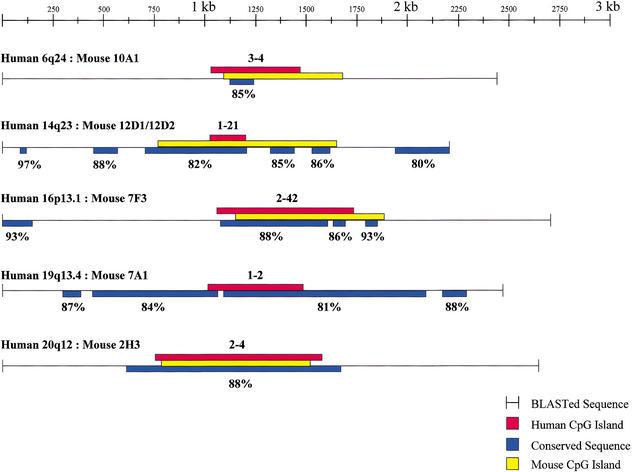
Sequence conservation of methylated CpG islands between human and mouse. Human methylated CpG islands and ∼1 kb of flanking DNA were compared to mouse sequence, synteny was confirmed, the corresponding mouse CpG islands were identified, and regions of conservation (percentage shown) were determined. In the case of gDMR 1–21, the corresponding mouse sequence, while GC-rich, showed an observed to expected CpG ratio of 0.45–0.50 and therefore was not classified as a CpG island. Colors are as indicated in the figure.

Comment in

References

    1. Altschul SF, Gish W, Miller W, Myers EW, Lipman DJ. Basic local alignment search tool. J Mol Biol. 1990;215:403–410. - PubMed
    1. Antequera F, Bird AP. Number of CpG islands and genes in human and mouse. Proc Natl Acad Sci. 1993;90:11995–11999. - PMC - PubMed
    1. Arima T, Drewell RA, Arney KL, Inoue J, Makita Y, Hata A, Oshimura M, Wake N, Surani MA. A conserved imprinting control region at the HYMAI/ZAC domain is implicated in transient neonatal diabetes mellitus. Hum Mol Genet. 2001;10:1475–1483. - PubMed
    1. Arima T, Drewell RA, Oshimura M, Wake N, Surani MA. A novel imprinted gene, HYMAI, is located within an imprinted domain on human chromosome 6 containing ZAC. Genomics. 2000;67:248–255. - PubMed
    1. Aso T, Yamazaki K, Amimoto K, Kuroiwa A, Higashi H, Matsuda Y, Kitajima S, Hatakeyama M. Identification and characterization of Elongin A2, a new member of the Elongin family of transcription elongation factors, specifically expressed in the testis. J Biol Chem. 2000;275:6546–6552. - PubMed

Publication types

Associated data