


Specific gene silencing by artificial MicroRNAs in Physcomitrella patens: an alternative to targeted gene knockouts
- PMID: 18753280
- PMCID: PMC2556843
- DOI: 10.1104/pp.108.128025
Specific gene silencing by artificial MicroRNAs in Physcomitrella patens: an alternative to targeted gene knockouts
Abstract
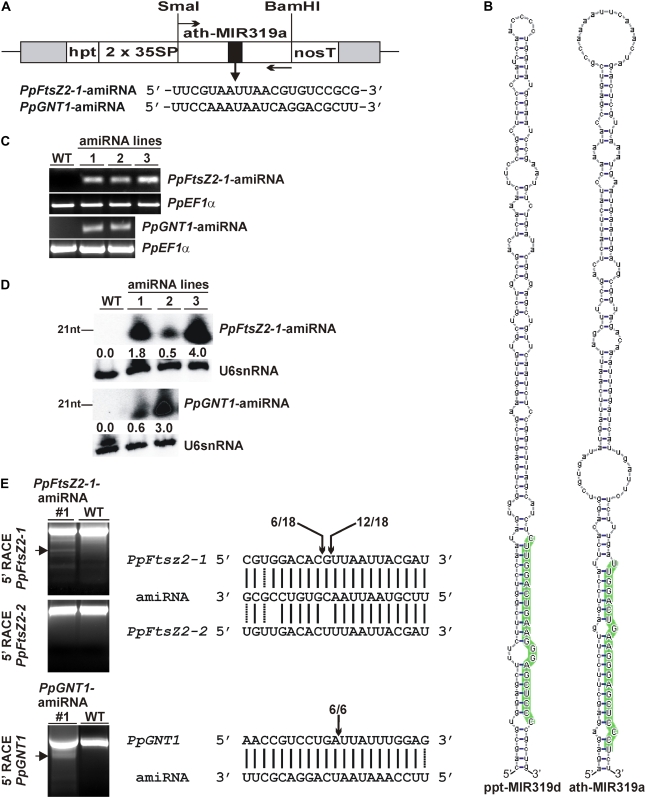
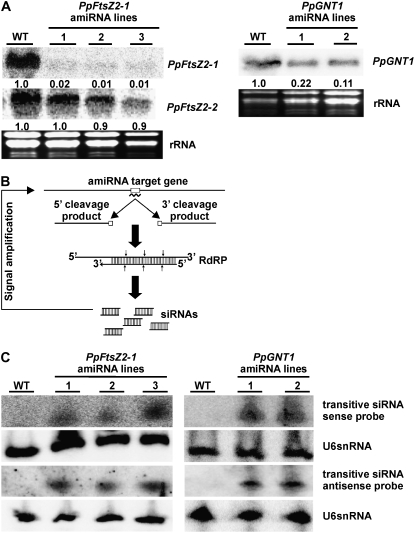
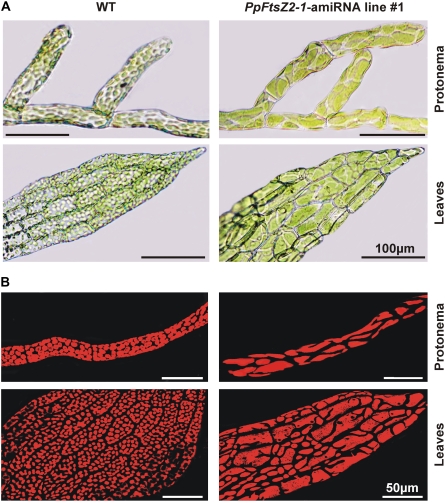
MicroRNAs (miRNAs) are approximately 21-nucleotide-long RNAs processed from nuclear-encoded transcripts, which include a characteristic hairpin-like structure. MiRNAs control the expression of target transcripts by binding to reverse complementary sequences directing cleavage or translational inhibition of the target RNA. Artificial miRNAs (amiRNAs) can be generated by exchanging the miRNA/miRNA* sequence within miRNA precursor genes, while maintaining the pattern of matches and mismatches in the foldback. Thus, for functional gene analysis, amiRNAs can be designed to target any gene of interest. The moss Physcomitrella patens exhibits the unique feature of a highly efficient homologous recombination mechanism, which allows for the generation of targeted gene knockout lines. However, the completion of the Physcomitrella genome necessitates the development of alternative techniques to speed up reverse genetics analyses and to allow for more flexible inactivation of genes. To prove the adaptability of amiRNA expression in Physcomitrella, we designed two amiRNAs, targeting the gene PpFtsZ2-1, which is indispensable for chloroplast division, and the gene PpGNT1 encoding an N-acetylglucosaminyltransferase. Both amiRNAs were expressed from the Arabidopsis (Arabidopsis thaliana) miR319a precursor fused to a constitutive promoter. Transgenic Physcomitrella lines harboring the overexpression constructs showed precise processing of the amiRNAs and an efficient knock down of the cognate target mRNAs. Furthermore, chloroplast division was impeded in PpFtsZ2-1-amiRNA lines that phenocopied PpFtsZ2-1 knockout mutants. We also provide evidence for the amplification of the initial amiRNA signal by secondary transitive small interfering RNAs, although these small interfering RNAs do not seem to have a major effect on sequence-related mRNAs, confirming specificity of the amiRNA approach.
Figures
References
-
- Aravin AA, Lagos-Quintana M, Yalcin A, Zavolan M, Marks D, Snyder B, Gaasterland T, Meyer J, Tuschl T (2003) The small RNA profile during Drosophila melanogaster development. Dev Cell 5 337–350 - PubMed
-
- Arazi T, Talmor-Neiman M, Stav R, Riese M, Huijser P, Baulcombe DC (2005) Cloning and characterization of micro-RNAs from moss. Plant J 43 837–848 - PubMed
-
- Axtell MJ, Bowman JL (2008) Evolution of plant microRNAs and their targets. Trends Plant Sci 13 343–349 - PubMed
-
- Axtell MJ, Jan C, Rajagopalan R, Bartel DP (2006) A two-hit trigger for siRNA biogenesis in plants. Cell 127 565–577 - PubMed
Publication types
MeSH terms
Substances
Associated data
- Actions
- Actions
LinkOut - more resources
Full Text Sources
Other Literature Sources
Molecular Biology Databases
