


Bacterioplankton community composition along a salinity gradient of sixteen high-mountain lakes located on the Tibetan Plateau, China
- PMID: 16885301
- PMCID: PMC1538701
- DOI: 10.1128/AEM.00767-06
Bacterioplankton community composition along a salinity gradient of sixteen high-mountain lakes located on the Tibetan Plateau, China
Abstract
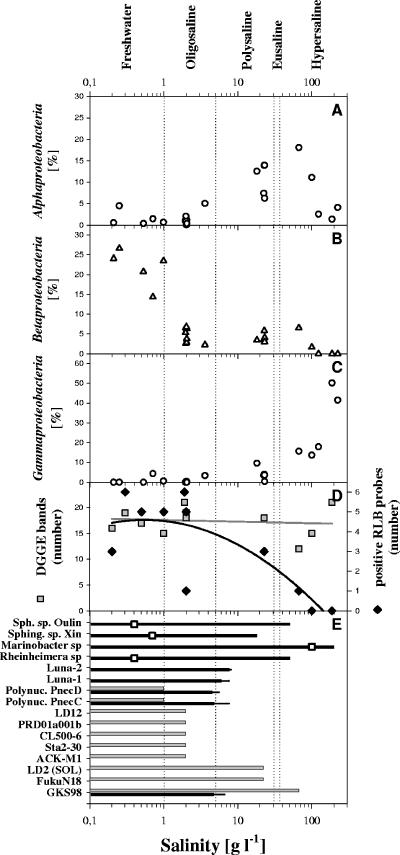
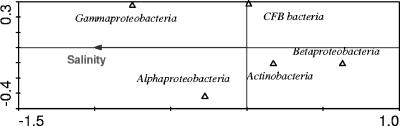
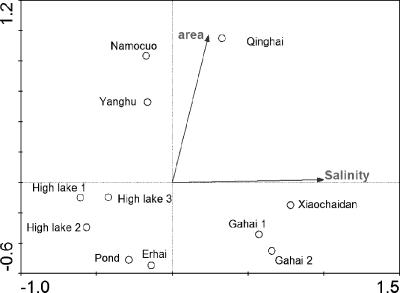
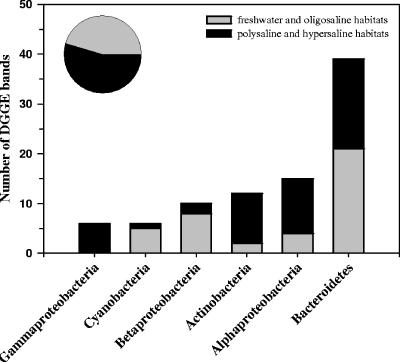
The influence of altitude and salinity on bacterioplankton community composition (BCC) in 16 high-mountain lakes located at altitudes of 2,817 to 5,134 m on the Eastern Qinghai-Xizang (Tibetan) Plateau, China, spanning a salinity gradient from 0.02% (freshwater) to 22.3% (hypersaline), was investigated. Three different methods, fluorescent in situ hybridization, denaturing gradient gel electrophoresis (DGGE) with subsequent band sequencing, and reverse line blot hybridization (RLB) with probes targeting 17 freshwater bacterial groups, were used for analysis of BCC. Furthermore, the salt tolerances of 47 strains affiliated with groups detected in or isolated from the Tibetan habitats were investigated. Altitude was not found to influence BCC significantly within the investigated range. Several groups of typical freshwater bacteria, e.g., the ACK-M1 cluster and the Polynucleobacter group, were detected in habitats located above 4,400 m. Salinity was found to be the dominating environmental factor controlling BCC in the investigated lakes, resulting in only small overlaps in the BCCs of freshwater and hypersaline lakes. The relative abundances of different classes of Proteobacteria showed a sharp succession along the salinity gradient. Both DGGE and RLB demonstrated that a few freshwater bacterial groups, e.g., GKS98 and LD2, appeared over wide salinity ranges. Six freshwater isolates affiliated with the GKS98 cluster grew in ecophysiological experiments at maximum salinities of 0.3% to 0.7% (oligosaline), while this group was detected in habitats with salinities up to 6.7% (hypersaline). This observation indicated ecologically significant differences in ecophysiological adaptations among members of this narrow phylogenetic group and suggested ecological significance of microdiversity.
Figures
References
-
- Benlloch, S., A. López-López, E. O. Casamayor, L. Øvreås, V. Goddard, F. L. Daae, G. Smerdon, R. Massana, I. Joint, F. Thingstad, C. Pedrós-Alió, and F. Rodríguez-Valera. 2002. Prokaryotic genetic diversity throughout the salinity gradient of a coastal solar saltern. Environ. Microbiol. 4:349-360. - PubMed
-
- Blumthaler, M., W. Ambach, and R. Ellinger. 1997. Increase in solar UV radiation with altitude. J. Photochem. Photobiol. B 39:130-134.
Publication types
MeSH terms
Substances
Associated data
- Actions
- Actions
- Actions
- Actions
- Actions
- Actions
- Actions
- Actions
- Actions
- Actions
- Actions
- Actions
- Actions
- Actions
- Actions
- Actions
- Actions
- Actions
- Actions
- Actions
- Actions
- Actions
- Actions
- Actions
- Actions
- Actions
- Actions
- Actions
- Actions
- Actions
- Actions
- Actions
- Actions
- Actions
- Actions
- Actions
- Actions
- Actions
- Actions
- Actions
- Actions
- Actions
- Actions
- Actions
- Actions
- Actions
- Actions
- Actions
- Actions
- Actions
- Actions
- Actions
- Actions
- Actions
- Actions
- Actions
- Actions
- Actions
- Actions
- Actions
LinkOut - more resources
Full Text Sources
Molecular Biology Databases
Research Materials
