. 2006 Jul;72(7):5061-8.
doi: 10.1128/AEM.00342-06.

Evidence for existence of "mesotogas," members of the order Thermotogales adapted to low-temperature environments

Affiliations

Evidence for existence of "mesotogas," members of the order Thermotogales adapted to low-temperature environments

Camilla L Nesbø et al. Appl Environ Microbiol. 2006 Jul.

Abstract

All cultivated isolates of the bacterial order Thermotogales are either thermophiles or hyperthermophiles, but Thermotogales 16S rRNA gene sequences have been detected in many mesophilic anaerobic and microaerophilic environments, particularly within communities involved in the remediation of pollutants. Here we provide metagenomic evidence for the existence of Thermotogales lineages, which we informally call "mesotoga," that are adapted to growth at lower temperatures. Two fosmid clones containing mesotoga DNA, originating from a low-temperature enrichment culture that degrades a polychlorinated biphenyl congener, were sequenced. Phylogenetic analysis clearly puts this bacterial lineage within the Thermotogales order, with the rRNA gene trees and 21 of 58 open reading frames strongly supporting this relationship. An analysis of protein sequence composition showed that mesotoga proteins are adapted to function at lower temperatures than are their identifiable homologs from thermophilic and hyperthermophilic members of the order Thermotogales, supporting the notion that this bacterium lives and grows optimally at lower temperatures. The phylogenetic analysis suggests that the mesotoga lineage from which our fosmids derive has used both the acquisition of genes from its neighbors and the modification of existing thermophilic sequences to adapt to a mesophilic lifestyle.


Figures
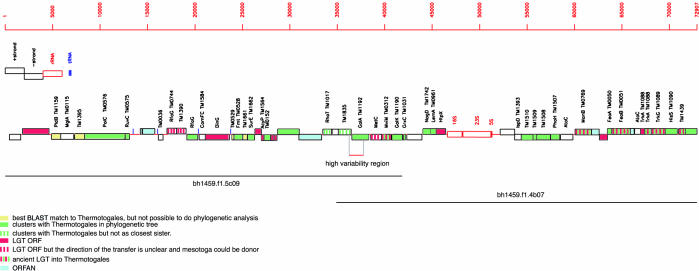
FIG. 1.
FIG. 1.
Overview of the sequenced mesotoga fosmids. Where a homolog is found in the Thermotoga maritima MSB8 genome, the locus tag is given. A white box represents an ORF for which none of the classifications listed in the figure applied, i.e., it does not have a Thermotogales sequence as a top-scoring BLAST hit, it does not cluster with Thermotogales sequences in phylogenetic trees, and the trees or the alignments were not reliable enough to conclude whether it is an instance of LGT.
FIG. 2.
FIG. 2.
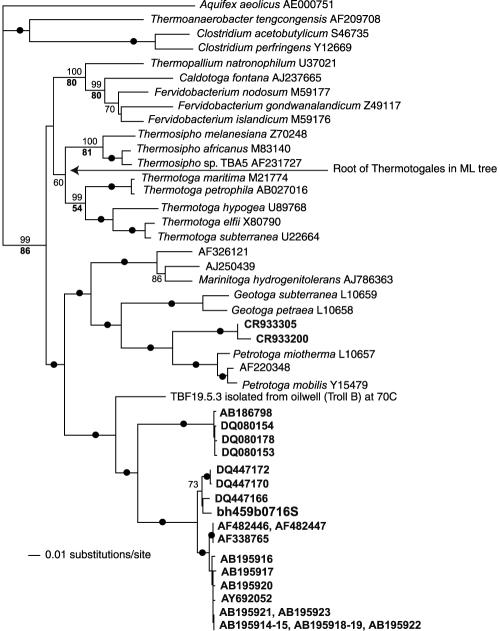
16S rRNA gene phylogeny of the order Thermotogales. Sequences in bold are 16S rRNA genes from mesophilic environments (see Table 1). The tree is a ME tree estimated in PAUP* using LogDet distances. The ML tree estimated using a GTR + Γ + I model was similar, the main difference being the placement of the root of the order Thermotogales (indicated by an arrow). Numbers on branches indicate the percentage of occurrence in 100 bootstrap replicates using LogDet distances (plain) and ML (bold). If the support was at least 90% in both analyses, a black circle is given on the branch.
FIG. 3.
FIG. 3.
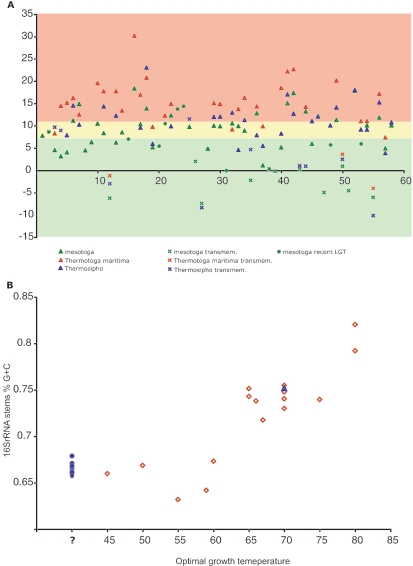
(A) Plot of CvP values of the ORFs along the mesotoga contig. CvP values are given on the y axis, and ORF numbers are along the x axis. The red area corresponds to ORFs classified as thermophilic (CvP value, >10.62), the yellow area corresponds to ORFs classified as intermediate (7.35 < CvP value < 10.62), and the green area corresponds to ORFs classified as mesophilic (CvP value, <7.35). The categories were defined following the observed CvP values in different genomes (Table 1 in reference 38). The CvP value was calculated for all mesotoga ORFs and for their closest T. maritima MSB8 and Thermosipho sp. TCF52B homologs (where available). (B) Plot of percent G+C content of 16S rRNA stems against optimal growth temperature. Thermotogales strains with known optimal growth temperature are represented by red diamonds. The strain TBF19.5.1, isolated at 70°C, is represented by a blue triangle. Mesotoga rRNA genes are represented by blue circles.

References

    1. Altschul, S. F., T. L. Madden, A. A. Schaffer, J. Zhang, Z. Zhang, W. Miller, and D. J. Lipman. 1997. Gapped BLAST and PSI-BLAST: a new generation of protein database search programs. Nucleic Acids Res. 25:3389-3402. - PMC - PubMed
    1. Bateman, A., L. Coin, R. Durbin, R. D. Finn, V. Hollich, S. Griffiths-Jones, A. Khanna, M. Marshall, S. Moxon, E. L. Sonnhammer, D. J. Studholme, C. Yeats, and S. R. Eddy. 2004. The Pfam protein families database. Nucleic Acids Res. 32:D138-D141. - PMC - PubMed
    1. Cannone, J. J., S. Subramanian, M. N. Schnare, J. R. Collett, L. M. D'Souza, Y. Du, B. Feng, N. Lin, L. V. Madabusi, K. M. Muller, N. Pande, Z. Shang, N. Yu, and R. R. Gutell. 2002. The comparative RNA web (CRW) site: an online database of comparative sequence and structure information for ribosomal, intron, and other RNAs. BMC Bioinformatics 3:2. - PMC - PubMed
    1. Chouari, R., D. Le Paslier, P. Daegelen, P. Ginestet, J. Weissenbach, and A. Sghir. 2005. Novel predominant archaeal and bacterial groups revealed by molecular analysis of an anaerobic sludge digester. Environ. Microbiol. 7:1104-1115. - PubMed
    1. Delcher, A. L., D. Harmon, S. Kasif, O. White, and S. L. Salzberg. 1999. Improved microbial gene identification with GLIMMER. Nucleic Acids Res. 27:4636-4641. - PMC - PubMed

Publication types

Associated data

LinkOut - more resources