. 2004 Apr;134(4):1460-70.
doi: 10.1104/pp.103.038323.

Relationship between the heat tolerance of photosynthesis and the thermal stability of rubisco activase in plants from contrasting thermal environments

Affiliations

Relationship between the heat tolerance of photosynthesis and the thermal stability of rubisco activase in plants from contrasting thermal environments

Michael E Salvucci et al. Plant Physiol. 2004 Apr.

Abstract

Inhibition of net photosynthesis (Pn) by moderate heat stress has been attributed to an inability of Rubisco activase to maintain Rubisco in an active form. To examine this proposal, the temperature response of Pn, Rubisco activation, chlorophyll fluorescence, and the activities of Rubisco and Rubisco activase were examined in species from contrasting environments. The temperature optimum of Rubisco activation was 10 degrees C higher in the creosote bush (Larrea tridentata) compared with the Antarctic hairgrass (Deschampsia antarctica), resembling the temperature response of Pn. Pn increased markedly with increasing internal CO(2) concentration in Antarctic hairgrass and creosote bush plants subjected to moderate heat stress even under nonphotorespiratory conditions. Nonphotochemical quenching of chlorophyll fluorescence, the effective quantum yield of photochemical energy conversion (DeltaF/F(m)') and the maximum yield of PSII (F(v)/F(m)) were more sensitive to temperature in Antarctic hairgrass and two other species endemic to cold regions (i.e. Lysipomia pumila and spinach [Spinacea oleracea]) compared with creosote bush and three species (i.e. jojoba [Simmondsia chinensis], tobacco [Nicotiana tabacum], and cotton [Gossypium hirsutum]) from warm regions. The temperature response of activity and the rate of catalytic inactivation of Rubisco from creosote bush and Antarctic hairgrass were similar, whereas the optimum for ATP hydrolysis and Rubisco activation by recombinant creosote bush, cotton, and tobacco activase was 8 degrees C to 10 degrees C higher than for Antarctic hairgrass and spinach activase. These results support a role for activase in limiting photosynthesis at high temperature.


Figures
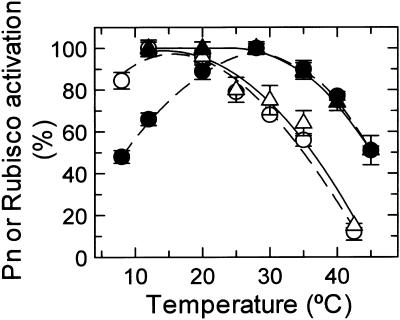
Figure 1.
Figure 1.
Effect of temperature on Pn and Rubisco activation in Antarctic hairgrass and creosote bush. Pn (•, ○, dashed lines) was measured in attached leaves of Antarctic hairgrass (○) and creosote bush (•) in air at the indicated leaf temperatures. Rubisco activation (▵, ▴, solid lines) was determined by rapid extraction and assay of Antarctic hairgrass (▵) and creosote bush (▴) leaves, sampled by freeze-clamping the same leaves used for gas exchange immediately following the measurement. The data for Pn are expressed as a percentage of the rate at the temperature optimum; 29 ± 2 and 19.4 ± 1 μmol m−2 s−1 for creosote bush and Antarctic hairgrass, respectively. The data for Rubisco activation are expressed as a percentage of the activity of the fully light-activated enzyme measured at the temperature optimum; 87.5 ± 1 and 81.1 ± 3.9 μmol m−2 s−1 for creosote bush and Antarctic hairgrass, respectively. These activities were similar to the activities of the enzymes after carbamylation in vitro with CO2 and Mg2+.
Figure 2.
Figure 2.
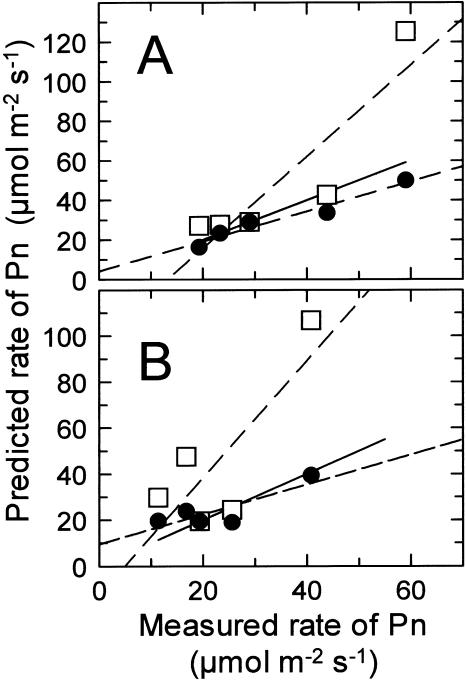
Relationship between the measured and predicted rates of Pn in nonstressed and heat stressed leaves of creosote bush and Antarctic hairgrass at ambient and elevated Ci. The predicted rates of Pn for creosote bush (A) and Antarctic hairgrass (B) were calculated from the kinetic properties of Rubisco with (•) and without (□) adjustment for the measured changes in Rubisco activation. The two dashed lines show the linear regression of the relationship between measured and predicted rates of Pn with (•) and without (□) adjustment for changes in Rubisco activation. Values for Pn and Rubisco activation, as well as the conditions of temperature, Ci, and O2, are from Tables I (A) and II (B). The solid line denotes a 1:1 relationship between measured and predicted rates.
Figure 3.
Figure 3.
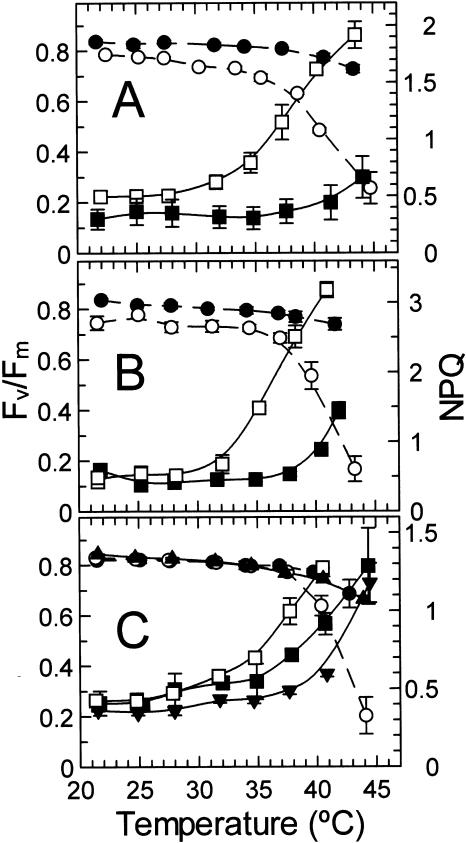
Effect of temperature on NPQ of chlorophyll fluorescence and the maximum yield of PSII (Fv/Fm) in plants native to warm and cold regions. The Fv/Fm (○, •, ▴) and NPQ (□, ▪, ▾) were determined at the indicated temperatures for attached leaves of the following plant species: A, the Antarctic hairgrass (○, □) and the creosote bush, (•, ▪); B, the Andean monocot L. pumila (○, □) and the desert shrub jojoba (•, ▪); and C, spinach (○, □), cotton (•, ▪), and tobacco (▴, ▾).
Figure 4.
Figure 4.
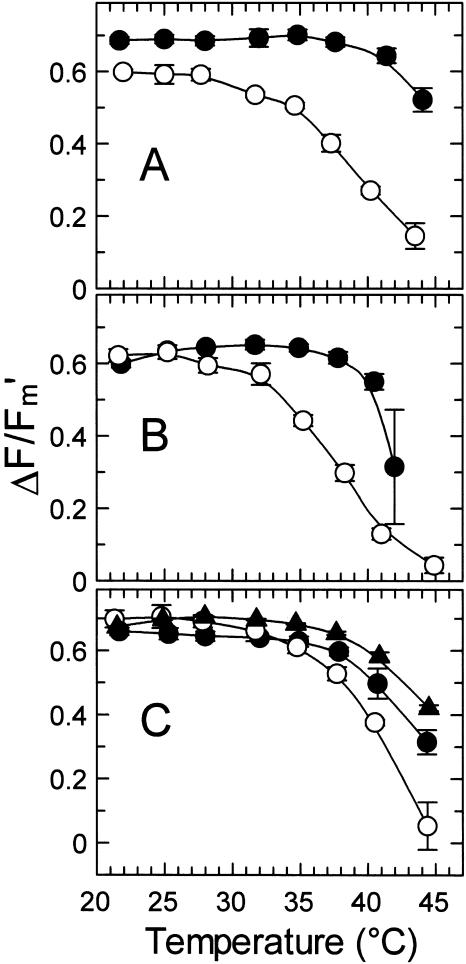
Effect of temperature on the effective quantum yield of photochemical energy conversion (ΔF/Fm′) in plants native to warm and cold regions. The ΔF/Fm′ were determined at the indicated temperatures for attached leaves of the following plant species: A, the Antarctic hairgrass (○) and the creosote bush (•); B, the Andean monocot L. pumila (○) and the desert shrub jojoba (•); and C, spinach (○), cotton (•), and tobacco (▴).
Figure 5.
Figure 5.
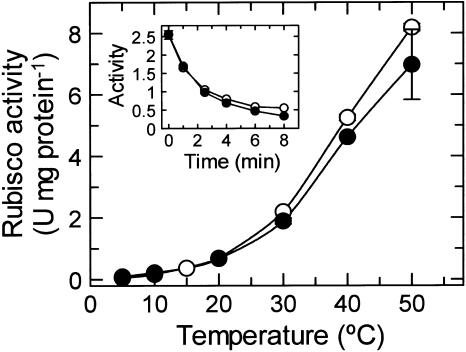
Effect of temperature on the carboxylase activity of Rubisco isolated from Antarctic hairgrass and creosote bush. The carboxylase activity of Rubisco from Antarctic hairgrass (○) and creosote bush (•) was determined at the indicated temperatures. The enzyme was incubated with 30 mm NaHCO3 and 10 mm MgCl2 to fully carbamylated the enzyme prior to assay. Inset, Time course of inactivation of Rubisco under catalytic conditions. Fully carbamylated Rubisco from Antarctic hairgrass (○) and creosote bush (•) was incubated at 40°C in the presence of RuBP, and residual activity was determined at 30°C at the indicated times.
Figure 6.
Figure 6.
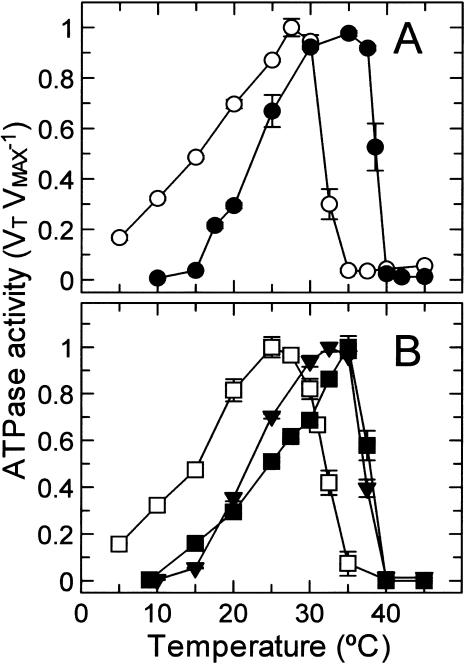
Effect of temperature on the activity of recombinant activase from plants native to warm and cold regions. A, The ATPase activity of recombinant Antarctic hairgrass (○) and creosote bush (•) activase was measured at the indicated temperatures. B, The ATPase activity of recombinant spinach (□), tobacco (▪), and cotton (▾) activase was measured at the indicated temperatures. Results are expressed as VT VMAX−1, the ratio of the activities at the indicated temperature (VT) to the activity at the temperature optimum (VMAX). Maximum rates of ATP hydrolysis were 0.9, 0.56, 0.75, 0.86, and 0.59 units mg protein−1 for activase from Antarctic hairgrass, creosote bush, spinach, tobacco, and cotton, respectively.
Figure 7.
Figure 7.
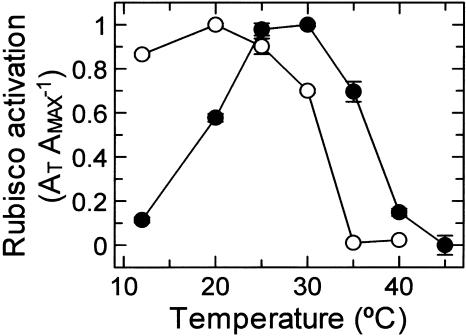
Effect of temperature on in vitro activation of Rubisco by recombinant activase from Antarctic hairgrass and creosote bush. Activation of Antarctic hairgrass Rubisco by recombinant Antarctic hairgrass activase (○) and creosote bush Rubisco by recombinant creosote bush activase (•) was measured at the indicated temperatures. The fraction of active sites converted from an inactive to an active form was determined by comparing the activity of Rubisco obtained after incubating the decarbamylated enzyme complexed with RuBP with activase to the activity of the fully carbamylated control. At each temperature, the values were adjusted for the fraction of sites that activated spontaneously, i.e. in the absence of activase. Results are expressed as AT AMAX−1, the ratio of the sites activated by activase at the indicated temperature (AT) to the sites activated at the temperature optimum (AMAX). The maximum extent of activation after correction for spontaneous activation was 79% and 28% of the sites for Antarctic hairgrass and creosote bush, respectively. The specific activity of the Antarctic hairgrass and creosote bush Rubisco used in these experiments was 1.2 and 1.4 units mg protein−1, respectively, at 30°C.
Figure 8.
Figure 8.
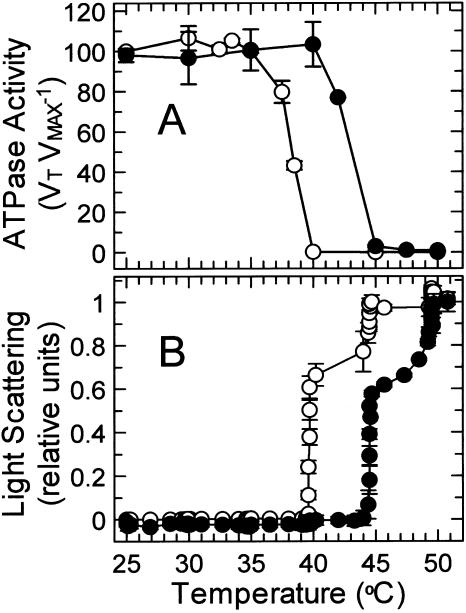
Effect of temperature on the stability of recombinant activase from Antarctic hairgrass and creosote bush. A, Residual ATPase activity of recombinant activase from Antarctic hairgrass (○) and creosote bush (•) was measured at 30°C after incubation for 10 min at the indicated temperatures in the presence of 0.75 mm ATPγS. Results are expressed as VT VMAX−1, the ratio of the activities after incubation at the indicated temperature (VT) to the control activity (VMAX) determined for enzyme maintained at 4°C. The rates of ATP hydrolysis by the controls were 0.85 and 0.51 units mg protein−1 for activase from Antarctic hairgrass and creosote bush, respectively. B, Thermal aggregation of recombinant activase from Antarctic hairgrass (○) and creosote bush (•) was determined by measuring light scattering at the indicated temperatures during a time course of increasing temperature. Recombinant activase (40 μg) was incubated in 400 μL in a thermostatted cuvette in the presence of 0.75 mm ATPγS. After 5 min at 25°C, the temperature of the cuvette was increased by increasing the temperature of circulating water bath by 5°C every 10 min.

References

    1. Alberdi M, Bravo LA, Gutiérrez A, Gidekel M, Corcuera LJ (2002) Ecophysiology of Antarctic vascular plants. Physiol Plant 115: 479–486 - PubMed
    1. Andrews TJ (1996) The bait in the Rubisco mousetrap. Nat Struct Biol 3: 3–7 - PubMed
    1. Andrews TJ, Badger MR, Lorimer GH (1975) Factors affecting interconversion between kinetic forms of ribulose diphosphate carboxylase-oxygenase from spinach. Arch Biochem Biophys 171: 93–103 - PubMed
    1. Berry J, Björkman O (1980) Photosynthetic response and adaptation to temperature in higher plants. Annu Rev Plant Physiol 31: 491–543
    1. Bilger W, Schreiber U, Lange OL (1987) Chlorophyll fluorescence as an indicator of heat induced limitation of photosynthesis in Arbutus unedo. In JD Tenhumen, FM Catarino, OL Lange, WC Oechel, eds, Plant Response to Stress. Springer-Verlag, Berlin, pp 391–399

MeSH terms

Associated data

LinkOut - more resources