


Molecular analysis of adenovirus isolates from vaccinated and unvaccinated young adults
- PMID: 15071026
- PMCID: PMC387592
- DOI: 10.1128/JCM.42.4.1686-1693.2004
Molecular analysis of adenovirus isolates from vaccinated and unvaccinated young adults
Abstract
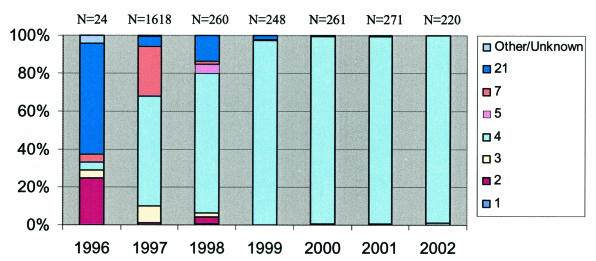
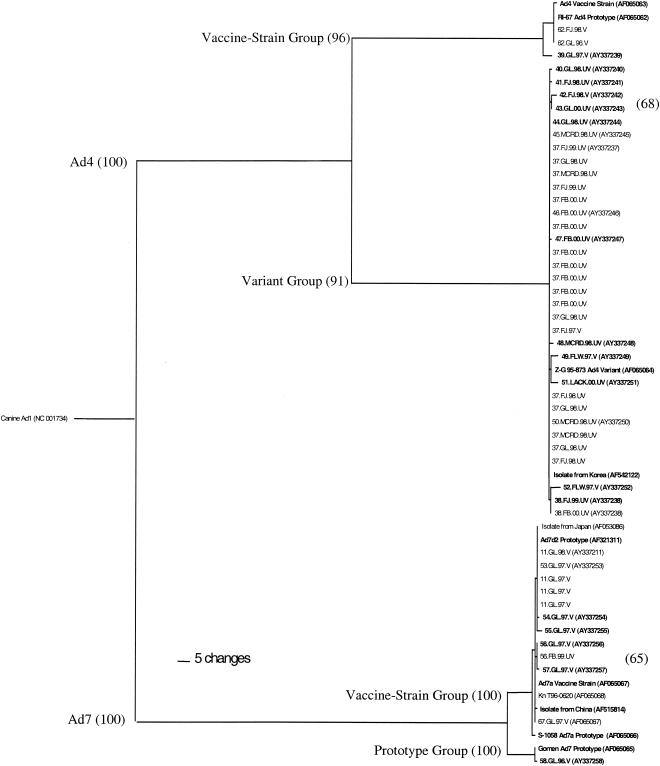
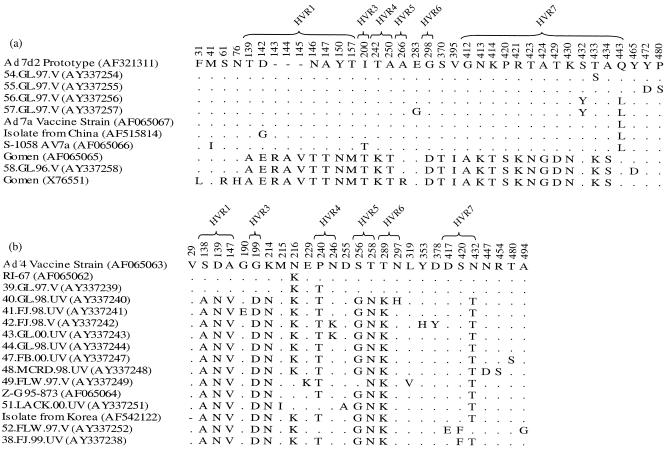
Infections of adenovirus type 4 (Ad4) and Ad7 were discovered among previously vaccinated individuals through febrile respiratory illness surveillance at military recruit camps. Genetic analysis was performed on these isolates and a sample of adenovirus isolates from unvaccinated patients. Antigenic regions of the adenovirus hexon gene from 21 vaccinated and 31 unvaccinated patients were sequenced and compared to homologous regions of Ad4 and Ad7 vaccine strains and of other representative hexon sequences archived in GenBank. The phylogenetic distribution of sequences from vaccinated individuals closely resembled those from unvaccinated individuals. The most common Ad7 strain was the Ad7d2 hexon genotype, and the most common Ad4 strain was a genotype nearly identical to the recently discovered Z-G 95-873 Ad4 variant. Near exclusive isolation of Ad4 since 1999 indicates that the Ad4 variant is currently responsible for the vast majority of adenovirus morbidity in military recruit camps. Different ratios of nonsynonymous to synonymous nucleotide substitution rates in known antigenic regions compared to nonantigenic regions indicated positive selection for diversity in the antigenic regions and purifying selection in the nonantigenic regions.
Figures
References
-
- Athappilly, F. K., R. Murali, J. J. Rux, Z. Cai, and R. M. Burnett. 1994. The refined crystal structure of hexon, the major coat protein of adenovirus type 2, at 2.9 Å resolution. J. Mol. Biol. 242:430-455. - PubMed
-
- Centers for Disease Control and Prevention. 2001. Two fatal cases of adenovirus-related illness in previously healthy young adults-Illinois, 2000. Morb. Mortal. Wkly. Rep. 50:553-555. - PubMed
-
- Chanock, R. M., W. Ludwig, R. J. Heubner, T. R. Cate, and L. W. Chu. 1966. Immunization by selective infection with type 4 adenovirus grown in human diploid tissue cultures. I. Safety and lack of oncogenicity and tests for potency in volunteers. JAMA 195:445-452. - PubMed
MeSH terms
Substances
Associated data
- Actions
- Actions
- Actions
- Actions
- Actions
- Actions
- Actions
- Actions
- Actions
- Actions
- Actions
- Actions
- Actions
- Actions
- Actions
- Actions
- Actions
- Actions
- Actions
- Actions
- Actions
- Actions
LinkOut - more resources
Full Text Sources
Medical
