


doi: 10.1128/AEM.01644-08.
Epub 2008 Dec 29.
Role of proP and proU in betaine uptake by Yersinia enterocolitica under cold and osmotic stress conditions
Affiliations
- PMID: 19114512
- PMCID: PMC2655450
- DOI: 10.1128/AEM.01644-08
Item in Clipboard
Role of proP and proU in betaine uptake by Yersinia enterocolitica under cold and osmotic stress conditions
Appl Environ Microbiol.
2009 Mar.
Abstract
Yersinia enterocolitica is a food-borne pathogen with the ability to grow at cold temperatures and tolerate high osmolarity. The bacterium tolerates osmotic stress by intracellular accumulation of osmolytes, such as betaine. The proP gene and proU operon of Y. enterocolitica were sequenced, and single (ProP(-) ProU(+) and ProP(+) ProU(-)) and double (ProP(-) ProU(-)) mutants were generated. Upon exposure to osmotic or chill stress, the single and double mutants demonstrated a reduction in betaine uptake compared to that in the wild type, suggesting that proP and proU play a role in betaine uptake during osmotic and chill stress responses of Y. enterocolitica.
Figures
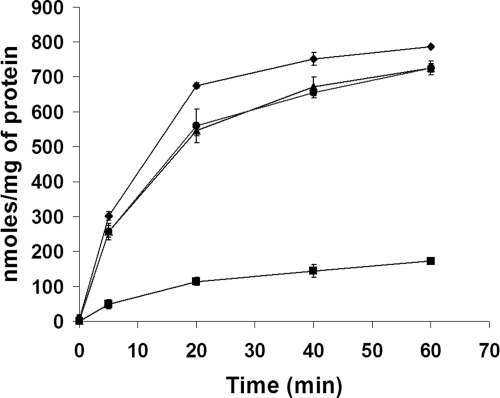
Accumulation of betaine, in response to osmotic stress (2.5% sodium chloride) at 30°C, by Y. enterocolitica. Cell suspensions containing [14C]betaine (1 mM) were incubated for 0, 20, 40, and 60 min. At appropriate time points, 1 ml of cell suspension was centrifuged and the pellet was subjected to scintillation counting to calculate betaine accumulation. Betaine accumulation was normalized per mg of total cellular protein. Error bars reflect standard errors of the means. ♦, 9610 (ProP+ ProU+); ▴, 9610P (ProP− ProU+); •, 9610U (ProP+ ProU−); ▪, 9610PU (ProP− ProU−).
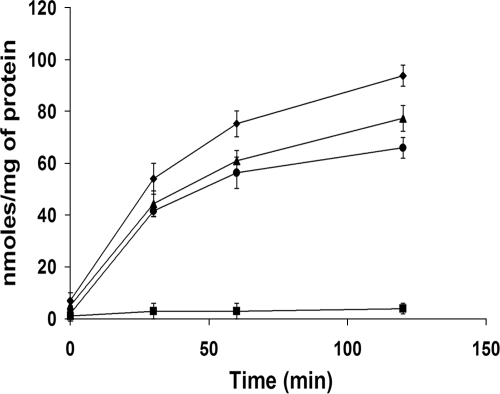
Accumulation of betaine, in response to chill stress at 4°C, by Y. enterocolitica. Cell suspensions containing [14C]betaine (1 mM) were incubated for 0, 30, 60, and 120 min. At appropriate time points, 1 ml of cell suspension was centrifuged and the pellet was subjected to scintillation counting to calculate betaine accumulation. Betaine accumulation was normalized per mg of total cellular protein. Error bars reflect standard errors of the means. ♦, 9610 (ProP+ ProU+); ▴, 9610P (ProP− ProU+); •, 9610U (ProP+ ProU−); ▪, 9610PU (ProP− ProU−).
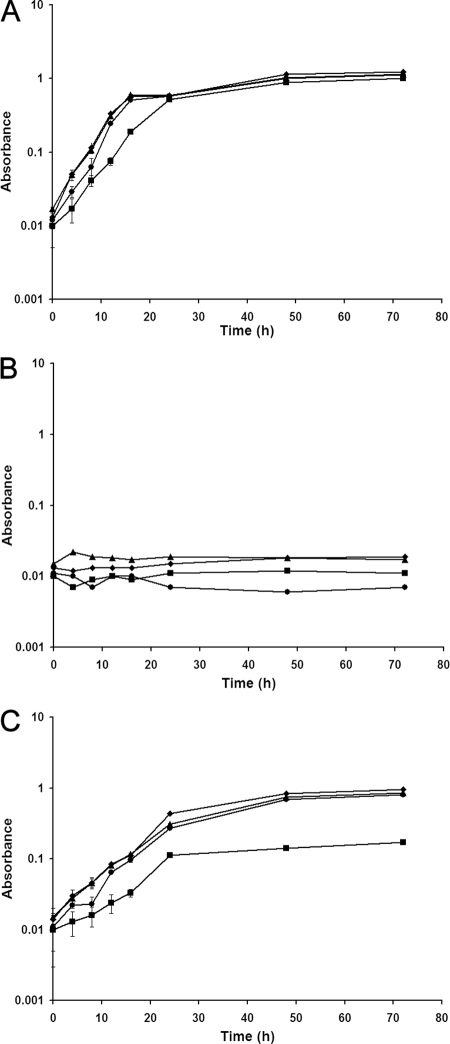
Growth, measured by absorbance at an optical density of 600 nm, of wild-type and mutant strains of Y. enterocolitica at 30°C in MMA medium (A), in MMA medium containing 2.5% sodium chloride (B), and in MMA medium containing 2.5% sodium chloride and 1 mM betaine (C). Error bars reflect standard errors of the means. ♦, 9610 (ProP+ ProU+); ▴, 9610P (ProP− ProU+); •, 9610U (ProP+ ProU−); ▪, 9610PU (ProP− ProU−).
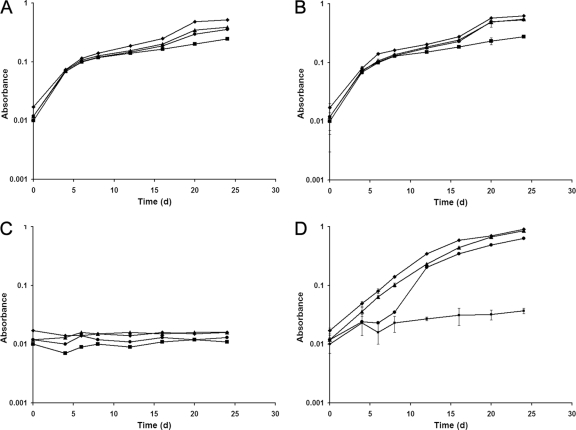
Growth, measured by absorbance at an optical density of 600 nm, of wild-type and mutant strains of Y. enterocolitica at 4°C in MMA medium (A), in MMA medium containing 1 mM betaine (B), in MMA medium containing 2.5% sodium chloride (C), and in MMA medium containing 2.5% sodium chloride and 1 mM betaine (D). Error bars reflect standard errors of the means. ♦, 9610 (ProP+ ProU+); ▴, 9610P (ProP− ProU+); •, 9610U (ProP+ ProU−); ▪, 9610PU (ProP− ProU−).
References
-
- Annamalai, T., and K. Venkitanarayanan. 2005. Expression of major cold shock proteins and genes by Yersinia enterocolitica in synthetic medium and foods. J. Food Prot. 68:2454-2458. - PubMed
-
- Bhaduri, S. 2006. Enrichment, isolation, and virulence of freeze-stressed plasmid-bearing virulent strains of Yersinia enterocolitica on pork. J. Food Prot. 69:1983-1985. - PubMed
-
- Bhaduri, S., R. Buchanan, and J. G. Phillips. 1995. Expanded response surface model for predicting the effects of temperatures, pH, sodium chloride contents and sodium nitrite concentrations on the growth rate of Yersinia enterocolitica. J. Appl. Bacteriol. 79:163-170. - PubMed
MeSH terms
Substances
Associated data
- Actions
- Actions
- Actions
- Actions
LinkOut - more resources
Full Text Sources
Molecular Biology Databases
