


N88D facilitates the co-occurrence of D30N and L90M and the development of multidrug resistance in HIV type 1 protease following nelfinavir treatment failure
- PMID: 17209774
- PMCID: PMC2573402
- DOI: 10.1089/aid.2006.22.1300
N88D facilitates the co-occurrence of D30N and L90M and the development of multidrug resistance in HIV type 1 protease following nelfinavir treatment failure
Abstract
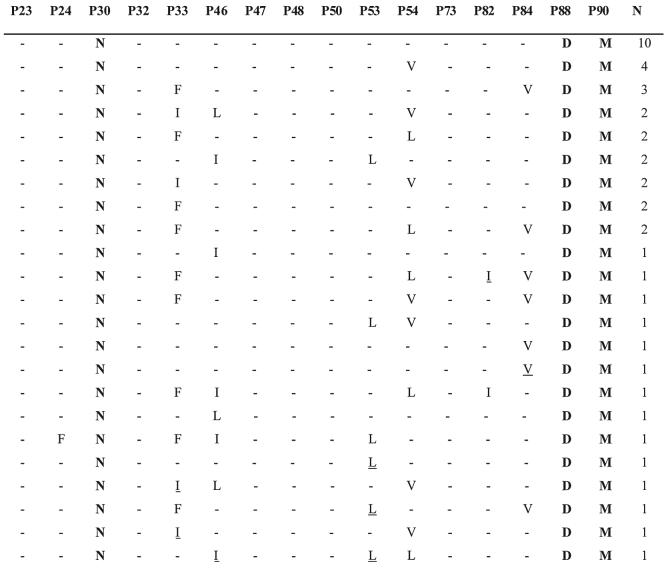
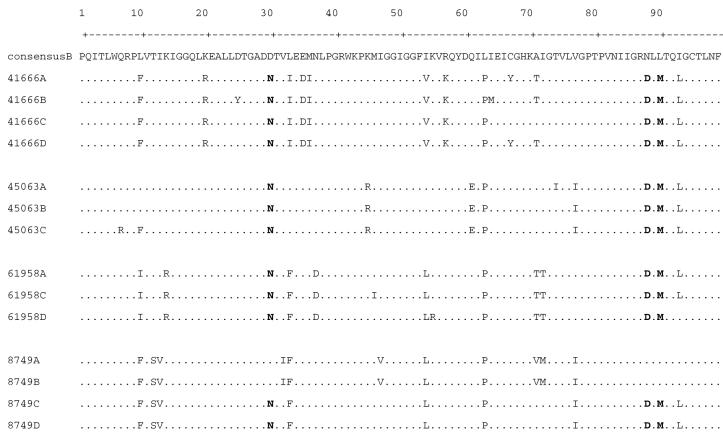
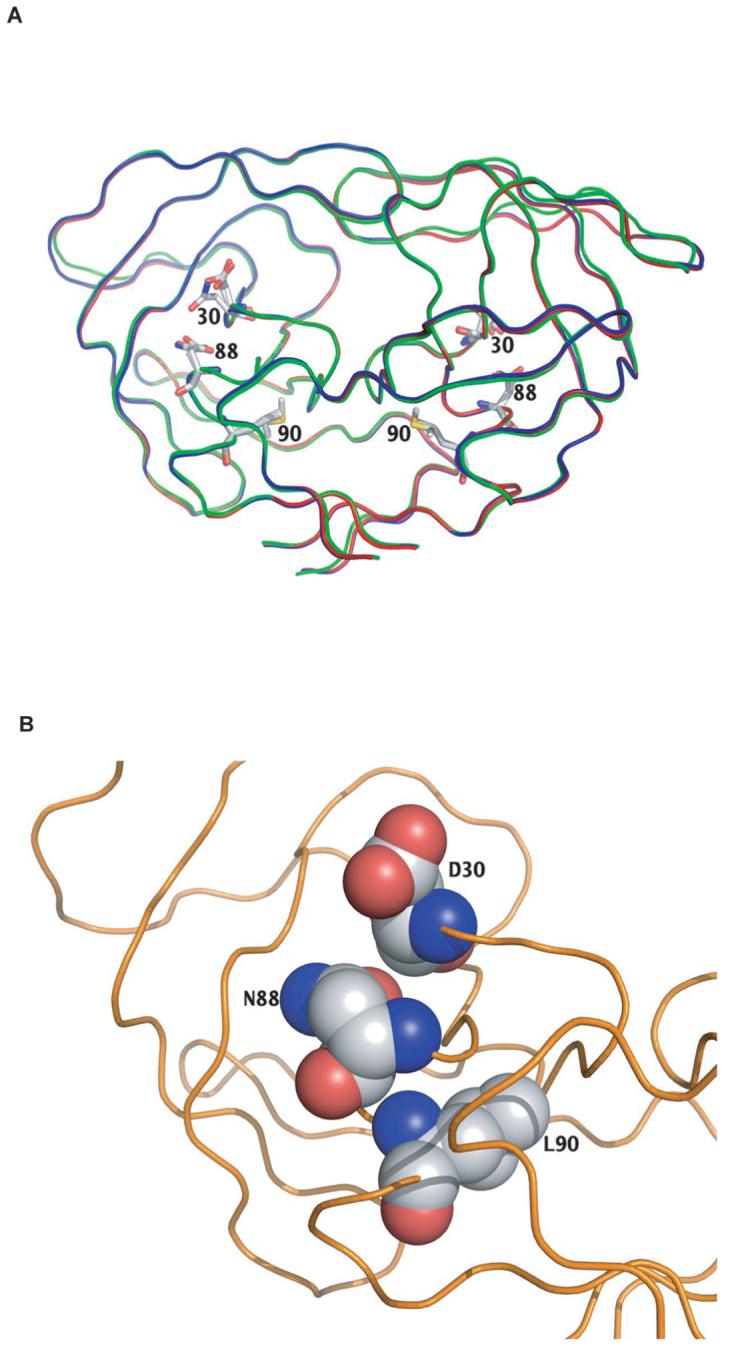
Nelfinavir was once one of the most commonly used protease inhibitors (PIs). To investigate the genetic mechanisms of multidrug resistance in protease isolates with the primary nelfinavir resistance mutation D30N, we analyzed patterns of protease mutations in 582 viruses with D30N from 460 persons undergoing HIV-1 genotypic resistance testing at Stanford University Hospital from 1997 to 2005. Three patterns of mutational associations were identified. First, D30N was positively associated with N88D but negatively associated with N88S. Second, D30N and L90M were negatively associated except in the presence of N88D, which facilitated the co-occurrence of D30N and L90M. Third, D30N+N88D+L90M formed a stable genetic backbone for the accumulation of additional protease inhibitor (PI) resistance mutations. In 16 patients having isolates with more than one combination of mutations at positions 30, 88, and 90, all exhibited one of the steps in the following progression: D30N-->D30N+N88D-->D30N+N88D+L90M-->D30N+N88D+L90M+(L33F+/-I84V or M46I/L+/-I54V). Although nelfinavir is now used less frequently than other PIs, the well-delineated mutational pathway we describe is likely to influence patterns of cross-resistance in viruses from persons who experience virologic failure while receiving this PI.
Figures
References
Publication types
MeSH terms
Substances
Associated data
- Actions
- Actions
- Actions
- Actions
- Actions
- Actions
- Actions
- Actions
- Actions
- Actions
- Actions
- Actions
- Actions
- Actions
- Actions
- Actions
- Actions
- Actions
- Actions
- Actions
- Actions
- Actions
- Actions
- Actions
- Actions
- Actions
- Actions
- Actions
- Actions
- Actions
- Actions
- Actions
- Actions
- Actions
- Actions
- Actions
- Actions
- Actions
- Actions
- Actions
- Actions
- Actions
- Actions
- Actions
- Actions
- Actions
- Actions
- Actions
- Actions
- Actions
- Actions
- Actions
- Actions
- Actions
- Actions
- Actions
- Actions
- Actions
- Actions
- Actions
- Actions
- Actions
- Actions
- Actions
- Actions
- Actions
- Actions
- Actions
- Actions
- Actions
- Actions
- Actions
- Actions
- Actions
- Actions
- Actions
- Actions
- Actions
- Actions
- Actions
- Actions
- Actions
- Actions
- Actions
- Actions
- Actions
- Actions
- Actions
- Actions
- Actions
- Actions
- Actions
- Actions
- Actions
- Actions
- Actions
- Actions
- Actions
- Actions
- Actions
- Actions
- Actions
- Actions
- Actions
- Actions
- Actions
- Actions
- Actions
- Actions
Grants and funding
LinkOut - more resources
Full Text Sources
Medical
Molecular Biology Databases
Research Materials
Miscellaneous
