


Modification of vascular function after handgrip exercise training in 73- to 90-yr-old men
- PMID: 19516158
- PMCID: PMC2903213
- DOI: 10.1249/MSS.0b013e318199bef4
Modification of vascular function after handgrip exercise training in 73- to 90-yr-old men
Abstract
Purpose: To examine the influence of a unilateral exercise training protocol on brachial artery reactivity (BAR) in 12 men (aged 81 +/- 5 yr).
Methods: Brachial artery diameters and blood flow parameters were assessed, in both arms, using high-resolution ultrasonography, before and after 5 min of forearm occlusion, before and at the end of each week of a 4-wk training program. Training consisted of a unilateral handgrip training protocol (nondominant arm) at 60% of maximal voluntary handgrip strength, performed for 4 wk, 4 d x wk(-1), 20 min per session, and a cadence of one contraction per 4 s.
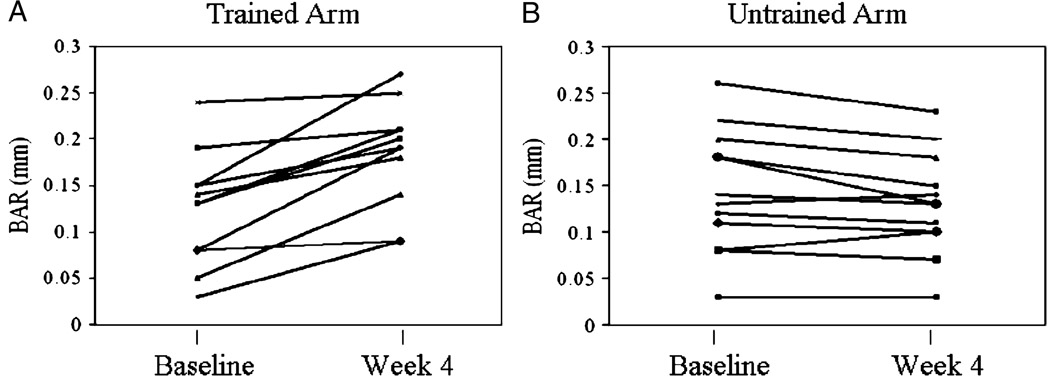
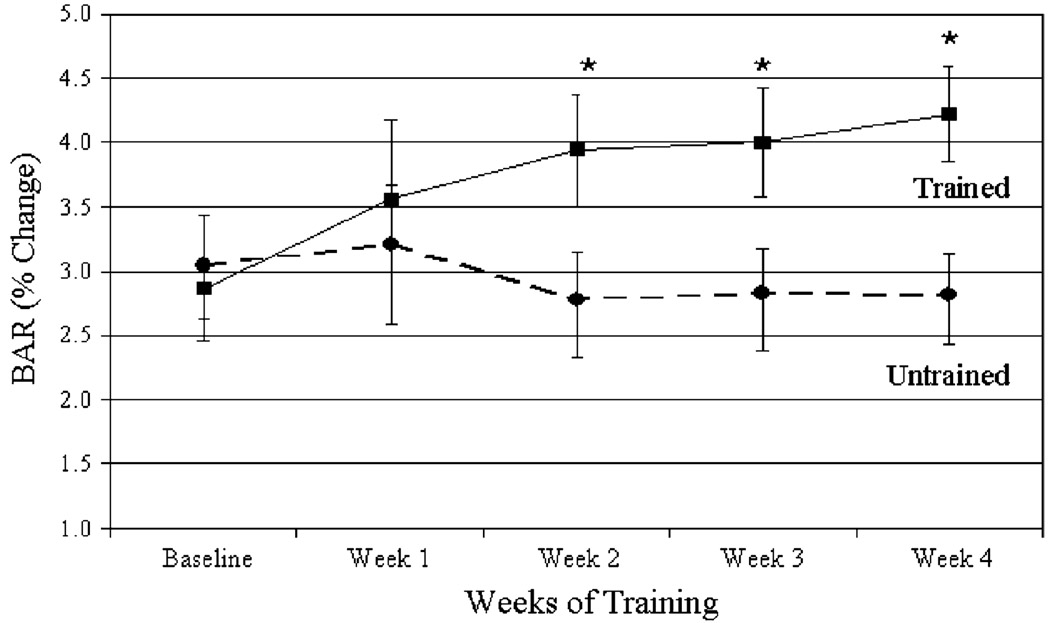
Results: After training, handgrip strength increased 6.2% (baseline = 32.4 +/- 7.0 kg vs week 4 = 34.4 +/- 6.7 kg) in the trained arm only but failed to reach statistical significance (P = 0.10). No statistical changes were observed for blood pressure or resting HR. In contrast, BAR increased 45% (Pre = 2.9% vs Post = 4.1%, P = 0.05) in the trained arm only. Improvements in BAR were observed after the second week of training, without significant changes in the main vasodilatory trigger, defined as the relevant shear stimulus after forearm occlusion (P > 0.05).
Conclusions: These data indicate that a localized short-term exercise program results in significant improvements in vascular function in the trained arm of elderly men compared with the control arm. Furthermore, the findings indicate a statistically significant increase in BAR at the end of the second week of training, despite a similar trigger for dilation versus before training.
Figures
References
-
- Allen JD, Geaghan JP, Greenway F, Welsch MA. Time course of improved flow-mediated dilation after short-term exercise training. Med Sci Sports Exerc. 2003;35(5):847–853. - PubMed
-
- Anderson TJ, Uehata A, Gerhard MD, et al. Close relation of endothelial function in the human coronary and peripheral circulations. J Am Coll Cardiol. 1995;26(5):1235–1241. - PubMed
-
- Beere PA, Russell SD, Morey MC, Kitzman DW, Higginbotham MB. Aerobic exercise training can reverse age-related peripheral circulatory changes in healthy older men. Circulation. 1999;100(10):1085–1094. - PubMed
-
- Celermajer DS, Sorensen KE, Gooch VM, et al. Non-invasive detection of endothelial dysfunction in children and adults at risk of atherosclerosis. Lancet. 1992;340(8828):1111–1115. - PubMed
