


Genome and proteome of long-chain alkane degrading Geobacillus thermodenitrificans NG80-2 isolated from a deep-subsurface oil reservoir
- PMID: 17372208
- PMCID: PMC1838512
- DOI: 10.1073/pnas.0609650104
Genome and proteome of long-chain alkane degrading Geobacillus thermodenitrificans NG80-2 isolated from a deep-subsurface oil reservoir
Abstract
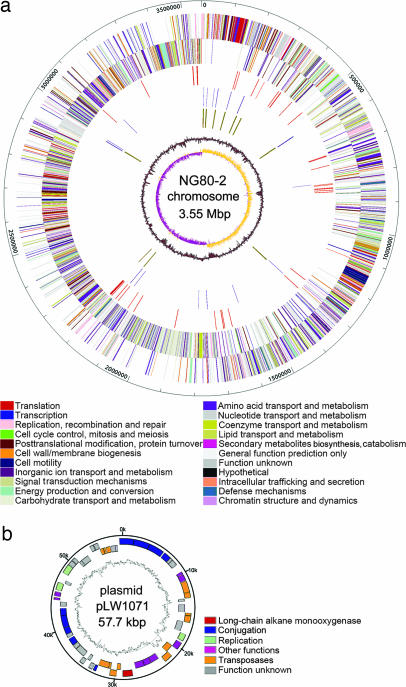
The complete genome sequence of Geobacillus thermodenitrificans NG80-2, a thermophilic bacillus isolated from a deep oil reservoir in Northern China, consists of a 3,550,319-bp chromosome and a 57,693-bp plasmid. The genome reveals that NG80-2 is well equipped for adaptation into a wide variety of environmental niches, including oil reservoirs, by possessing genes for utilization of a broad range of energy sources, genes encoding various transporters for efficient nutrient uptake and detoxification, and genes for a flexible respiration system including an aerobic branch comprising five terminal oxidases and an anaerobic branch comprising a complete denitrification pathway for quick response to dissolved oxygen fluctuation. The identification of a nitrous oxide reductase gene has not been previously described in Gram-positive bacteria. The proteome further reveals the presence of a long-chain alkane degradation pathway; and the function of the key enzyme in the pathway, the long-chain alkane monooxygenase LadA, is confirmed by in vivo and in vitro experiments. The thermophilic soluble monomeric LadA is an ideal candidate for treatment of environmental oil pollutions and biosynthesis of complex molecules.
Conflict of interest statement
Conflict of interest statement: L.F., W.W., Y.T., and L.W. have a financial conflict of interest resulting from a patent application for the DNA sequence of the
Figures


References
-
- Nazina TN, Tourova TP, Poltaraus AB, Novikova EV, Grigoryan AA, Ivanova AE, Lysenko AM, Petrunyaka VV, Osipov GA, Belyaev SS, et al. Int J Syst Evol Microbiol. 2001;51:433–446. - PubMed
-
- McMullan G, Christie JM, Rahman TJ, Banat IM, Ternan NG, Marchant R. Biochem Soc Trans. 2004;32:214–217. - PubMed
-
- Rahman TJ, Marchant R, Banat IM. Biochem Soc Trans. 2004;32:209–213. - PubMed
-
- Manachini PL, Mora D, Nicastro G, Parini C, Stackebrandt E, Pukall R, Fortina MG. Int J Syst Evol Microbiol. 2000;50:1331–1337. - PubMed
Publication types
MeSH terms
Substances
Associated data
- Actions
- Actions
Grants and funding
LinkOut - more resources
Full Text Sources
Other Literature Sources
Molecular Biology Databases
