


Long-Term Effect of Weight Regain Following Behavioral Weight Management Programs on Cardiometabolic Disease Incidence and Risk: Systematic Review and Meta-Analysis
- PMID: 36974678
- PMCID: PMC10106109
- DOI: 10.1161/CIRCOUTCOMES.122.009348
Long-Term Effect of Weight Regain Following Behavioral Weight Management Programs on Cardiometabolic Disease Incidence and Risk: Systematic Review and Meta-Analysis
Abstract
Background: Behavioral weight management programs (BWMPs) enhance weight loss in the short term, but longer term cardiometabolic effects are uncertain as weight is commonly regained. We assessed the impact of weight regain after BWMPs on cardiovascular risk factors, diabetes, and cardiovascular disease.
Methods: Trial registries, 11 databases, and forward-citation searching (latest search, December 19) were used to identify articles published in English, from any geographical region. Randomized trials of BWMPs in adults with overweight/obesity reporting cardiometabolic outcomes at ≥12 months at and after program end were included. Differences between more intensive interventions and comparator groups were synthesized using mixed-effects, meta-regression, and time-to-event models to assess the impact of weight regain on cardiovascular disease incidence and risk.
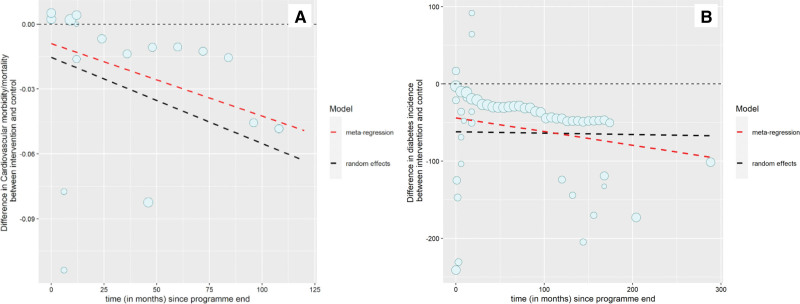
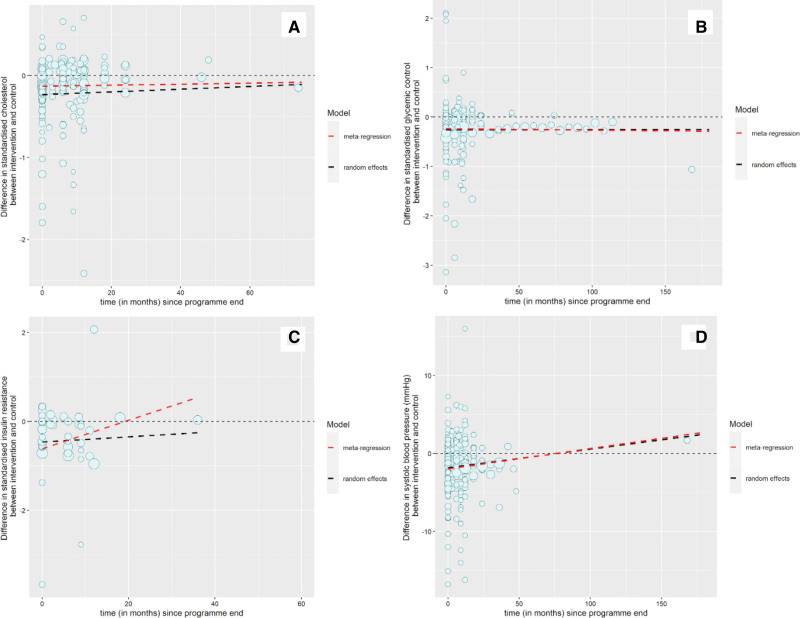
Results: One hundred twenty-four trials reporting on ≥1 cardiometabolic outcomes with a median follow-up of 28 (range, 11-360) months after program end were included. Median baseline participant body mass index was 33 kg/m2; median age was 51 years. Eight and 15 study arms (7889 and 4202 participants, respectively) examined the incidence of cardiovascular disease and type 2 diabetes, respectively, with imprecise evidence of a lower incidence for at least 5 years. Weight regain in BWMPs relative to comparators reduced these differences. One and 5 years after program end, total cholesterol/HDL (high-density lipoprotein) ratio was 1.5 points lower at both times (82 studies; 19 003 participants), systolic blood pressure was 1.5 mm mercury and 0.4 mm lower (84 studies; 30 836 participants), and HbA1c (%) 0.38 lower at both times (94 studies; 28 083 participants). Of the included studies, 22% were judged at high risk of bias; removing these did not meaningfully change results.
Conclusions: Despite weight regain, BWMPs reduce cardiometabolic risk factors with effects lasting at least 5 years after program end and dwindling with weight regain. Evidence that they reduce the incidence of cardiovascular disease or diabetes is less certain. Few studies followed participants for ≥5 years.
Registration: URL: https://www.crd.york.ac.uk/PROSPERO/; Unique identifier: CRD42018105744.
Keywords: adult; cardiovascular diseases; glycated hemoglobin; meta-analysis; obesity; systematic review; weight loss.
Conflict of interest statement
P. Aveyard and Jebb were investigators on a trial of a low-energy total diet replacement programme funded by the Cambridge Weight Plan. P. Aveyard spoke at a seminar at the Royal College of General Practitioners conference that was funded by Novo Nordisk. Neither of these led to personal payments. The other authors report no conflicts.
Figures
Comment in
-
Long-Term Outcomes Following Behavioral Weight Management Programs: Worth the Weight.Circ Cardiovasc Qual Outcomes. 2023 Apr;16(4):e009965. doi: 10.1161/CIRCOUTCOMES.123.009965. Epub 2023 Mar 28. Circ Cardiovasc Qual Outcomes. 2023. PMID: 36974899 Free PMC article. No abstract available.
References
-
- World Health Organization. Obesity and overweight. 2020. Accessed October 9, 2020. https://www.who.int/news-room/fact-sheets/detail/obesity-and-overweight
-
- Whitlock G, Lewington S, Sherliker P, Clarke R, Emberson J, Halsey J, Qizilbash N, Collins R, Peto R; Prospective Studies Collaboration. Body-mass index and cause-specific mortality in 900 000 adults: collaborative analyses of 57 prospective studies. Lancet. 2009;373:1083–1096. doi: 10.1016/S0140-6736(09)60318-4 - PMC - PubMed
-
- Force UPST. Behavioral weight loss interventions to prevent obesity-related morbidity and mortality in adults: US preventive services task force recommendation statement. JAMA. 2018;320:1163–1171. doi: 10.1001/jama.2018.13022 - PubMed
-
- Aucott L, Poobalan A, Smith WC, Avenell A, Jung R, Broom J. Effects of weight loss in overweight/obese individuals and long-term hypertension outcomes: a systematic review. Hypertension. 2005;45:1035–1041. doi: 10.1161/01.HYP.0000165680.59733.d4 - PubMed
-
- Poobalan A, Aucott L, Smith WC, Avenell A, Jung R, Broom J, Grant AM. Effects of weight loss in overweight/obese individuals and long-term lipid outcomes--a systematic review. Obes Rev. 2004;5:43–50. doi: 10.1111/j.1467-789x.2004.00127.x - PubMed
